Jeon Yubyeol, Nam Yeong-Hee, Cheong Seung-A, Kwak Seong-Sung, Lee Eunsong, Hyun Sang-Hwan
Laboratory of Veterinary Embryology and Biotechnology (VETEMBIO), College of Veterinary Medicine, Chungbuk National University, Cheongju 361-763, Chungbuk, Republic of Korea.
J Reprod Dev. 2016 Aug 25;62(4):345-50. doi: 10.1262/jrd.2015-175. Epub 2016 Apr 10.
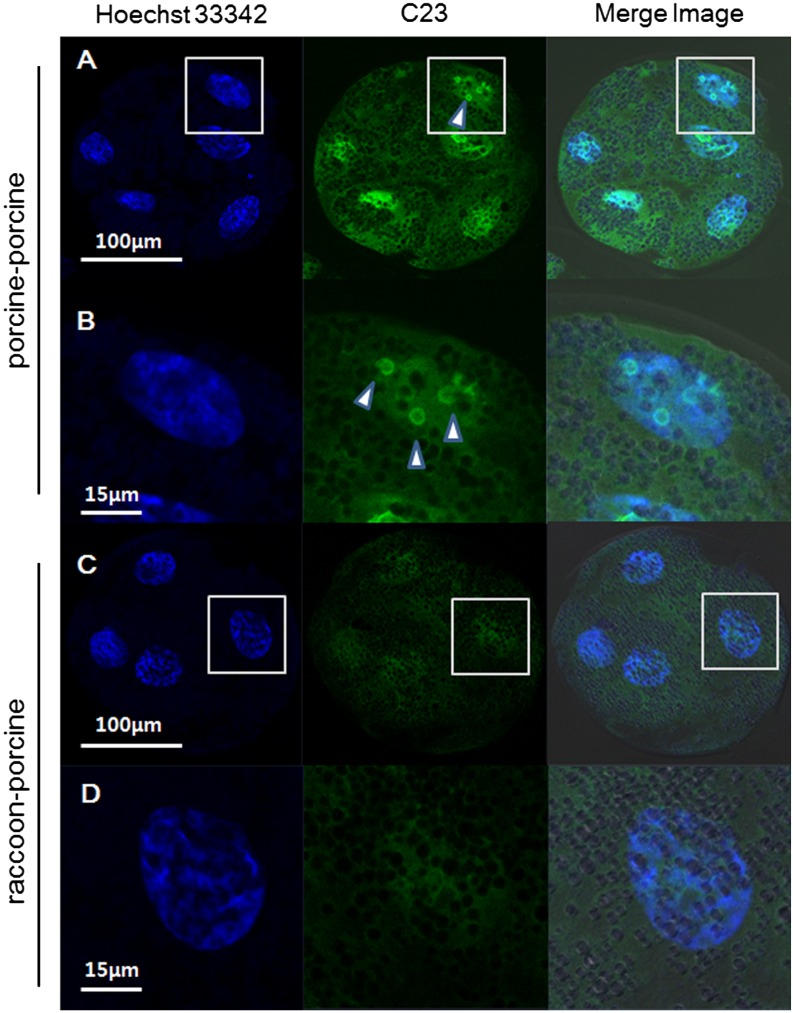
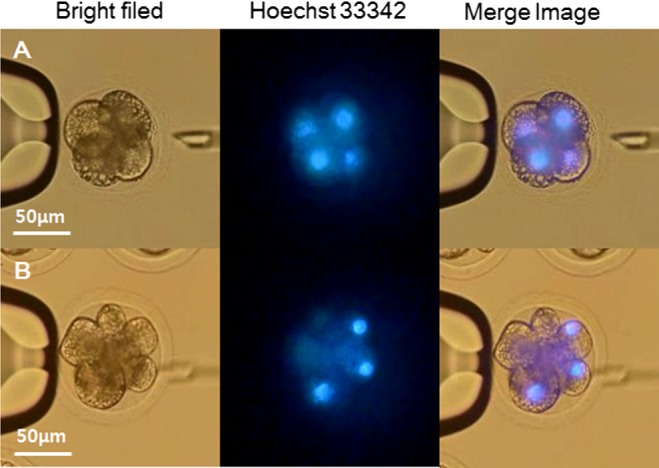
Interspecies somatic cell nuclear transfer (iSCNT) can be a solution for preservation of endangered species that have limited oocytes. It has been reported that blastocyst production by iSCNT is successful even if the genetic distances between donors and recipients are large. In particular, domestic pig oocytes can support the development of canine to porcine iSCNT embryos. Therefore, we examined whether porcine oocytes may be suitable recipient oocytes for Korean raccoon dog iSCNT. We investigated the effects of trichostatin A (TSA) treatment on iSCNT embryo developmental patterns and nucleolus formation. Enucleated porcine oocytes were fused with raccoon dog fibroblasts by electrofusion and cleavage, and blastocyst development and nucleolus formation were evaluated. To our knowledge, this study is the first in which raccoon dog iSCNT was performed using porcine oocytes; we found that 68.5% of 158 iSCNT embryos had the ability to cleave. However, these iSCNT embryos did not develop past the 4-cell stage. Treatment with TSA did not affect iSCNT embryonic development; moreover, the nuclei failed to form nucleoli at 48 and 72 h post-activation (hpa). In contrast, pig SCNT embryos of the control group showed 18.8% and 87.9% nucleolus formation at 48 and 72 hpa, respectively. Our results demonstrated that porcine cytoplasts efficiently supported the development of raccoon dog iSCNT embryos to the 4-cell stage, the stage of porcine embryonic genome activation (EGA); however, these embryos failed to reach the blastocyst stage and showed defects in nucleolus formation.
种间体细胞核移植(iSCNT)对于保存卵母细胞数量有限的濒危物种可能是一种解决办法。据报道,即使供体和受体之间的遗传距离很大,通过iSCNT产生囊胚也是成功的。特别是,家猪卵母细胞能够支持犬到猪的iSCNT胚胎的发育。因此,我们研究了猪卵母细胞是否可能是韩国貉iSCNT合适的受体卵母细胞。我们研究了曲古抑菌素A(TSA)处理对iSCNT胚胎发育模式和核仁形成的影响。去核猪卵母细胞通过电融合与貉成纤维细胞融合并进行卵裂,评估囊胚发育和核仁形成。据我们所知,本研究是首次使用猪卵母细胞进行貉iSCNT;我们发现158个iSCNT胚胎中有68.5%具有卵裂能力。然而,这些iSCNT胚胎没有发育到4细胞期以后。TSA处理不影响iSCNT胚胎发育;此外,在激活后48小时和72小时(hpa),细胞核未能形成核仁。相比之下,对照组的猪SCNT胚胎在48 hpa和72 hpa时分别有18.8%和87.9%形成核仁。我们的结果表明,猪细胞质有效地支持了貉iSCNT胚胎发育到4细胞期,即猪胚胎基因组激活(EGA)阶段;然而,这些胚胎未能发育到囊胚期,并在核仁形成方面表现出缺陷。