Kimura Takashi, Iso Hiroyasu, Honjo Kaori, Ikehara Satoyo, Sawada Norie, Iwasaki Motoki, Tsugane Shoichiro
Public Health, Department of Social Medicine, Osaka University Graduate School of Medicine.
J Epidemiol. 2016 Jun 5;26(6):315-21. doi: 10.2188/jea.JE20140253. Epub 2016 Apr 9.
Suicide rates have been related to educational level and other socioeconomic statuses. However, no prospective study has examined the association between educational level and the risk of suicide in Japan.
We examined the association of education level and suicide risk in a population-based cohort of Japanese men and women aged 40-59 years in the Japan Public Health Center-based Prospective Study Cohort I. In the baseline survey initiated in 1990, a total of 46 156 subjects (21 829 men and 24 327 women) completed a self-administered questionnaire, which included a query of educational level, and were followed up until the end of December 2011. Educational levels were categorized into four groups (junior high school, high school, junior or career college, and university or higher education). During a median follow-up of 21.6 years, the hazard ratios (HRs) and 95% confidence intervals (CIs) of suicide according to educational level were estimated using the Cox proportional hazards regression model adjusted for age; study area; previous history of stroke, ischemic heart disease, or cancer; self-reported stress; alcohol consumption; smoking; living with spouse; and employment status. A total of 299 deaths attributed to suicide occurred.
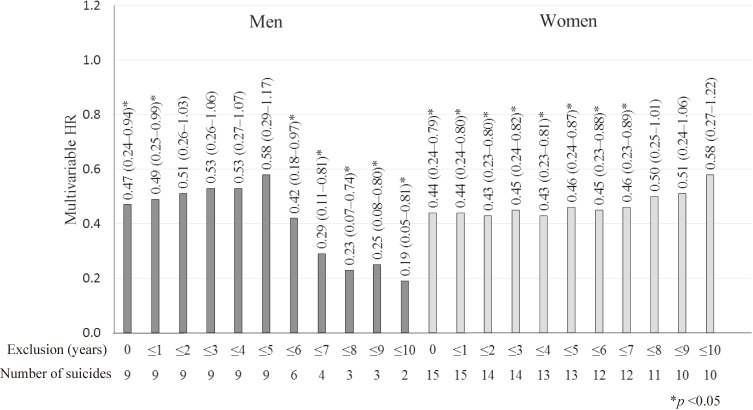
The HR for university graduates or those with higher education versus junior high school graduates was 0.47 (95% CI, 0.24-0.94) in men, and that for high school graduates versus junior high school graduates was 0.44 (95% CI, 0.24-0.79) in women.
High educational levels were associated with a reduced risk of suicide for both Japanese men and women.
自杀率与教育水平及其他社会经济地位相关。然而,在日本尚无前瞻性研究探讨教育水平与自杀风险之间的关联。
我们在日本公共卫生中心前瞻性研究队列I中,对40至59岁的日本男性和女性人群队列进行了教育水平与自杀风险的关联研究。在1990年启动的基线调查中,共有46156名受试者(21829名男性和24327名女性)完成了一份自填式问卷,其中包括对教育水平的询问,并随访至2011年12月底。教育水平分为四组(初中、高中、专科或职业学院、大学及以上学历)。在中位随访21.6年期间,使用经年龄、研究地区、既往中风、缺血性心脏病或癌症病史、自我报告的压力、饮酒、吸烟、与配偶同住及就业状况调整的Cox比例风险回归模型,估计了不同教育水平下自杀的风险比(HR)和95%置信区间(CI)。共有299例自杀死亡病例。
男性中,大学毕业生或更高学历者与初中毕业生相比的HR为0.47(95%CI,0.24 - 0.94);女性中,高中毕业生与初中毕业生相比的HR为0.44(95%CI,0.24 - 0.79)。
高教育水平与日本男性和女性的自杀风险降低相关。