Provencher David, Hennebelle Marie, Cunnane Stephen C, Bérubé-Lauzière Yves, Whittingstall Kevin
Department of Nuclear Medicine and Radiobiology, Université de Sherbrooke Sherbrooke, QC, Canada.
Research Center on Aging, Université de Sherbrooke Sherbrooke, QC, Canada.
Front Aging Neurosci. 2016 Mar 29;8:63. doi: 10.3389/fnagi.2016.00063. eCollection 2016.
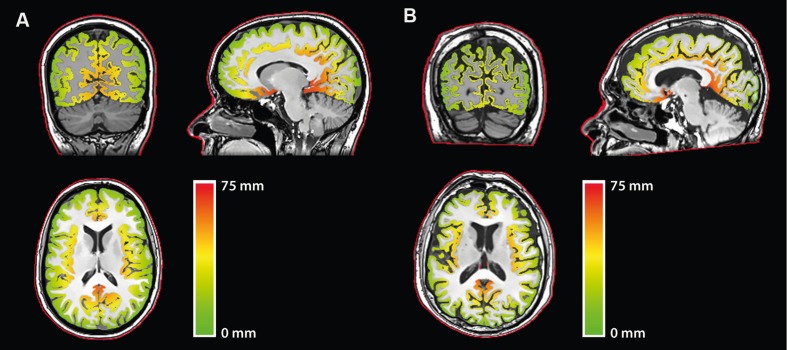
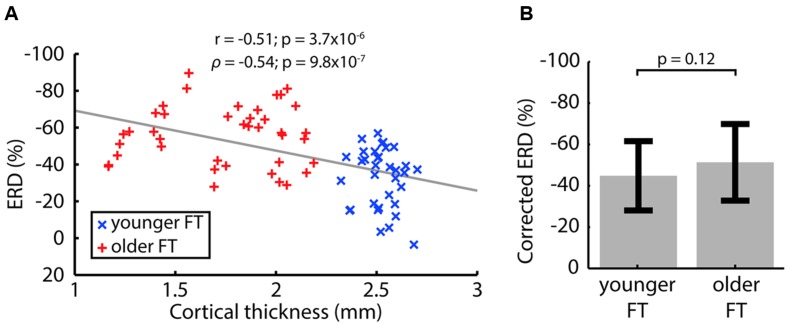
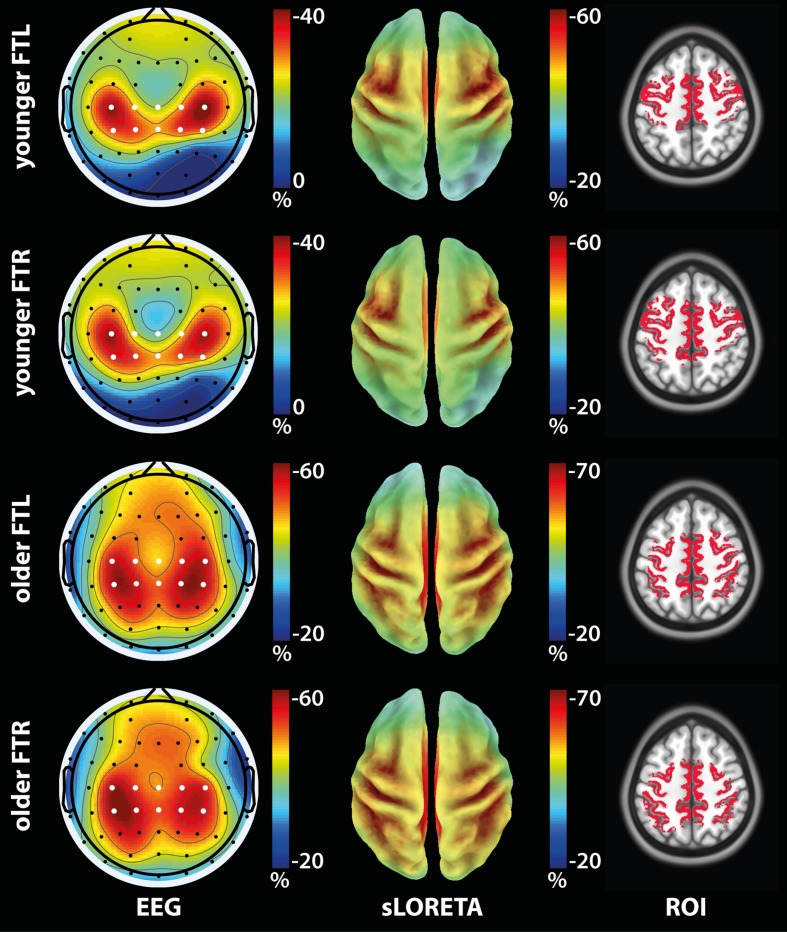
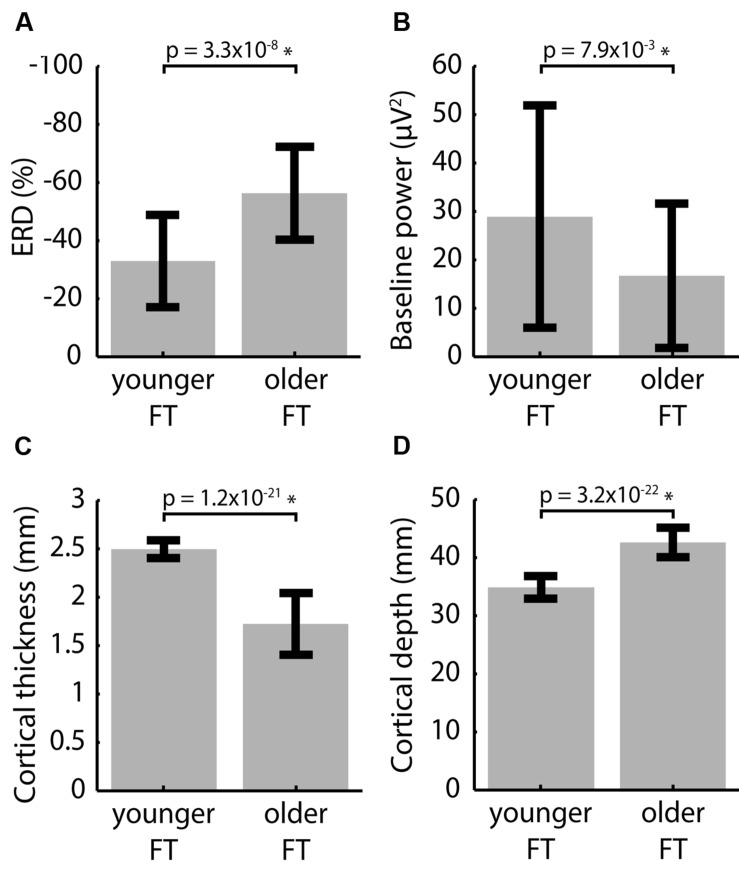
Although electroencephalography (EEG) is a valuable tool to investigate neural activity in patients and controls, exactly how local anatomy impacts the measured signal remains unclear. Better characterizing this relationship is important to improve the understanding of how inter-subject differences in the EEG signal are related to neural activity. We hypothesized that cortical structure might affect event-related desynchronization (ERD) in EEG. Since aging is a well-documented cause of cortical thinning, we investigated the effects of cortical thickness (CT) and cortical depth (CD - the skull-to-cortex distance) on ERD using anatomical MRI and motor-evoked EEG in 17 healthy young adults and 20 healthy older persons. Results showed a significant negative correlation between ERD and CT, but no consistent relationship between ERD and CD. A thinner cortex was associated with a larger ERD in the α/β band and correcting for CT removed most of the inter-group difference in ERD. This indicates that differences in neural activity might not be the primary cause for the observed aging-related differences in ERD, at least in the motor cortex. Further, it emphasizes the importance of considering conditions affecting the EEG signal, such as cortical anatomical changes due to aging, when interpreting differences between healthy controls and/or patients.
尽管脑电图(EEG)是研究患者和对照者神经活动的一种有价值的工具,但局部解剖结构究竟如何影响测量信号仍不清楚。更好地描述这种关系对于增进对EEG信号中个体间差异与神经活动之间关系的理解很重要。我们假设皮质结构可能会影响EEG中的事件相关去同步化(ERD)。由于衰老已被充分证明是皮质变薄的原因,我们使用解剖磁共振成像(MRI)和运动诱发EEG,研究了17名健康年轻人和20名健康老年人的皮质厚度(CT)和皮质深度(CD——颅骨到皮质的距离)对ERD的影响。结果显示,ERD与CT之间存在显著的负相关,但ERD与CD之间没有一致的关系。较薄的皮质与α/β频段中较大的ERD相关,并且校正CT后消除了ERD中大部分的组间差异。这表明神经活动的差异可能不是观察到的与衰老相关的ERD差异的主要原因,至少在运动皮质中是这样。此外,这强调了在解释健康对照者和/或患者之间的差异时,考虑影响EEG信号的因素(如因衰老导致的皮质解剖结构变化)的重要性。