Tsai Cheng-Ting, Robinson Peter V, Spencer Carole A, Bertozzi Carolyn R
Department of Chemistry, University of California , Berkeley, California 94720, United States.
USC Endocrine Laboratories, Department of Medicine, University of Southern California , Los Angeles, California 91105, United States.
ACS Cent Sci. 2016 Mar 23;2(3):139-147. doi: 10.1021/acscentsci.5b00340. Epub 2016 Feb 16.
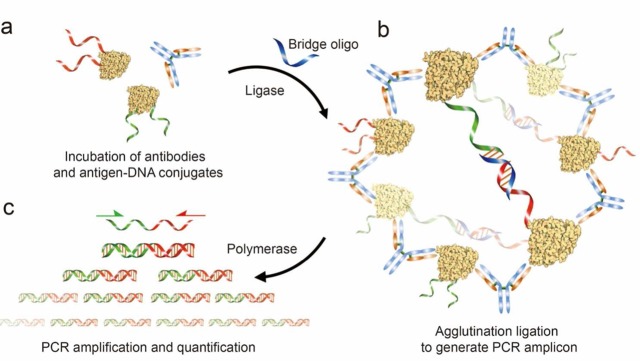
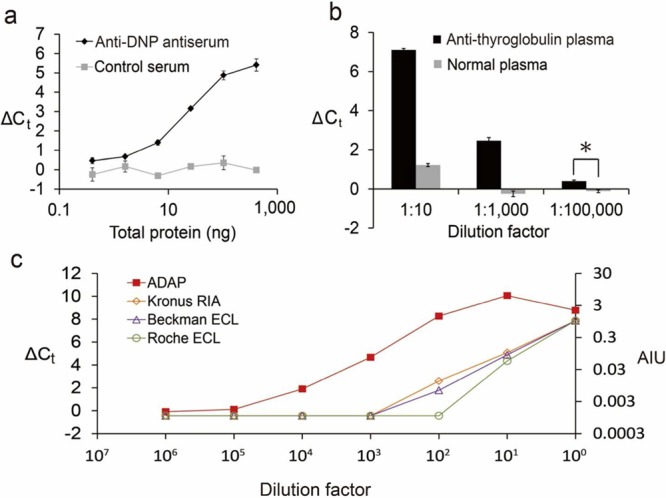
Antibodies are widely used biomarkers for the diagnosis of many diseases. Assays based on solid-phase immobilization of antigens comprise the majority of clinical platforms for antibody detection, but can be undermined by antigen denaturation and epitope masking. These technological hurdles are especially troublesome in detecting antibodies that bind nonlinear or conformational epitopes, such as anti-insulin antibodies in type 1 diabetes patients and anti-thyroglobulin antibodies associated with thyroid cancers. Radioimmunoassay remains the gold standard for these challenging antibody biomarkers, but the limited multiplexability and reliance on hazardous radioactive reagents have prevented their use outside specialized testing facilities. Here we present an ultrasensitive solution-phase method for detecting antibodies, termed antibody detection by agglutination-PCR (ADAP). Antibodies bind to and agglutinate synthetic antigen-DNA conjugates, enabling ligation of the DNA strands and subsequent quantification by qPCR. ADAP detects zepto- to attomoles of antibodies in 2 μL of sample with a dynamic range spanning 5-6 orders of magnitude. Using ADAP, we detected anti-thyroglobulin autoantibodies from human patient plasma with a 1000-fold increased sensitivity over an FDA-approved radioimmunoassay. Finally, we demonstrate the multiplexability of ADAP by simultaneously detecting multiple antibodies in one experiment. ADAP's combination of simplicity, sensitivity, broad dynamic range, multiplexability, and use of standard PCR protocols creates new opportunities for the discovery and detection of antibody biomarkers.
抗体是广泛用于多种疾病诊断的生物标志物。基于抗原固相固定的检测方法构成了抗体检测的大多数临床平台,但可能会因抗原变性和表位掩盖而受到影响。在检测结合非线性或构象表位的抗体时,这些技术障碍尤其棘手,例如1型糖尿病患者中的抗胰岛素抗体和与甲状腺癌相关的抗甲状腺球蛋白抗体。放射免疫测定仍然是这些具有挑战性的抗体生物标志物的金标准,但有限的多重检测能力和对危险放射性试剂的依赖使其无法在专业检测设施之外使用。在此,我们提出了一种用于检测抗体的超灵敏液相方法,称为凝集PCR抗体检测法(ADAP)。抗体与合成抗原-DNA缀合物结合并使其凝集,从而使DNA链得以连接,并随后通过定量PCR进行定量。ADAP可在2 μL样品中检测zeptomole至attomole的抗体,动态范围跨越5至6个数量级。使用ADAP,我们从人类患者血浆中检测抗甲状腺球蛋白自身抗体,其灵敏度比FDA批准的放射免疫测定法提高了1000倍。最后,我们通过在一个实验中同时检测多种抗体来证明ADAP的多重检测能力。ADAP的简单性、灵敏度、宽动态范围、多重检测能力以及对标准PCR方案的使用相结合,为抗体生物标志物的发现和检测创造了新机会。