Zadeh Masoud Maleki, Motamed Nasrin, Ranji Najmeh, Majidi Mohammad, Falahi Fahimeh
Department of Cell & Molecular Biology, School of Biology, College of Science, University of Tehran, Tehran, Iran.
Department of Genetics, College of Science, Rasht Branch, Islamic Azad University, Rasht, Iran.
J Breast Cancer. 2016 Mar;19(1):45-52. doi: 10.4048/jbc.2016.19.1.45. Epub 2016 Mar 25.
MicroRNAs (miRNAs) have received much attention owing to their aberrant expression in various stages of cancer. In many biological processes, miRNAs negatively regulate gene expression, and may be useful in therapeutic strategies. The present study evaluated the effects of silibinin (silybin), a natural flavonoid, on miRNA expression and attempted to elucidate therapeutic targets in MCF-7 breast cancer cells.
The rates of cell proliferation and apoptosis were determined in silibinin-treated and untreated MCF-7 cells. Furthermore, the expression levels of miR-21 and miR-155 were measured in MCF-7 cells after incubation with silibinin (100 µg/mL), and the putative targets of the miRNAs within the apoptotic pathways were predicted using bioinformatic approaches. The expression levels of some of these targets were evaluated by quantitative reverse transcription polymerase chain reaction (qRT-PCR).
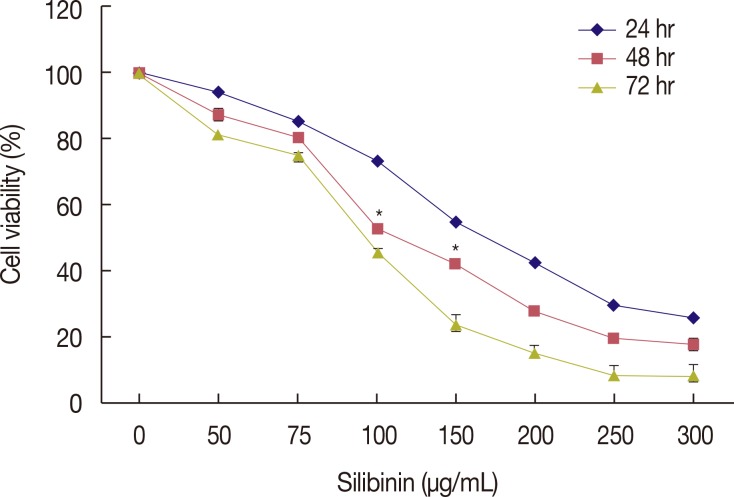
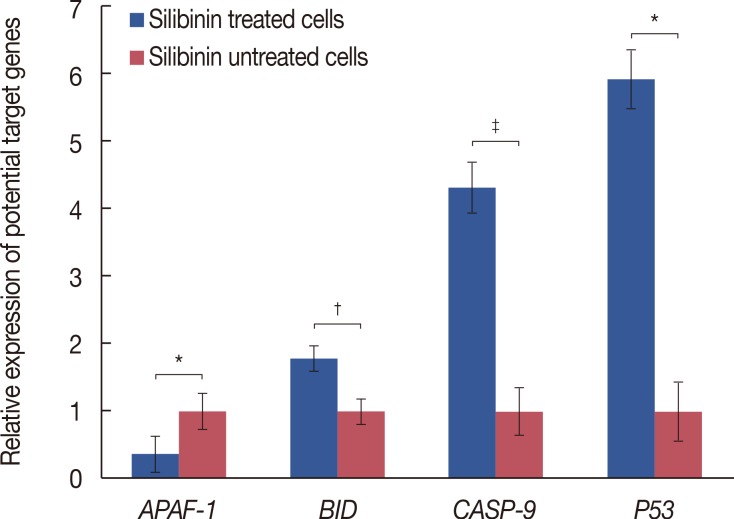
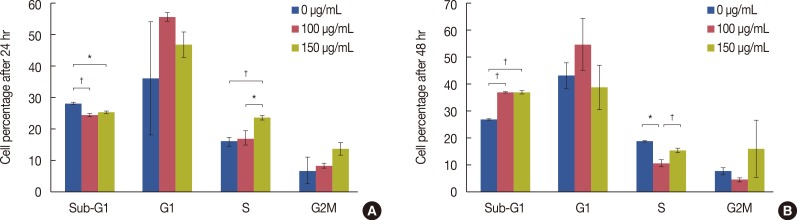
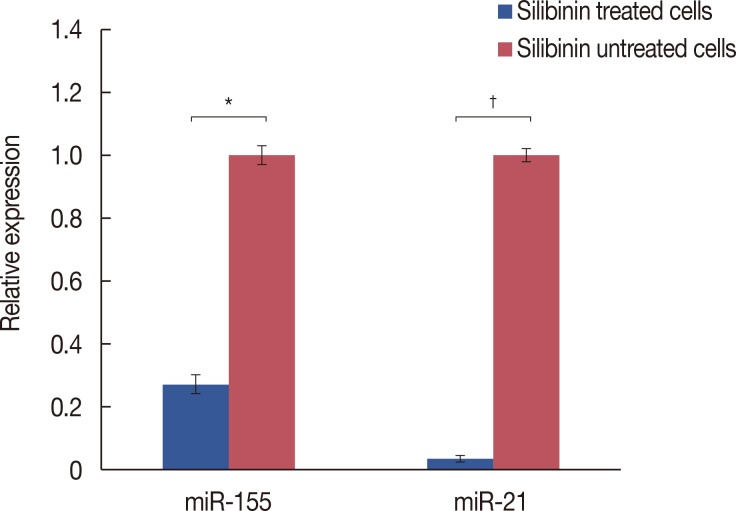
Silibinin induced apoptosis in MCF-7 cells in a dose- and time-dependent manner. qRT-PCR analysis revealed a decrease in miR-21 and miR-155 expression levels in silibinin-treated cells relative to the levels in the untreated cells. Potential miR-21 and miR-155 targets within the apoptotic pathways, such as CASP-9, BID, APAF-1, CASP-3, CASP-8, and PDCD4, were predicted by in silico analysis. qRT-PCR analysis showed upregulation of some of these potential targets including caspase-9 (CASP-9) and BID after silibinin treatment for 48 hours.
Our results suggest a correlation between the expression of miR-21 and miR-155, and MCF-7 cell proliferation. The antiproliferative activity of silibinin may partly be attributable to the downregulation of miR-21 and miR-155, and the upregulation of their apoptotic targets. Furthermore, the upregulation of CASP-9 and BID indicates that silibinin induces apoptosis through both the extrinsic and intrinsic pathways.
微小RNA(miRNA)因其在癌症各个阶段的异常表达而备受关注。在许多生物学过程中,miRNA负向调节基因表达,可能在治疗策略中发挥作用。本研究评估了天然黄酮类化合物水飞蓟宾对miRNA表达的影响,并试图阐明MCF-7乳腺癌细胞中的治疗靶点。
测定水飞蓟宾处理和未处理的MCF-7细胞的细胞增殖率和凋亡率。此外,用100μg/mL水飞蓟宾孵育MCF-7细胞后,检测miR-21和miR-155的表达水平,并使用生物信息学方法预测凋亡途径中miRNA的潜在靶点。通过定量逆转录聚合酶链反应(qRT-PCR)评估其中一些靶点的表达水平。
水飞蓟宾以剂量和时间依赖性方式诱导MCF-7细胞凋亡。qRT-PCR分析显示,与未处理细胞相比,水飞蓟宾处理细胞中miR-21和miR-155的表达水平降低。通过计算机分析预测了凋亡途径中潜在的miR-21和miR-155靶点,如CASP-9、BID、APAF-1、CASP-3、CASP-8和PDCD4。qRT-PCR分析显示,水飞蓟宾处理48小时后,其中一些潜在靶点包括半胱天冬酶-9(CASP-9)和BID上调。
我们的结果表明miR-21和miR-155的表达与MCF-7细胞增殖之间存在相关性。水飞蓟宾的抗增殖活性可能部分归因于miR-21和miR-155的下调及其凋亡靶点的上调。此外,CASP-9和BID的上调表明水飞蓟宾通过外源性和内源性途径诱导凋亡。