Nguyen Diem, Castagneyrol Bastien, Bruelheide Helge, Bussotti Filippo, Guyot Virginie, Jactel Hervé, Jaroszewicz Bogdan, Valladares Fernando, Stenlid Jan, Boberg Johanna
Department of Forest Mycology and Plant Pathology Swedish University of Agricultural Sciences Box 7026 75007 Uppsala Sweden.
BIOGECO University of Bordeaux UMR 1202 33615 Pessac France; INRA BIOGECO UMR 1202 33612 Cestas France.
Ecol Evol. 2016 Mar 11;6(8):2426-38. doi: 10.1002/ece3.2056. eCollection 2016 Apr.
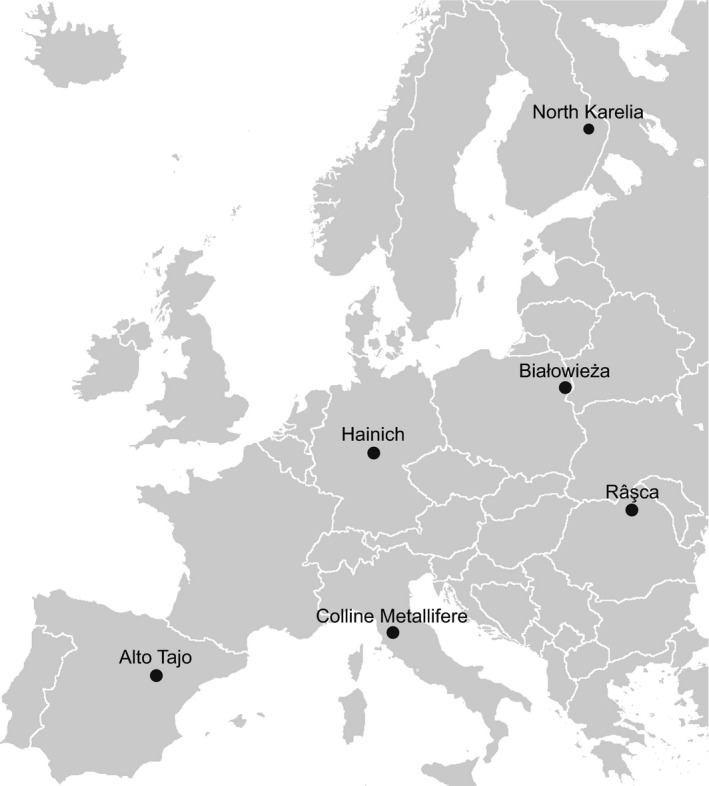
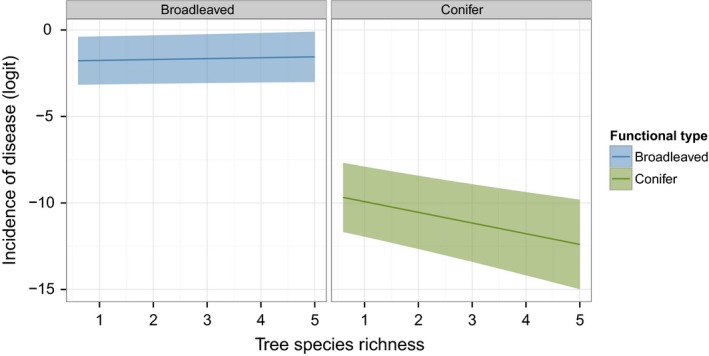
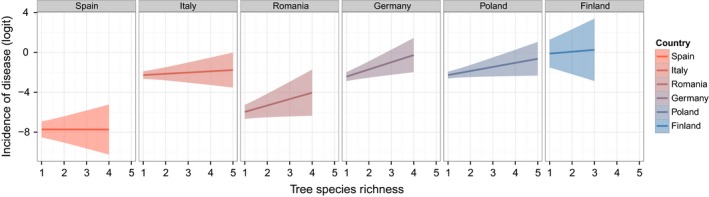
European forests host a diversity of tree species that are increasingly threatened by fungal pathogens, which may have cascading consequences for forest ecosystems and their functioning. Previous experimental studies suggest that foliar and root pathogen abundance and disease severity decrease with increasing tree species diversity, but evidences from natural forests are rare. Here, we tested whether foliar fungal disease incidence was negatively affected by tree species diversity in different forest types across Europe. We measured the foliar fungal disease incidence on 16 different tree species in 209 plots in six European countries, representing a forest-type gradient from the Mediterranean to boreal forests. Forest plots of single species (monoculture plots) and those with different combinations of two to five tree species (mixed species plots) were compared. Specifically, we analyzed the influence of tree species richness, functional type (conifer vs. broadleaved) and phylogenetic diversity on overall fungal disease incidence. The effect of tree species richness on disease incidence varied with latitude and functional type. Disease incidence tended to increase with tree diversity, in particular in northern latitudes. Disease incidence decreased with tree species richness in conifers, but not in broadleaved trees. However, for specific damage symptoms, no tree species richness effects were observed. Although the patterns were weak, susceptibility of forests to disease appears to depend on the forest site and tree type.
欧洲森林中有各种各样的树种,这些树种正日益受到真菌病原体的威胁,而这可能会对森林生态系统及其功能产生连锁反应。先前的实验研究表明,随着树种多样性的增加,叶部和根部病原体的数量以及病害严重程度会降低,但来自天然林的证据却很少。在此,我们测试了欧洲不同森林类型中树种多样性是否会对叶部真菌病害发生率产生负面影响。我们在六个欧洲国家的209个样地中,对16种不同的树种测量了叶部真菌病害发生率,这些样地代表了从地中海森林到北方森林的森林类型梯度。我们比较了单一树种的森林样地(单一栽培样地)和具有两到五个树种不同组合的样地(混交树种样地)。具体而言,我们分析了树种丰富度、功能类型(针叶树与阔叶树)和系统发育多样性对总体真菌病害发生率的影响。树种丰富度对病害发生率的影响随纬度和功能类型而变化。病害发生率往往随着树种多样性的增加而上升,尤其是在高纬度地区。针叶树的病害发生率随树种丰富度的增加而降低,但阔叶树则不然。然而,对于特定的损害症状,未观察到树种丰富度的影响。尽管这些模式并不明显,但森林对病害的易感性似乎取决于森林地点和树木类型。