Section of Immunology, Allergy and Rheumatology, Department of Pediatrics, Texas Children's Hospital, Baylor College of Medicine , Houston, TX , USA.
Immune Deficiency Foundation , Towson, MD , USA.
Front Med (Lausanne). 2016 Mar 30;3:12. doi: 10.3389/fmed.2016.00012. eCollection 2016.
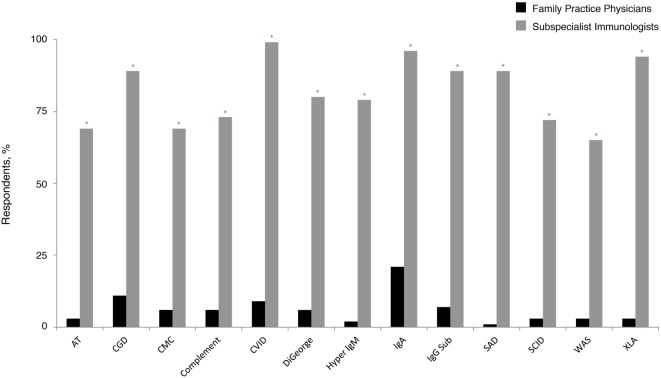
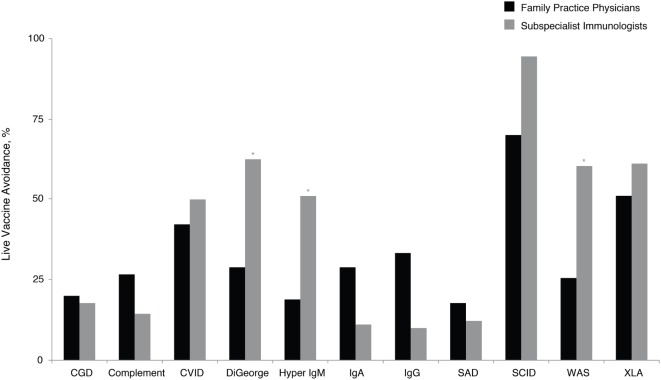
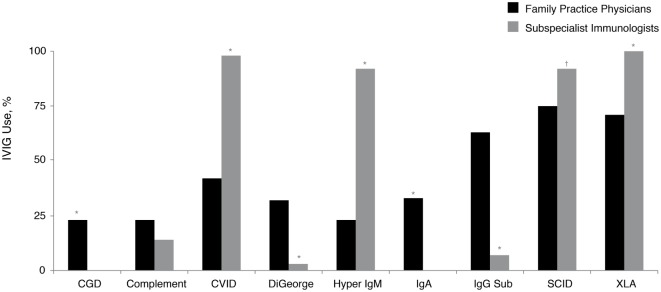
Primary immunodeficiency diseases (PIDs) include over 250 diverse disorders. The current study assessed management of PID by family practice physicians. The American Academy of Allergy, Asthma, and Immunology Primary Immunodeficiency Committee and the Immune Deficiency Foundation conducted an incentivized mail survey of family practice physician members of the American Medical Association and the American Osteopathic Association in direct patient care. Responses were compared with subspecialist immunologist responses from a similar survey. Surveys were returned by 528 (of 4500 surveys mailed) family practice physicians, of whom 44% reported following ≥1 patient with PID. Selective immunoglobulin A deficiency (21%) and chronic granulomatous disease (11%) were most common and were followed by significantly more subspecialist immunologists (P < 0.05). Use of intravenously administered immunoglobulin and live viral vaccinations across PID was significantly different (P < 0.05). Few family practice physicians were aware of professional guidelines for diagnosis and management of PID (4 vs. 79% of subspecialist immunologists, P < 0.05). Family practice physicians will likely encounter patients with PID diagnoses during their career. Differences in how family practice physicians and subspecialist immunologists manage patients with PID underscore areas where improved educational and training initiatives may benefit patient care.
原发性免疫缺陷病(PID)包括 250 多种不同的疾病。本研究评估了家庭医生对 PID 的管理。美国过敏、哮喘和免疫学学会原发性免疫缺陷委员会和免疫缺陷基金会对美国医学协会和美国骨科协会直接接受患者的家庭医生成员进行了一项有奖邮件调查。将调查结果与类似调查中专科免疫学家的调查结果进行了比较。共有 528 名(邮寄的 4500 份调查中的)家庭医生回复了调查,其中 44%的医生报告说至少有 1 名 PID 患者。选择性免疫球蛋白 A 缺乏症(21%)和慢性肉芽肿病(11%)最为常见,且明显多于专科免疫学家(P < 0.05)。PID 患者静脉注射免疫球蛋白和活病毒疫苗的使用情况存在显著差异(P < 0.05)。很少有家庭医生了解 PID 诊断和管理的专业指南(4% vs. 79%的专科免疫学家,P < 0.05)。家庭医生在其职业生涯中可能会遇到 PID 诊断的患者。家庭医生和专科免疫学家在 PID 患者管理方面的差异突出了在哪些方面可以改善教育和培训计划,从而改善患者的护理。