Zhang S-X, Huang F, Gates M, Shen X, Holmberg E G
Spinal Cord Society Research Center, Spinal Cord Society, Fort Collins, CO, USA.
Department of Bioelectronics Nantong University, Nantong, Jiangsu, China.
Spinal Cord. 2016 Nov;54(11):942-946. doi: 10.1038/sc.2016.30. Epub 2016 Apr 12.
This is a randomized controlled prospective trial with two parallel groups.
The objective of this study was to determine whether early application of tail nerve electrical stimulation (TANES)-induced walking training can improve the locomotor function.
This study was conducted in SCS Research Center in Colorado, USA.
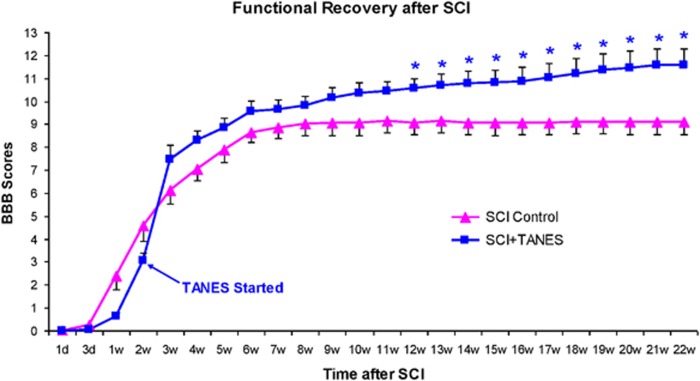
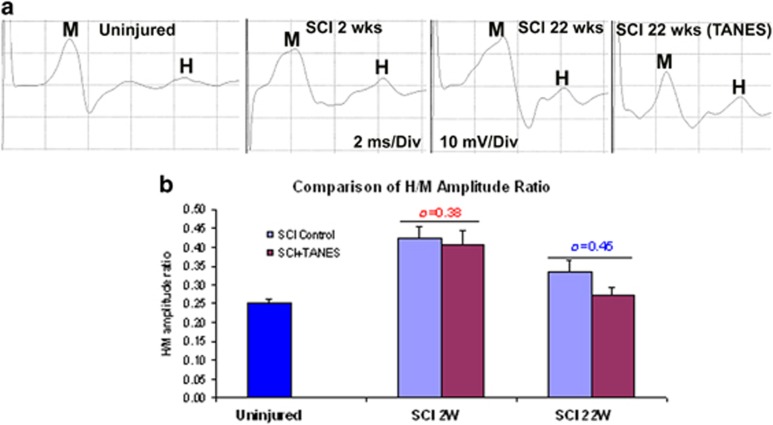
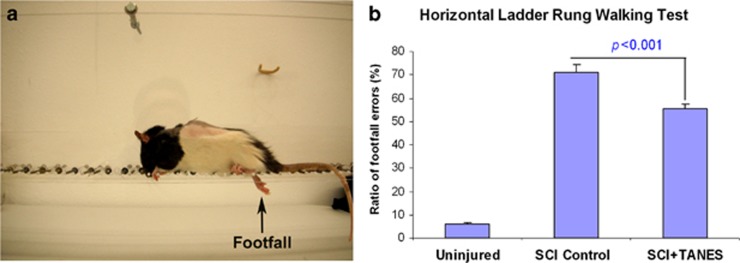
A contusion injury to spinal cord T10 was produced using the New York University impactor device with a 25 -mm height setting in female, adult Long-Evans rats. Injured rats were randomly divided into two groups (n=12 per group). One group was subjected to TANES-induced walking training 2 weeks post injury, and the other group, as control, received no TANES-induced walking training. Restorations of behavior and conduction were assessed using the Basso, Beattie and Bresnahan open-field rating scale, horizontal ladder rung walking test and electrophysiological test (Hoffmann reflex).
Early application of TANES-induced walking training significantly improved the recovery of locomotor function and benefited the restoration of Hoffmann reflex.
TANES-induced walking training is a useful method to promote locomotor recovery in rats with spinal cord injury.
这是一项具有两个平行组的随机对照前瞻性试验。
本研究的目的是确定早期应用尾神经电刺激诱导的步行训练是否能改善运动功能。
本研究在美国科罗拉多州的脊髓刺激研究中心进行。
使用纽约大学撞击装置,将成年雌性Long-Evans大鼠的脊髓T10设置为25毫米高度进行挫伤损伤。将受伤大鼠随机分为两组(每组n = 12)。一组在受伤后2周接受尾神经电刺激诱导的步行训练,另一组作为对照组,不接受尾神经电刺激诱导的步行训练。使用Basso、Beattie和Bresnahan旷场评分量表、水平梯级行走测试和电生理测试(霍夫曼反射)评估行为和传导的恢复情况。
早期应用尾神经电刺激诱导的步行训练显著改善了运动功能的恢复,并有利于霍夫曼反射的恢复。
尾神经电刺激诱导的步行训练是促进脊髓损伤大鼠运动恢复的一种有效方法。