Naqid Ibrahim A, Owen Jonathan P, Maddison Ben C, Spiliotopoulos Anastasios, Emes Richard D, Warry Andrew, Tchórzewska Monika A, Martelli Francesca, Gosling Rebecca J, Davies Robert H, La Ragione Roberto M, Gough Kevin C
School of Veterinary Medicine and Science, The University of Nottingham, Sutton Bonington Campus, College Road, Sutton Bonington, Leicestershire, LE12 5RD, UK.
ADAS UK, School of Veterinary Medicine and Science, The University of Nottingham, Sutton Bonington Campus, College Road, Sutton Bonington, Leicestershire, LE12 5RD, UK.
Sci Rep. 2016 Apr 13;6:24232. doi: 10.1038/srep24232.
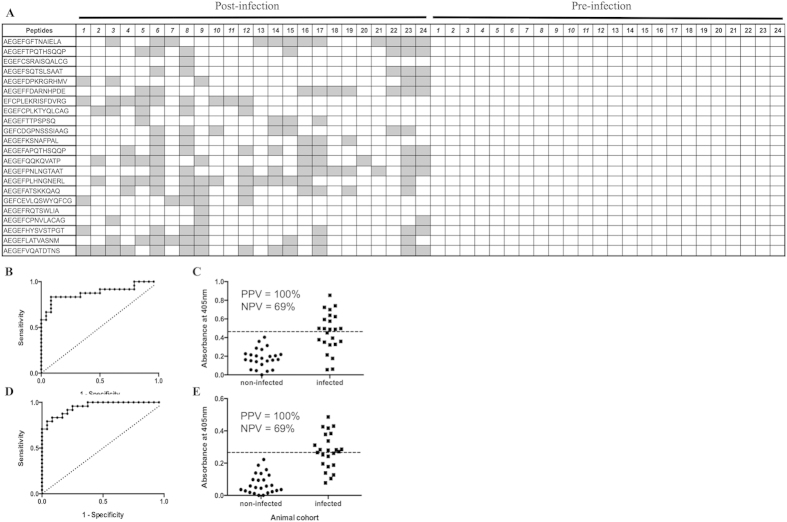
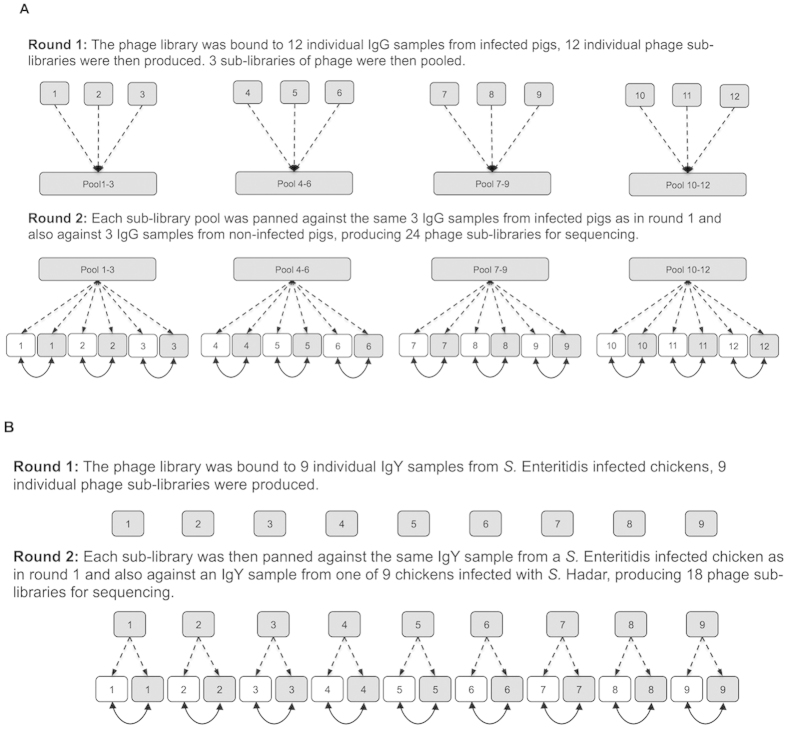
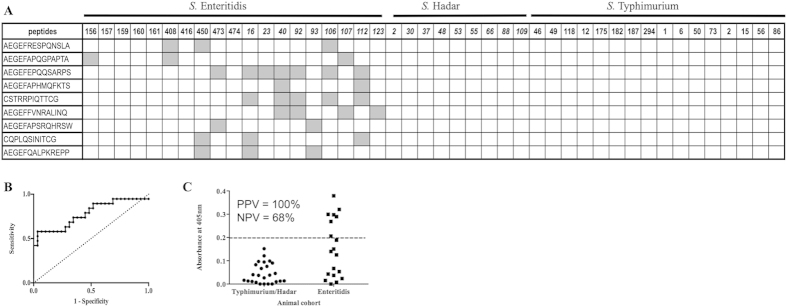
Mapping polyclonal antibody responses to infectious diseases to identify individual epitopes has the potential to underpin the development of novel serological assays and vaccines. Here, phage-peptide library panning coupled with screening using next generation sequencing was used to map antibody responses to bacterial infections. In the first instance, pigs experimentally infected with Salmonella enterica serovar Typhimurium was investigated. IgG samples from twelve infected pigs were probed in parallel and phage binding compared to that with equivalent IgG from pre-infected animals. Seventy-seven peptide mimotopes were enriched specifically against sera from multiple infected animals. Twenty-seven of these peptides were tested in ELISA and twenty-two were highly discriminatory for sera taken from pigs post-infection (P < 0.05) indicating that these peptides are mimicking epitopes from the bacteria. In order to further test this methodology, it was applied to differentiate antibody responses in poultry to infections with distinct serovars of Salmonella enterica. Twenty-seven peptides were identified as being enriched specifically against IgY from multiple animals infected with S. Enteritidis compared to those infected with S. Hadar. Nine of fifteen peptides tested in ELISA were highly discriminatory for IgY following S. Enteritidis infection (p < 0.05) compared to infections with S. Hadar or S. Typhimurium.
绘制针对传染病的多克隆抗体反应图谱以识别单个表位,有可能为新型血清学检测方法和疫苗的开发提供支持。在此,噬菌体肽库淘选结合下一代测序筛选被用于绘制针对细菌感染的抗体反应图谱。首先,对实验感染肠炎沙门氏菌鼠伤寒血清型的猪进行了研究。并行检测了12头感染猪的IgG样本,并将噬菌体结合情况与感染前动物的等量IgG进行比较。77个肽模拟表位被特异性富集,针对多个感染动物的血清。其中27个肽在酶联免疫吸附测定(ELISA)中进行了测试,22个对感染后猪的血清具有高度区分性(P < 0.05),表明这些肽模拟了来自细菌的表位。为了进一步测试该方法,将其应用于区分家禽对肠炎沙门氏菌不同血清型感染的抗体反应。与感染哈达尔沙门氏菌的动物相比,27个肽被确定为特异性富集于感染肠炎沙门氏菌的多个动物的IgY。在ELISA中测试的15个肽中,有9个对肠炎沙门氏菌感染后的IgY具有高度区分性(p < 0.05),与哈达尔沙门氏菌或鼠伤寒沙门氏菌感染相比。