Pase Matthew P, Beiser Alexa, Enserro Danielle, Xanthakis Vanessa, Aparicio Hugo, Satizabal Claudia L, Himali Jayandra J, Kase Carlos S, Vasan Ramachandran S, DeCarli Charles, Seshadri Sudha
From the Department of Neurology (M.P.P., A.B., H.A., C.L.S., J.J.H., S.S.), and Section of Preventive Medicine, Department of Medicine (D.E., V.X., R.S.V.), Boston University School of Medicine and Framingham Heart Study (M.P.P., A.B., D.E., V.X., H.A., C.L.S., J.J.H., R.S.V., S.S.), Boston, MA; Centre for Human Psychopharmacology, Swinburne University of Technology, Melbourne, Victoria, Australia (M.P.P.); Department of Biostatistics, Boston University School of Public Health, MA (A.B.); Department of Neurology, Boston Medical Centre, MA (H.A., C.S.K.); and Department of Neurology, School of Medicine and Imaging of Dementia and Aging Laboratory, Center for Neuroscience, University of California Davis, Sacramento (C.D.).
Stroke. 2016 May;47(5):1201-6. doi: 10.1161/STROKEAHA.115.012608. Epub 2016 Apr 12.
The American Heart Association developed the ideal cardiovascular health (CVH) index as a simple tool to promote CVH; yet, its association with brain atrophy and dementia remains unexamined.
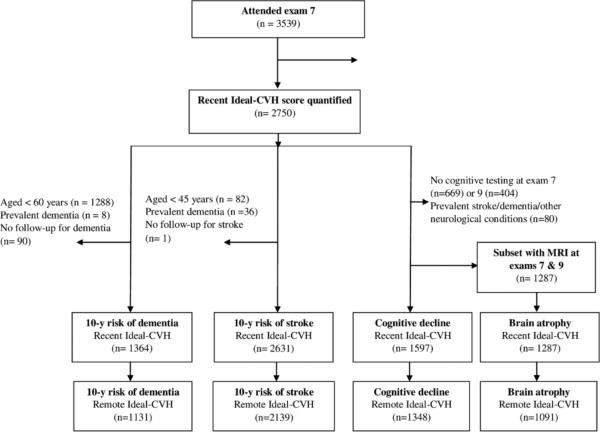
Our aim was to investigate the prospective association of ideal CVH with vascular brain injury, including the 10-year risks of incident stroke and dementia, as well as cognitive decline and brain atrophy on magnetic resonance imaging, measured for ≈7 years. We studied 2750 stroke- and dementia-free Framingham Heart Study Offspring cohort participants (mean age, 62±9 years; 45% men). Ideal CVH was quantified on a 7-point scale with 1 point awarded for each of the following: nonsmoking status, ideal body mass index, regular physical activity, healthy diet, as well as optimum blood pressure, cholesterol, and fasting blood glucose. Both recent (baseline) and remote (6.9 years earlier) ideal CVH scores were examined.
Recent ideal CVH was associated with stroke (hazard ratio, 0.80; 95% confidence interval, 0.67-0.95), vascular dementia (hazard ratio, 0.49; 95% confidence interval, 0.30-0.81), frontal brain atrophy (P=0.003), and cognitive decline on tasks measuring visual memory and reasoning (P<0.05). In addition to predicting stroke, vascular dementia, whole-brain atrophy, and cognitive decline, remote ideal CVH was associated with the incidence of all-cause dementia (hazard ratio, 0.80; 95% confidence interval, 0.67-0.97) and Alzheimer disease (hazard ratio, 0.79; 95% confidence interval, 0.64-0.98).
Adherence to the American Heart Association's ideal CVH factors and behaviors, particularly in midlife, may protect against cerebrovascular disease and dementia.
美国心脏协会制定了理想心血管健康(CVH)指数,作为促进心血管健康的一种简单工具;然而,其与脑萎缩和痴呆症之间的关联尚未得到研究。
我们的目的是调查理想CVH与血管性脑损伤的前瞻性关联,包括中风和痴呆症的10年发病风险,以及在约7年的时间里通过磁共振成像测量的认知能力下降和脑萎缩情况。我们研究了2750名无中风和痴呆症的弗雷明汉心脏研究后代队列参与者(平均年龄62±9岁;45%为男性)。理想CVH通过7分制进行量化,以下每一项得1分:不吸烟状态、理想体重指数、规律体育活动、健康饮食,以及最佳血压、胆固醇和空腹血糖。同时检查了近期(基线)和远期(6.9年前)的理想CVH评分。
近期理想CVH与中风(风险比,0.80;95%置信区间,0.67 - 0.95)、血管性痴呆(风险比,0.49;95%置信区间,0.30 - 0.81)、额叶脑萎缩(P = 0.003)以及视觉记忆和推理任务中的认知能力下降(P < 0.05)相关。除了预测中风、血管性痴呆、全脑萎缩和认知能力下降外,远期理想CVH还与全因痴呆症的发病率(风险比,0.80;95%置信区间,0.67 - 0.97)和阿尔茨海默病(风险比,0.79;95%置信区间,0.64 - 0.98)相关。
坚持美国心脏协会的理想CVH因素和行为,尤其是在中年时期,可能预防脑血管疾病和痴呆症。