Ma Zhanjun, Shou Kangquan, Li Zonghuan, Jian Chao, Qi Baiwen, Yu Aixi
Department of Orthopedics, Zhongnan Hospital of Wuhan University, Wuhan, Hubei 430071, P.R. China.
Exp Ther Med. 2016 Apr;11(4):1307-1317. doi: 10.3892/etm.2016.3083. Epub 2016 Feb 17.
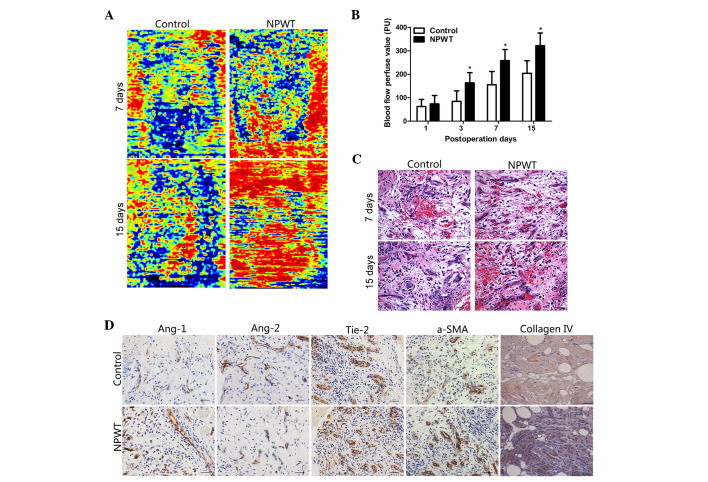
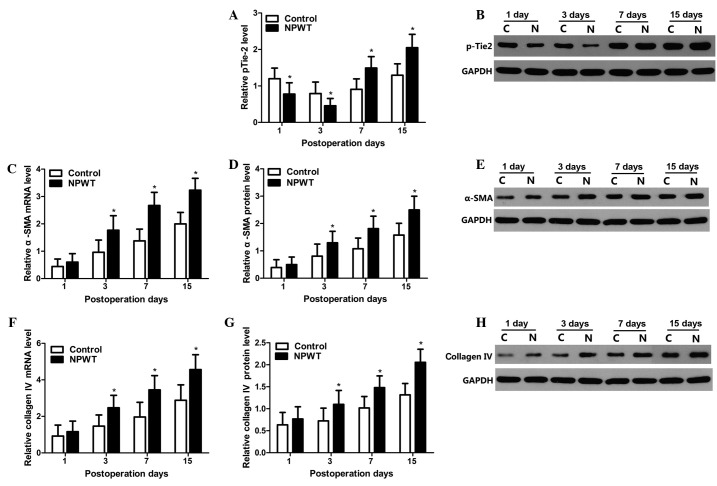
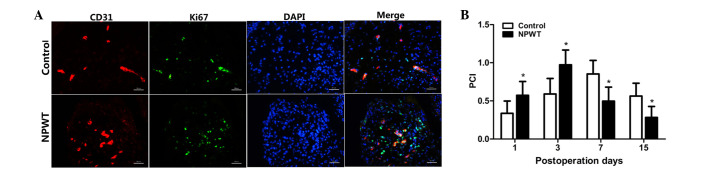
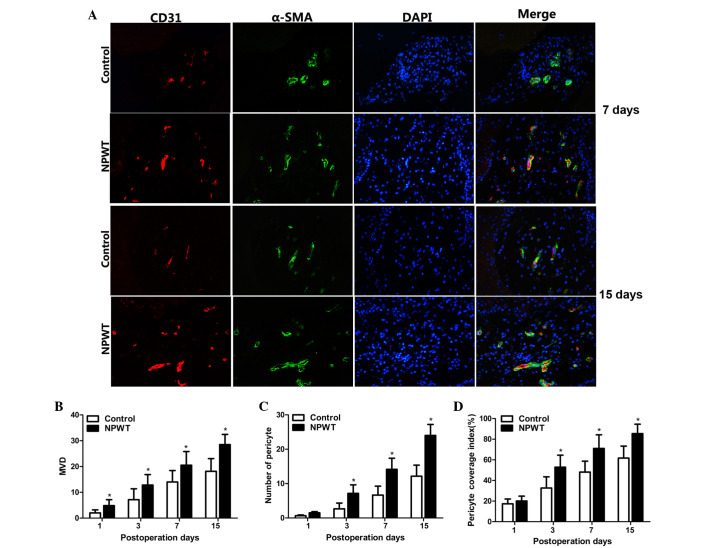
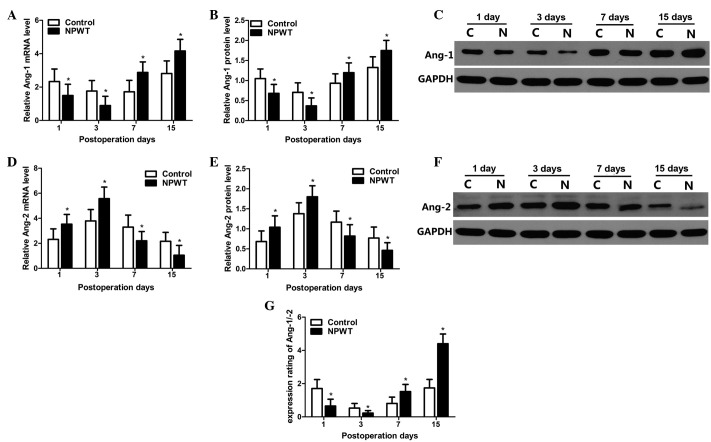
Negative pressure wound therapy (NPWT) has been observed to accelerate the wound healing process in humans through promoting angiogenesis. However, the potential biological effect and relevant molecular mechanisms, including microvessel destabilization, regression and endothelial cell proliferation in the early stage (1-3 days), and the neovascular stabilization and maturation in the later stage (7-15 days), have yet to be fully elucidated. The current study aimed to research the potential effect of NPWT on angiogenesis and vessel maturation, and investigate relevant association between mature microvessels and wound prognosis, as well as the regulatory mechanisms in human wound healing. Patients in the present study (n=48) were treated with NPWT or a petrolatum gauze, and relevant growth factors and vessel changes were detected using various experimental methods. NPWT increased the expression levels of angiogenin-2 (Ang-2), and decreased the expression levels of Ang-1 and ratios of Ang-1/Ang-2 in the initial stages of wound healing. However, in the latter stages of wound healing, NPWT increased the expression levels of Ang-1 and ratios of Ang-1/Ang-2, as well as the phosphorylation level of tyrosine kinase receptor-2. Consequently, microvessel pericyte coverage was gradually elevated, and the basement membrane was gradually supplied with new blood at the later stage of wound healing. In conclusion, NPWT may preferentially stimulate microvessel destabilization and regression in the early stage of wound healing, and as a consequence, increase angiogenesis. Subsequently, in the later stage of wound healing, NPWT may preferentially promote microvessel stabilization, thereby promoting microvessel maturation in human wounds through the angiogenin/tyrosine kinase receptor-2 signaling pathway. The results of the present study results demonstrated that NPWT was able to accelerate wound healing speed, and thus influence wound prognosis, as a result of an abundance of mature microvessels in human wounds.
负压伤口治疗(NPWT)已被观察到可通过促进血管生成来加速人类伤口愈合过程。然而,其潜在的生物学效应和相关分子机制,包括早期(1 - 3天)微血管的不稳定、消退和内皮细胞增殖,以及后期(7 - 15天)新血管的稳定和成熟,尚未完全阐明。当前研究旨在探究NPWT对血管生成和血管成熟的潜在影响,研究成熟微血管与伤口预后之间的相关关联,以及人类伤口愈合中的调节机制。本研究中的患者(n = 48)接受了NPWT或凡士林纱布治疗,并使用各种实验方法检测相关生长因子和血管变化。NPWT在伤口愈合初期增加了血管生成素 - 2(Ang - 2)的表达水平,降低了Ang - 1的表达水平以及Ang - 1/Ang - 2的比值。然而,在伤口愈合后期,NPWT增加了Ang - 1的表达水平以及Ang - 1/Ang - 2的比值,以及酪氨酸激酶受体 - 2的磷酸化水平。因此,微血管周细胞覆盖率在伤口愈合后期逐渐升高,基底膜在后期逐渐有新的血液供应。总之,NPWT可能在伤口愈合早期优先刺激微血管的不稳定和消退,从而增加血管生成。随后,在伤口愈合后期,NPWT可能优先促进微血管稳定,从而通过血管生成素/酪氨酸激酶受体 - 2信号通路促进人类伤口中的微血管成熟。本研究结果表明,由于人类伤口中存在大量成熟微血管,NPWT能够加速伤口愈合速度,进而影响伤口预后。