Cho Min Jeng, Yang Jung-Hyun, Yu Yeong Beom, Park Kyoung Sik, Chung Hyun Woo, So Young, Choi Nami, Kim Mi Young
Department of Surgery, Konkuk University Medical Center, Konkuk University School of Medicine, Seoul, Korea.
Department of Nuclear Medicine, Konkuk University Medical Center, Konkuk University School of Medicine, Seoul, Korea.
Ann Surg Treat Res. 2016 Apr;90(4):194-200. doi: 10.4174/astr.2016.90.4.194. Epub 2016 Mar 30.
The purpose of this study was to assess the breast-specific gamma imaging (BSGI) in Breast Imaging Reporting and Data System (BI-RADS) 4 lesions on mammography and/or ultrasound.
We performed a retrospective review of 162 patients who underwent BSGI in BI-RADS 4 lesions on mammography and/or ultrasound.
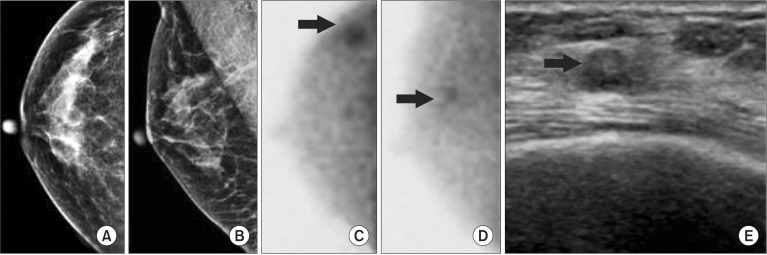
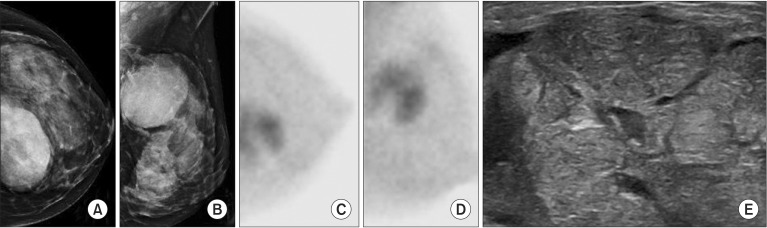
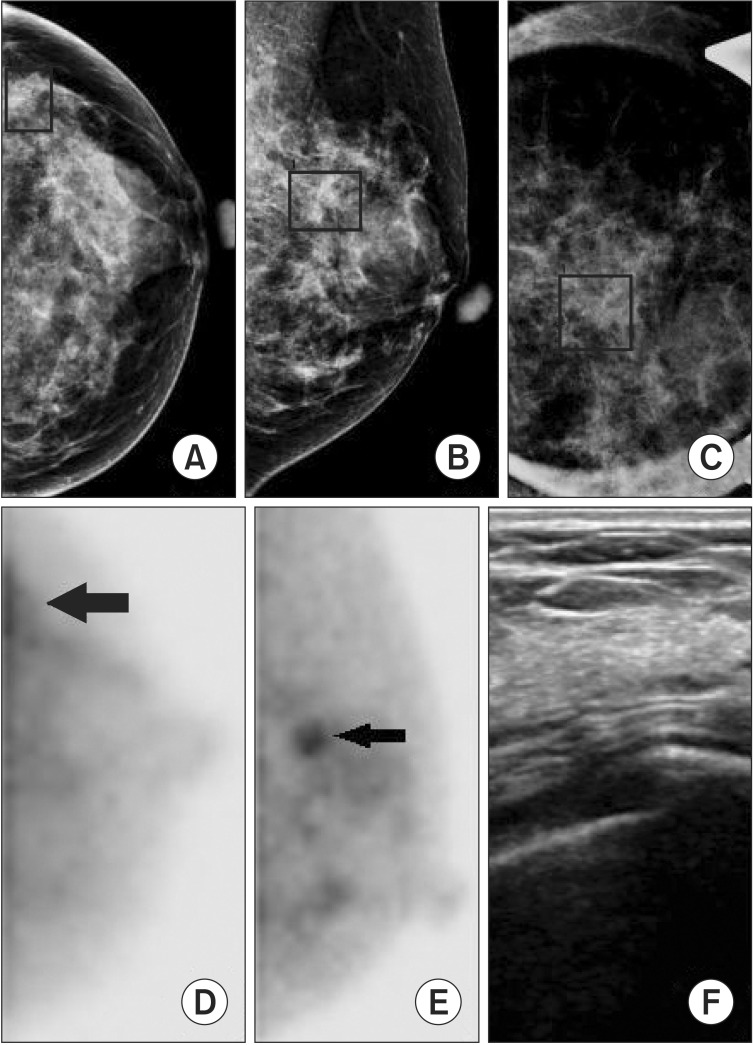
Of the 162 breast lesions, 66 were malignant tumors and 96 were benign tumors. Sensitivity and specificity of BSGI were 90.9% and 78.1%, and positive predictive value and negative predictive value were 74.1% and 92.6%. The sensitivity or specificity of mammography and ultrasound were 74.2% and 56.3% and 87.9% and 19.8%, respectively. The sensitivity and specificity of BSGI for breast lesions ≤1 cm were 88.0% and 86.8%, while the values of beast lesions >1 cm were 92.7% and 61.5%. The sensitivity or specificity of BSGI and mammography for patients with dense breasts were 92.0% and 81.3% and 72.0% and 50.0%, respectively. 26 patients showed neither a nodule nor microcalcification on ultrasound, but showed suspicious calcification on mammography. The sensitivity and specificity of BSGI with microcalcification only lesion were 75.0% and 94.4%.
This study demonstrated that BSGI had shown high sensitivity and specificity, as well as positive and negative predictive values in BI-RADS 4 lesions on ultrasound and/or mammography. BSGI showed excellent results in dense breasts, in lesions that are less than 1 cm in size and lesions with suspicious microcalcification only.
本研究旨在评估乳腺影像报告和数据系统(BI-RADS)4类乳腺钼靶和/或超声检查病变的乳腺特异性γ成像(BSGI)。
我们对162例接受乳腺钼靶和/或超声检查为BI-RADS 4类病变的患者进行了BSGI检查,并进行回顾性分析。
162例乳腺病变中,66例为恶性肿瘤,96例为良性肿瘤。BSGI的敏感性和特异性分别为90.9%和78.1%,阳性预测值和阴性预测值分别为74.1%和92.6%。乳腺钼靶和超声的敏感性和特异性分别为74.2%和56.3%以及87.9%和19.8%。BSGI对≤1 cm乳腺病变的敏感性和特异性分别为88.0%和86.8%,而对>1 cm乳腺病变的值分别为92.7%和61.5%。对于乳腺致密的患者,BSGI和乳腺钼靶的敏感性和特异性分别为92.0%和81.3%以及72.0%和50.0%。26例患者超声检查未见结节及微钙化,但乳腺钼靶显示可疑钙化。仅微钙化病变的BSGI敏感性和特异性分别为75.0%和94.4%。
本研究表明,BSGI在超声和/或乳腺钼靶检查的BI-RADS 4类病变中显示出高敏感性、特异性以及阳性和阴性预测值。BSGI在乳腺致密、小于1 cm的病变以及仅伴有可疑微钙化的病变中显示出良好结果。