Beller Ebba, Klopp David, Göttler Jens, Kaesmacher Johannes, Zimmer Claus, Kirschke Jan S, Prothmann Sascha
Abteilung für Diagnostische und Interventionelle Neuroradiologie, Klinikum rechts der Isar, Technische Universität München, Munich, Germany.
Acandis GmbH & Co. KG, Pforzheim, Germany.
PLoS One. 2016 Apr 13;11(4):e0153403. doi: 10.1371/journal.pone.0153403. eCollection 2016.
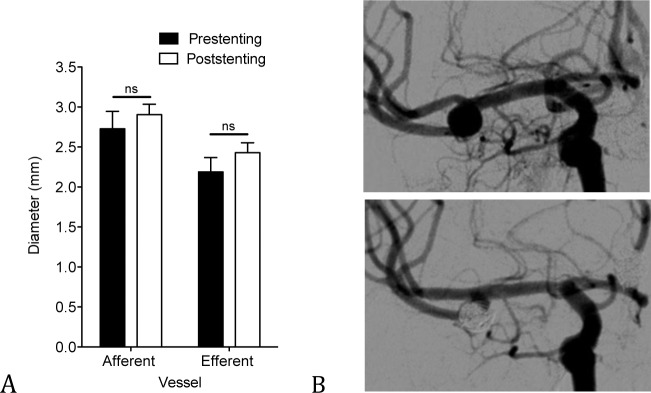
Stent-assisted coil embolization (SACE) plays an important role in the treatment of intracranial aneurysms. The purpose of this study was to investigate geometrical changes caused by closed-cell design stents in bifurcation and sidewall aneurysms.
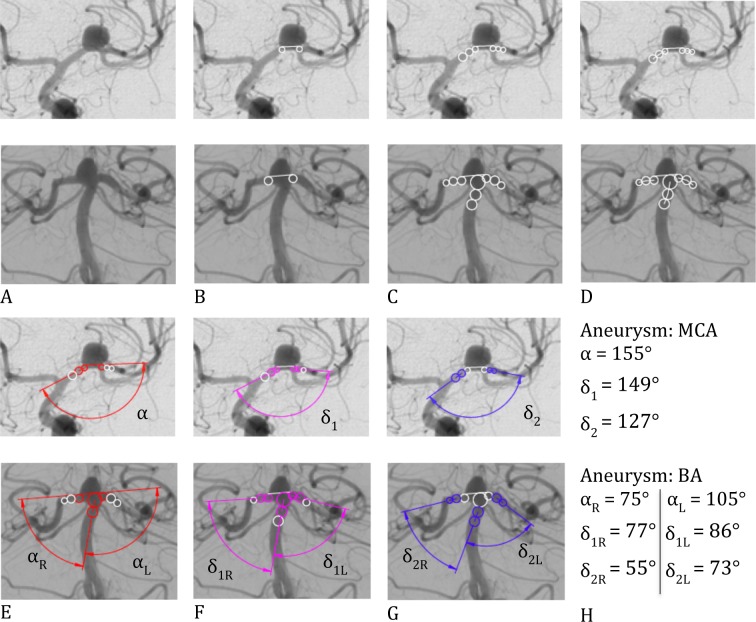
31 patients with 34 aneurysms underwent SACE with closed-cell design stents. Inflow angle α, determined by aneurysm neck and afferent vessel, and angle between afferent and efferent vessel close to (δ1), respectively, more remote from the aneurysm neck (δ2) were graphically determined in 2D angiography projections.
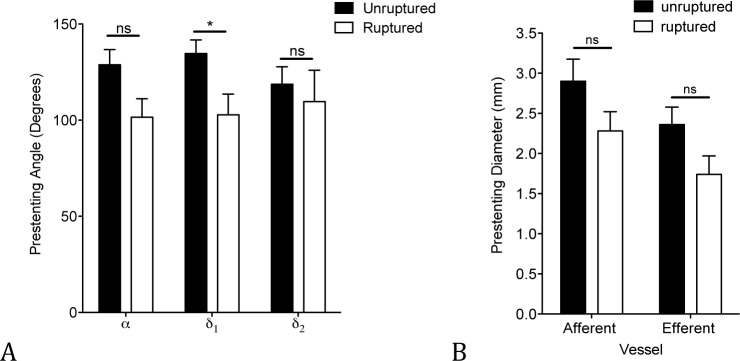
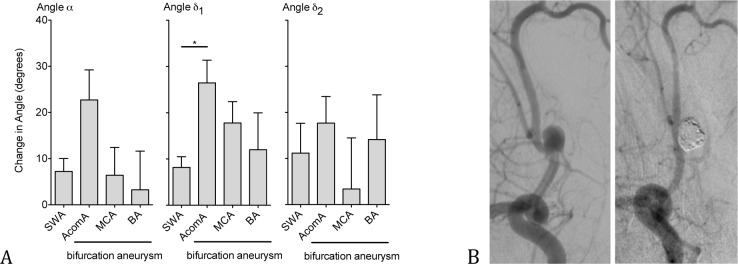
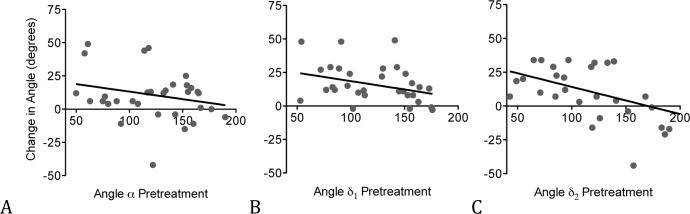
Stent assisted coiling resulted in a significant increase of all three angles from a mean value (±SEM) of α = 119° (±6.5°) pretreatment to 130° (±6.6°) posttreatment (P ≤ .001), δ1 = 129° (±6.4°) to 139° (±6.1°), (P ≤ .001) and δ2 = 115° (±8.4°) to 126° (±7.5°), (P ≤ .01). Angular change of δ1 in AcomA aneurysms was significant greater compared to sidewall aneurysms (26°±4.9° versus 8°± 2.3°, P ≤ .05). The initial angle of δ1 and δ2 revealed a significantly inverse relationship to the angle increase (δ1: r = -0.41, P ≤ .05 and δ2: r = -0.47, P ≤ .01). Moreover, angle δ1 was significantly higher in unruptured compared to ruptured aneurysms (135°±7.1° versus 103°±10.8°, P ≤ .05).
Stent deployment modulates the geometry of the aneurysm-vessel complex, which may lead to favorable hemodynamic changes more similar to unruptured than to ruptured aneurysms. Our findings also suggest that the more acute-angled aneurysm-vessel anatomy, the larger the angular change. Further studies are needed to investigate whether these changes improve the clinical outcome.
支架辅助弹簧圈栓塞术(SACE)在颅内动脉瘤治疗中发挥着重要作用。本研究旨在探讨闭孔设计支架在分叉部和侧壁动脉瘤中引起的几何形状变化。
31例患者的34个动脉瘤接受了闭孔设计支架的SACE治疗。在二维血管造影投影图上,通过动脉瘤颈部和输入血管确定流入角α,以及分别靠近(δ1)和远离动脉瘤颈部(δ2)的输入血管与输出血管之间的夹角。
支架辅助弹簧圈栓塞术使所有三个角度均显著增加,从治疗前的平均值(±标准误)α = 119°(±6.5°)增至治疗后的130°(±6.6°)(P≤.001),δ1从129°(±6.4°)增至139°(±6.1°),(P≤.001),δ2从115°(±8.4°)增至126°(±7.5°),(P≤.01)。前交通动脉瘤(AcomA)中δ1的角度变化显著大于侧壁动脉瘤(26°±4.9°对8°±2.3°,P≤.05)。δ1和δ2的初始角度与角度增加呈显著负相关(δ1:r = -0.41,P≤.05;δ2:r = -0.47,P≤.01)。此外,未破裂动脉瘤的δ1角度显著高于破裂动脉瘤(135°±7.1°对103°±10.8°,P≤.05)。
支架置入可调节动脉瘤-血管复合体的几何形状,这可能导致更有利于血流动力学变化,与未破裂动脉瘤相比,更类似于未破裂而非破裂动脉瘤。我们的研究结果还表明,动脉瘤-血管解剖结构的角度越尖锐,角度变化越大。需要进一步研究来探讨这些变化是否能改善临床结局。