Chávez-Santiago Raúl, Szydełko Michał, Kliks Adrian, Foukalas Fotis, Haddad Yoram, Nolan Keith E, Kelly Mark Y, Masonta Moshe T, Balasingham Ilangko
Norwegian University of Science and Technology, Trondheim, Norway ; Intervention Center, Oslo University Hospital, Oslo, Norway ; Institute of Clinical Medicine, University of Oslo, Oslo, Norway.
Huawei R&D Sweden, Stockholm, Sweden.
Wirel Pers Commun. 2015;83(3):1617-1642. doi: 10.1007/s11277-015-2467-2. Epub 2015 Mar 13.
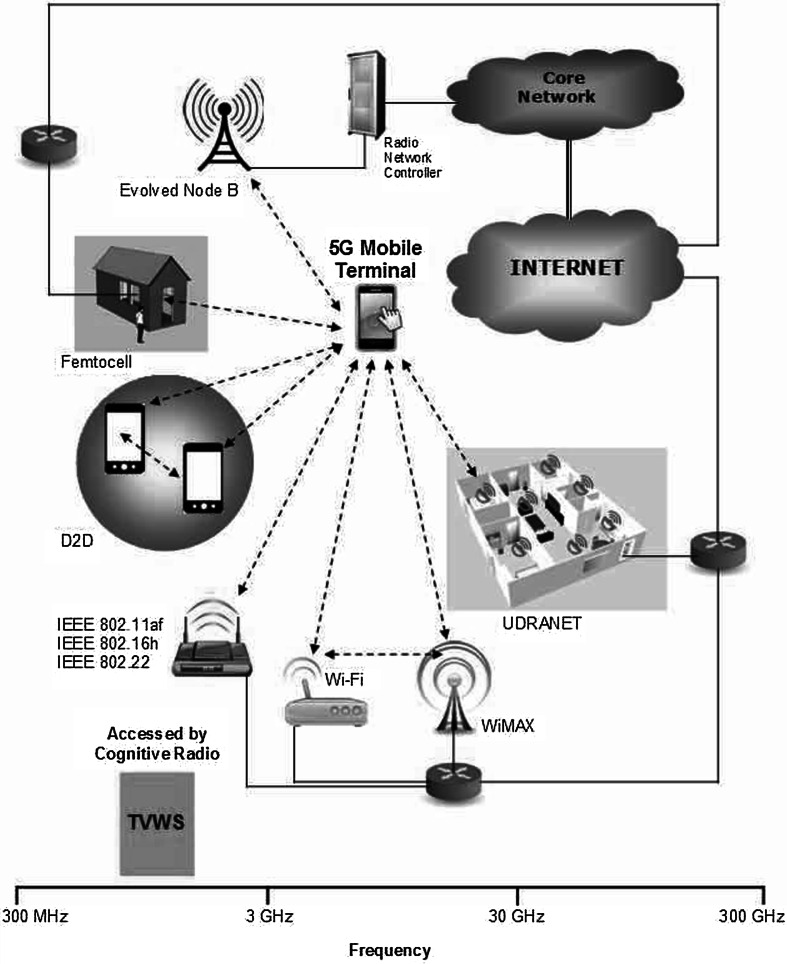
As the rollout of 4G mobile communication networks takes place, representatives of industry and academia have started to look into the technological developments toward the next generation (5G). Several research projects involving key international mobile network operators, infrastructure manufacturers, and academic institutions, have been launched recently to set the technological foundations of 5G. However, the architecture of future 5G systems, their performance, and mobile services to be provided have not been clearly defined. In this paper, we put forth the vision for 5G as the convergence of evolved versions of current cellular networks with other complementary radio access technologies. Therefore, 5G may not be a single radio access interface but rather a "network of networks". Evidently, the seamless integration of a variety of air interfaces, protocols, and frequency bands, requires paradigm shifts in the way networks cooperate and complement each other to deliver data rates of several Gigabits per second with end-to-end latency of a few milliseconds. We provide an overview of the key radio technologies that will play a key role in the realization of this vision for the next generation of mobile communication networks. We also introduce some of the research challenges that need to be addressed.
随着4G移动通信网络的逐步推出,业界和学术界的代表已开始关注面向下一代(5G)的技术发展。最近,几个涉及主要国际移动网络运营商、基础设施制造商和学术机构的研究项目已经启动,以奠定5G的技术基础。然而,未来5G系统的架构、其性能以及将要提供的移动服务尚未明确界定。在本文中,我们提出了5G的愿景,即当前蜂窝网络的演进版本与其他互补无线接入技术的融合。因此,5G可能不是单一的无线接入接口,而是一个“网络之网络”。显然,各种空中接口、协议和频段的无缝集成,要求网络相互协作和互补的方式发生范式转变,以实现每秒数千兆比特的数据速率以及几毫秒的端到端延迟。我们概述了在实现下一代移动通信网络这一愿景中将发挥关键作用的关键无线技术。我们还介绍了一些需要解决的研究挑战。