Suppr超能文献

二年级人工耳蜗植入儿童语音及形态句法技能的早期预测因素

Early predictors of phonological and morphosyntactic skills in second graders with cochlear implants.

作者信息

Nittrouer Susan, Lowenstein Joanna H, Holloman Christopher

机构信息

Otolaryngology, Ohio State University, United States.

Otolaryngology, Ohio State University, United States.

出版信息

Res Dev Disabil. 2016 Aug;55:143-60. doi: 10.1016/j.ridd.2016.03.020. Epub 2016 Apr 12.

Abstract

PURPOSE

Newborn hearing screening has made it possible to provide early treatment of hearing loss to more children than ever before, raising expectations these children will be able to attend regular schools. But continuing deficits in spoken language skills have led to challenges in meeting those expectations. This study was conducted to (1) examine two kinds of language skills (phonological and morphosyntactic) at school age (second grade) for children with cochlear implants (CIs); (2) see which measures from earlier in life best predicted performance at second grade; (3) explore how well these skills supported other cognitive and language functions; and (4) examine how treatment factors affected measured outcomes.

METHODS

Data were analyzed from 100 second-grade, monolingual English-speaking children: 51 with CIs and 49 with normal hearing (NH). Ten measures of spoken language and related functions were collected: three each of phonological and morphosyntactic skills; and four of other cognitive and language functions. Six measures from preschool and seven from kindergarten served as predictor variables. The effects of treatment variables were examined.

RESULTS

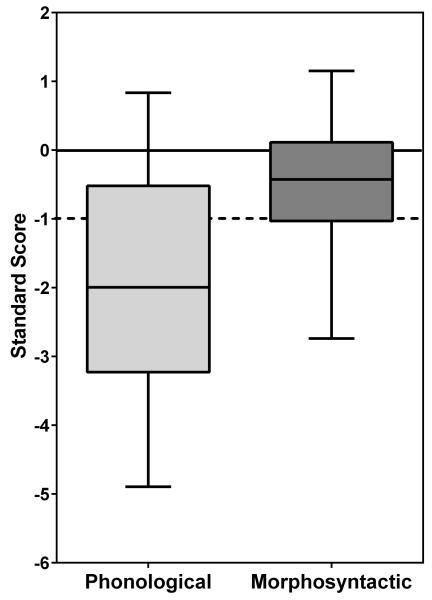
Children with CIs were more delayed acquiring phonological than morphosyntactic skills. Mean length of utterance at earlier ages was the most consistent predictor of both phonological and morphosyntactic skills at second grade. Early bimodal stimulation had a weak, but positive effect on phonological skills at second grade; sign language experience during preschool had a negative effect on morphosyntactic structures in spoken language.

CONCLUSIONS

Children with CIs are delayed in language acquisition, and especially so in phonological skills. Appropriate testing and treatments can help ameliorate these delays.

摘要

目的

新生儿听力筛查使比以往更多的儿童能够获得听力损失的早期治疗,这提高了人们对这些儿童能够进入正规学校的期望。但口语技能持续存在的缺陷给实现这些期望带来了挑战。本研究旨在:(1)检查学龄期(二年级)人工耳蜗植入(CI)儿童的两种语言技能(语音和形态句法);(2)确定生命早期的哪些指标最能预测二年级时的表现;(3)探究这些技能对其他认知和语言功能的支持程度;(4)研究治疗因素如何影响测量结果。

方法

对100名二年级单语说英语的儿童的数据进行分析:51名人工耳蜗植入儿童和49名听力正常(NH)儿童。收集了10项口语及相关功能的指标:语音和形态句法技能各3项;其他认知和语言功能4项。来自学前班的6项指标和来自幼儿园的7项指标作为预测变量。研究了治疗变量的影响。

结果

人工耳蜗植入儿童在语音技能的获得上比形态句法技能更滞后。早期年龄的平均语句长度是二年级语音和形态句法技能最一致的预测指标。早期双模式刺激对二年级的语音技能有微弱但积极的影响;学前班期间的手语经验对口语中的形态句法结构有负面影响。

结论

人工耳蜗植入儿童在语言习得方面存在延迟,尤其是在语音技能方面。适当的测试和治疗有助于改善这些延迟。
相似文献

1
Early predictors of phonological and morphosyntactic skills in second graders with cochlear implants.
Res Dev Disabil. 2016 Aug;55:143-60. doi: 10.1016/j.ridd.2016.03.020. Epub 2016 Apr 12.
2
Development of Phonological, Lexical, and Syntactic Abilities in Children With Cochlear Implants Across the Elementary Grades.
J Speech Lang Hear Res. 2018 Oct 26;61(10):2561-2577. doi: 10.1044/2018_JSLHR-H-18-0047.
3
Auditory and verbal memory predictors of spoken language skills in children with cochlear implants.
Res Dev Disabil. 2016 Oct;57:112-24. doi: 10.1016/j.ridd.2016.06.019. Epub 2016 Jul 12.
5
Beyond Early Intervention: Supporting Children With CIs Through Elementary School.
Otol Neurotol. 2016 Feb;37(2):e43-9. doi: 10.1097/MAO.0000000000000906.
6
Narrative spoken language skills in severely hearing impaired school-aged children with cochlear implants.
Res Dev Disabil. 2013 Nov;34(11):3833-46. doi: 10.1016/j.ridd.2013.07.033. Epub 2013 Sep 9.
7
Emergent literacy in kindergartners with cochlear implants.
Ear Hear. 2012 Nov-Dec;33(6):683-97. doi: 10.1097/AUD.0b013e318258c98e.
9
Computer-assisted training of phoneme-grapheme correspondence for children who are deaf and hard of hearing: effects on phonological processing skills.
Int J Pediatr Otorhinolaryngol. 2013 Dec;77(12):2049-57. doi: 10.1016/j.ijporl.2013.10.007. Epub 2013 Oct 20.
10
Phonological processing skills and its relevance to receptive vocabulary development in children with early cochlear implantation.
Int J Pediatr Otorhinolaryngol. 2012 Dec;76(12):1755-60. doi: 10.1016/j.ijporl.2012.08.016. Epub 2012 Sep 8.

引用本文的文献

1
Nomogram for prediction of hearing rehabilitation outcome in children with congenital sensorineural hearing loss after cochlear implantation.
Heliyon. 2024 Apr 16;10(8):e29529. doi: 10.1016/j.heliyon.2024.e29529. eCollection 2024 Apr 30.
2
Expressive vocabulary word categories of children who are deaf and hard-of-hearing.
J Deaf Stud Deaf Educ. 2024 Jun 24;29(3):362-376. doi: 10.1093/deafed/enad066.
3
Preschoolers rely on rich speech representations to process variable speech.
Child Dev. 2023 Jul-Aug;94(4):e197-e214. doi: 10.1111/cdev.13922. Epub 2023 Apr 10.
4
The emergence of bifurcated structure in children's language.
J Exp Psychol Gen. 2022 Dec;151(12):3045-3059. doi: 10.1037/xge0001245. Epub 2022 Jun 13.
5
Meta-Analytic Findings on Reading in Children With Cochlear Implants.
J Deaf Stud Deaf Educ. 2021 Jun 14;26(3):336-350. doi: 10.1093/deafed/enab010.
6
The Duality of Patterning in Language and its Relationship to Reading in Children with Hearing Loss.
Perspect ASHA Spec Interest Groups. 2020 Dec;5(6):1400-1409. doi: 10.1044/2020_PERSP-20-00029. Epub 2020 Aug 6.
7
The Relation Between Vocabulary Knowledge and Phonological Awareness in Children With Cochlear Implants.
J Speech Lang Hear Res. 2020 Jul 20;63(7):2386-2402. doi: 10.1044/2020_JSLHR-19-00259. Epub 2020 Jul 8.
8
Early Cognitive Predictors of 9-Year-Old Spoken Language in Children With Mild to Severe Hearing Loss Using Hearing Aids.
Front Psychol. 2019 Sep 26;10:2180. doi: 10.3389/fpsyg.2019.02180. eCollection 2019.
9
Rhyme Awareness in Children With Normal Hearing and Children With Cochlear Implants: An Exploratory Study.
Front Psychol. 2019 Sep 12;10:2072. doi: 10.3389/fpsyg.2019.02072. eCollection 2019.
10
Effects of Early Acoustic Hearing on Speech Perception and Language for Pediatric Cochlear Implant Recipients.
J Speech Lang Hear Res. 2019 Sep 20;62(9):3620-3637. doi: 10.1044/2019_JSLHR-H-18-0255. Epub 2019 Sep 13.

本文引用的文献

1
The Lexicon and Phonology: Interactions in Language Acquisition.
Lang Speech Hear Serv Sch. 2002 Jan 1;33(1):24-37. doi: 10.1044/0161-1461(2002/003).
2
Results in cochlear implanted children before 5 years of age. a long term follow up.
Int J Pediatr Otorhinolaryngol. 2014 Dec;78(12):2183-9. doi: 10.1016/j.ijporl.2014.10.006. Epub 2014 Oct 19.
4
Influence of implantation age on school-age language performance in pediatric cochlear implant users.
Int J Audiol. 2013 Apr;52(4):219-29. doi: 10.3109/14992027.2012.759666. Epub 2013 Feb 28.
5
Enduring advantages of early cochlear implantation for spoken language development.
J Speech Lang Hear Res. 2013 Apr;56(2):643-55. doi: 10.1044/1092-4388(2012/11-0347). Epub 2012 Dec 28.
6
Speech perception in noise by children with cochlear implants.
J Speech Lang Hear Res. 2013 Feb;56(1):13-30. doi: 10.1044/1092-4388(2012/11-0338). Epub 2012 Jun 28.
9
Evaluating phonological processing skills in children with prelingual deafness who use cochlear implants.
J Deaf Stud Deaf Educ. 2009 Winter;14(1):1-21. doi: 10.1093/deafed/enn013. Epub 2008 Apr 18.
10
Dyslexia and the failure to form a perceptual anchor.
Nat Neurosci. 2006 Dec;9(12):1558-64. doi: 10.1038/nn1800. Epub 2006 Nov 19.

文献AI研究员

20分钟写一篇综述,助力文献阅读效率提升50倍。

立即体验

用中文搜PubMed

大模型驱动的PubMed中文搜索引擎

马上搜索

文档翻译

学术文献翻译模型,支持多种主流文档格式。

立即体验