Robinson Emma, Tate Mitchel, Lockhart Samuel, McPeake Claire, O'Neill Karla M, Edgar Kevin S, Calderwood Danielle, Green Brian D, McDermott Barbara J, Grieve David J
Wellcome-Wolfson Institute for Experimental Medicine, Queen's University Belfast, 97 Lisburn Road, Belfast, BT9 7AE, UK.
School of Biological Sciences, Institute for Global Food Security, Queen's University Belfast, Belfast, BT9 5HN, UK.
Cardiovasc Diabetol. 2016 Apr 14;15:65. doi: 10.1186/s12933-016-0386-5.
Glucagon-like peptide-1 (GLP-1) therapies are routinely used for glycaemic control in diabetes and their emerging cardiovascular actions have been a major recent research focus. In addition to GLP-1 receptor activation, the metabolically-inactive breakdown product, GLP-1(9-36)amide, also appears to exert notable cardiovascular effects, including protection against acute cardiac ischaemia. Here, we specifically studied the influence of GLP-1(9-36)amide on chronic post-myocardial infarction (MI) remodelling, which is a major driver of heart failure progression.
Adult female C57BL/6 J mice were subjected to permanent coronary artery ligation or sham surgery prior to continuous infusion with GLP-1(9-36)amide or vehicle control for 4 weeks.
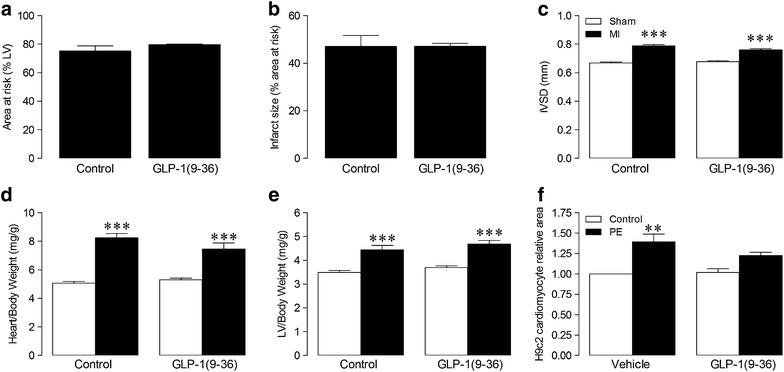
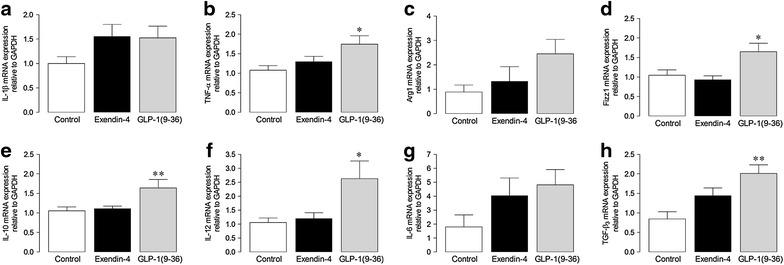
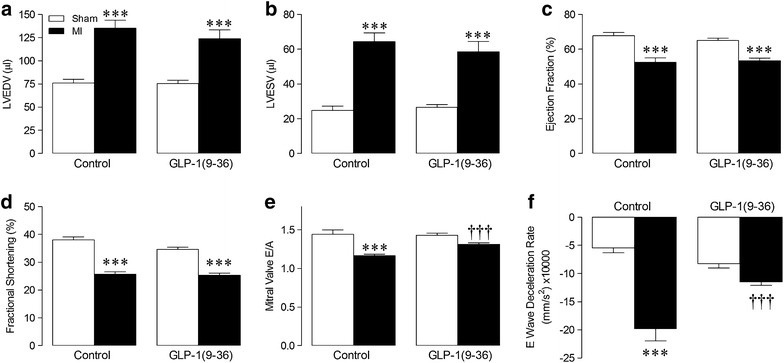
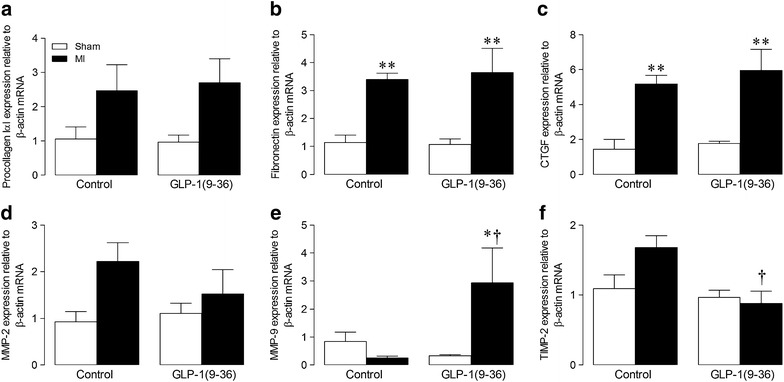
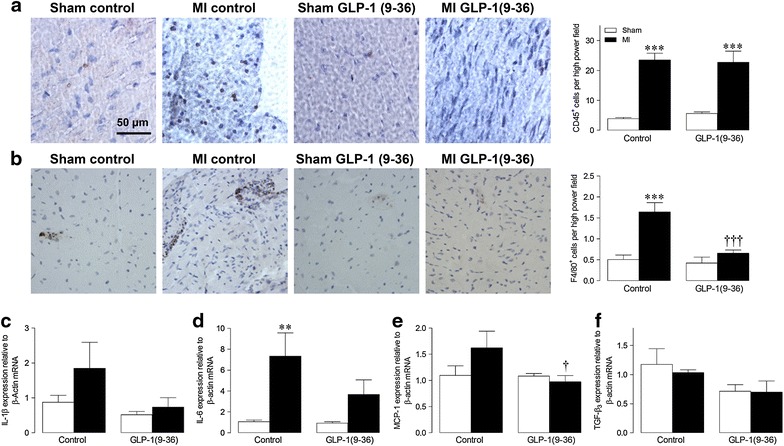
Infarct size was similar between groups with no effect of GLP-1(9-36)amide on MI-induced cardiac hypertrophy, although modest reduction of in vitro phenylephrine-induced H9c2 cardiomyoblast hypertrophy was observed. Whilst echocardiographic systolic dysfunction post-MI remained unchanged, diastolic dysfunction (decreased mitral valve E/A ratio, increased E wave deceleration rate) was improved by GLP-1(9-36)amide treatment. This was associated with modulation of genes related to extracellular matrix turnover (MMP-2, MMP-9, TIMP-2), although interstitial fibrosis and pro-fibrotic gene expression were unaltered by GLP-1(9-36)amide. Cardiac macrophage infiltration was also reduced by GLP-1(9-36)amide together with pro-inflammatory cytokine expression (IL-1β, IL-6, MCP-1), whilst in vitro studies using RAW264.7 macrophages revealed global potentiation of basal pro-inflammatory and tissue protective cytokines (e.g. IL-1β, TNF-α, IL-10, Fizz1) in the presence of GLP-1(9-36)amide versus exendin-4.
These data suggest that GLP-1(9-36)amide confers selective protection against post-MI remodelling via preferential preservation of diastolic function, most likely due to modulation of infiltrating macrophages, indicating that this often overlooked GLP-1 breakdown product may exert significant actions in this setting which should be considered in the context of GLP-1 therapy in patients with cardiovascular disease.
胰高血糖素样肽-1(GLP-1)疗法常用于糖尿病患者的血糖控制,其新发现的心血管作用是近期主要的研究焦点。除了激活GLP-1受体外,代谢无活性的降解产物GLP-1(9-36)酰胺似乎也具有显著的心血管效应,包括对急性心肌缺血的保护作用。在此,我们专门研究了GLP-1(9-36)酰胺对心肌梗死后(MI)慢性重塑的影响,心肌梗死后重塑是心力衰竭进展的主要驱动因素。
成年雌性C57BL/6 J小鼠在永久性冠状动脉结扎或假手术后,连续输注GLP-1(9-36)酰胺或载体对照4周。
各组梗死面积相似,GLP-1(9-36)酰胺对MI诱导的心脏肥大无影响,不过观察到其对体外苯肾上腺素诱导的H9c2心肌成纤维细胞肥大有适度减轻作用。虽然MI后超声心动图收缩功能障碍保持不变,但GLP-1(9-36)酰胺治疗改善了舒张功能障碍(二尖瓣E/A比值降低,E波减速速率增加)。这与细胞外基质周转相关基因(MMP-2、MMP-9、TIMP-2)的调节有关,尽管GLP-1(9-36)酰胺未改变间质纤维化和促纤维化基因表达。GLP-1(9-36)酰胺还减少了心脏巨噬细胞浸润以及促炎细胞因子表达(IL-1β、IL-6、MCP-1),而使用RAW264.7巨噬细胞的体外研究显示,与艾塞那肽-4相比,在存在GLP-1(9-36)酰胺的情况下,基础促炎和组织保护细胞因子(如IL-1β、TNF-α、IL-10、Fizz1)总体增强。
这些数据表明,GLP-1(9-36)酰胺通过优先保留舒张功能,对MI后重塑具有选择性保护作用,这很可能是由于对浸润巨噬细胞的调节,表明这种常被忽视的GLP-1降解产物在这种情况下可能发挥重要作用,在心血管疾病患者的GLP-1治疗背景下应予以考虑。