• 文献检索
  • 文档翻译
  • 深度研究
  • 学术资讯
  • Suppr Zotero 插件Zotero 插件
  • 邀请有礼
  • 套餐&价格
  • 历史记录
应用&插件
Suppr Zotero 插件Zotero 插件浏览器插件Mac 客户端Windows 客户端微信小程序
定价
高级版会员购买积分包购买API积分包
服务
文献检索文档翻译深度研究API 文档MCP 服务
关于我们
关于 Suppr公司介绍联系我们用户协议隐私条款
关注我们

Suppr 超能文献

核心技术专利:CN118964589B侵权必究
粤ICP备2023148730 号-1Suppr @ 2026

文献检索

告别复杂PubMed语法,用中文像聊天一样搜索,搜遍4000万医学文献。AI智能推荐,让科研检索更轻松。

立即免费搜索

文件翻译

保留排版,准确专业,支持PDF/Word/PPT等文件格式,支持 12+语言互译。

免费翻译文档

深度研究

AI帮你快速写综述,25分钟生成高质量综述,智能提取关键信息,辅助科研写作。

立即免费体验

比较肯尼亚西部疟疾传播情况不同的两个地点的蚊帐拥有情况和使用情况。

Comparing ownership and use of bed nets at two sites with differential malaria transmission in western Kenya.

作者信息

Ernst Kacey C, Hayden Mary H, Olsen Heather, Cavanaugh Jamie L, Ruberto Irene, Agawo Maurice, Munga Stephen

机构信息

Division of Epidemiology and Biostatistics, Mel and Enid Zuckerman School of Public Health, The University of Arizona, 1295 N. Martin Ave., Tucson, AZ, 85724, USA.

National Center for Atmospheric Research, 3450 Mitchell Lane, Boulder, CO, 80301, USA.

出版信息

Malar J. 2016 Apr 14;15:217. doi: 10.1186/s12936-016-1262-1.

DOI:10.1186/s12936-016-1262-1
PMID:27079380
原文链接:https://pmc.ncbi.nlm.nih.gov/articles/PMC4832536/
Abstract

BACKGROUND

Challenges persist in ensuring access to and optimal use of long-lasting, insecticidal bed nets (LLINs). Factors associated with ownership and use may differ depending on the history of malaria and prevention control efforts in a specific region. Understanding how the cultural and social-environmental context of bed net use may differ between high- and low-risk regions is important when identifying solutions to improve uptake and appropriate use.

METHODS

Community forums and a household, cross-sectional survey were used to collect information on factors related to bed net ownership and use in western Kenya. Sites with disparate levels of transmission were selected, including an endemic lowland area, Miwani, and a highland epidemic-prone area, Kapkangani. Analysis of ownership was stratified by site. A combined site analysis was conducted to examine factors associated with use of all available bed nets. Logistic regression modelling was used to determine factors associated with ownership and use of owned bed nets.

RESULTS

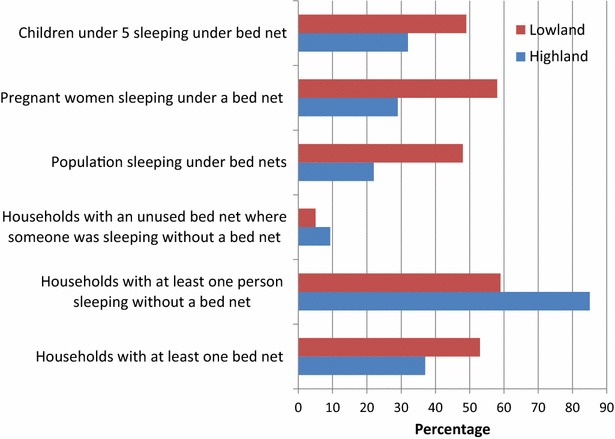
Access to bed nets as the leading barrier to their use was identified in community forums and cross-sectional surveys. While disuse of available bed nets was discussed in the forums, it was a relatively rare occurrence in both sites. Factors associated with ownership varied by site. Education, perceived risk of malaria and knowledge of individuals who had died of malaria were associated with higher bed net ownership in the highlands, while in the lowlands individuals reporting it was easy to get a bed net were more likely to own one. A combined site analysis indicated that not using an available bed net was associated with the attitudes that taking malaria drugs is easier than using a bed net and that use of a bed net will not prevent malaria. In addition, individuals with an unused bed net in the household were more likely to indicate that bed nets are difficult to use, that purchased bed nets are better than freely distributed ones, and that bed nets should only be used during the rainy season.

CONCLUSION

Variations in factors associated with ownership should be acknowledged when constructing messaging and distribution campaigns. Despite reports of bed nets being used for other purposes, those in the home were rarely unused in these communities. Disuse seemed to be related to beliefs that can be addressed through education programmes. As mass distributions continue to take place, additional research is needed to determine if factors associated with LLIN ownership and use change with increasing availability of LLIN.

摘要

背景

在确保长效驱虫蚊帐(LLINs)的可及性和优化使用方面,挑战依然存在。与蚊帐拥有和使用相关的因素可能因特定地区的疟疾流行史和预防控制措施而异。在确定提高蚊帐使用率和正确使用的解决方案时,了解高风险和低风险地区蚊帐使用的文化和社会环境背景差异很重要。

方法

通过社区论坛和家庭横断面调查,收集肯尼亚西部与蚊帐拥有和使用相关因素的信息。选择了传播水平不同的地点,包括一个地方性低地地区米瓦尼和一个易发生疟疾流行的高地地区卡普坎加尼。按地点对蚊帐拥有情况进行分层分析。进行综合地点分析,以研究与所有可用蚊帐使用相关的因素。使用逻辑回归模型确定与自有蚊帐的拥有和使用相关的因素。

结果

在社区论坛和横断面调查中,蚊帐获取困难被确定为蚊帐使用的主要障碍。虽然论坛中讨论了现有蚊帐的闲置问题,但在两个地点这种情况都相对少见。与蚊帐拥有相关的因素因地点而异。在高地,教育程度、对疟疾风险的认知以及对死于疟疾者情况的了解与更高的蚊帐拥有率相关;而在低地,报告称容易获得蚊帐的个人更有可能拥有蚊帐。综合地点分析表明,不使用现有蚊帐与认为服用疟疾药物比使用蚊帐更容易以及使用蚊帐不能预防疟疾的态度有关。此外,家中有闲置蚊帐的个人更有可能表示蚊帐难以使用、购买的蚊帐比免费分发的更好,以及蚊帐只应在雨季使用。

结论

在制定宣传和分发活动时,应认识到与蚊帐拥有相关因素的差异。尽管有报道称蚊帐被用于其他目的,但在这些社区中,家中的蚊帐很少闲置。闲置似乎与一些观念有关,这些观念可通过教育项目加以解决。随着大规模分发的继续,需要进一步研究以确定与长效驱虫蚊帐拥有和使用相关的因素是否会随着长效驱虫蚊帐供应量的增加而发生变化。
https://cdn.ncbi.nlm.nih.gov/pmc/blobs/ebdd/4832536/68c398f31784/12936_2016_1262_Fig1_HTML.jpg

相似文献

1
Comparing ownership and use of bed nets at two sites with differential malaria transmission in western Kenya.比较肯尼亚西部疟疾传播情况不同的两个地点的蚊帐拥有情况和使用情况。
Malar J. 2016 Apr 14;15:217. doi: 10.1186/s12936-016-1262-1.
2
Insufficient Ratio of Long-Lasting Insecticidal Nets to Household Members Limited Universal Usage in Western Kenya: A 2015 Cross-Sectional Study.在肯尼亚西部,由于长效杀虫蚊帐与家庭成员的比例不足,限制了其普遍使用:2015 年的一项横断面研究。
Am J Trop Med Hyg. 2020 Jun;102(6):1328-1342. doi: 10.4269/ajtmh.19-0119.
3
Factors influencing the ownership and utilization of long-lasting insecticidal nets for malaria prevention in Ethiopia.影响埃塞俄比亚用于疟疾预防的长效驱虫蚊帐所有权及使用情况的因素。
Malar J. 2017 Jul 1;16(1):262. doi: 10.1186/s12936-017-1907-8.
4
"After those nets are torn, most people use them for other purposes": an examination of alternative bed net use in western Kenya.“那些蚊帐一旦被撕破,大多数人就会将其用于其他用途”:肯尼亚西部对替代蚊帐使用情况的调查。
Malar J. 2020 Jul 29;19(1):272. doi: 10.1186/s12936-020-03342-1.
5
Bed net care practices and associated factors in western Kenya.肯尼亚西部的蚊帐护理实践和相关因素。
Malar J. 2019 Aug 14;18(1):274. doi: 10.1186/s12936-019-2908-6.
6
A Longitudinal Analysis of Mosquito Net Ownership and Use in an Indigenous Batwa Population after a Targeted Distribution.对目标分发后一个原住民巴特瓦人群蚊帐拥有情况和使用情况的纵向分析。
PLoS One. 2016 May 4;11(5):e0154808. doi: 10.1371/journal.pone.0154808. eCollection 2016.
7
Long-lasting insecticidal net source, ownership and use in the context of universal coverage: a household survey in eastern Rwanda.长效驱虫蚊帐的来源、所有权及在全面覆盖背景下的使用情况:卢旺达东部的一项家庭调查
Malar J. 2015 Oct 6;14:390. doi: 10.1186/s12936-015-0915-9.
8
LLIN Evaluation in Uganda Project (LLINEUP): factors associated with ownership and use of long-lasting insecticidal nets in Uganda: a cross-sectional survey of 48 districts.乌干达长效驱虫蚊帐评估项目(LLINEUP):与乌干达长效驱虫蚊帐拥有和使用相关的因素:对 48 个区的横断面调查。
Malar J. 2018 Nov 13;17(1):421. doi: 10.1186/s12936-018-2571-3.
9
Access to and use of long-lasting insecticidal nets and factors associated with non-use among communities in malaria-endemic areas of Al Hudaydah governorate in the Tihama region, west of Yemen.也门西部提哈马地区胡代达省疟疾流行区社区长效驱虫蚊帐的获取与使用情况以及与未使用相关的因素。
Malar J. 2017 Jun 9;16(1):244. doi: 10.1186/s12936-017-1894-9.
10
Individual and household factors associated with use of insecticide treated nets in southern Ethiopia.埃塞俄比亚南部与使用经杀虫剂处理蚊帐相关的个人和家庭因素。
Trans R Soc Trop Med Hyg. 2014 Oct;108(10):616-24. doi: 10.1093/trstmh/tru129. Epub 2014 Aug 28.

引用本文的文献

1
Barriers of persistent long-lasting insecticidal nets utilization in Northwest Ethiopia: a qualitative study.在埃塞俄比亚西北部,阻碍人们持续长期使用长效驱虫蚊帐的因素:一项定性研究。
BMC Public Health. 2024 Oct 15;24(1):2828. doi: 10.1186/s12889-024-20319-w.
2
A cross-sectional study investigating malaria prevalence and associated predictors of infection among migrants to a newly established gold mining settlement in the Gambella Region of Ethiopia.横断面研究调查了在埃塞俄比亚甘贝拉地区新建立的金矿定居点移民中的疟疾流行情况以及感染的相关预测因素。
Malar J. 2024 Sep 30;23(1):292. doi: 10.1186/s12936-024-05117-4.
3
Acceptance of and Adherence to a Four-Dose RTS,S/AS01 Schedule: Findings from a Longitudinal Qualitative Evaluation Study for the Malaria Vaccine Implementation Programme.

本文引用的文献

1
Strategies to increase the ownership and use of insecticide-treated bednets to prevent malaria.增加经杀虫剂处理蚊帐的拥有率和使用率以预防疟疾的策略。
Cochrane Database Syst Rev. 2015 Mar 30;2015(3):CD009186. doi: 10.1002/14651858.CD009186.pub2.
2
"When I sleep under the net, nothing bothers me; I sleep well and I'm happy": Senegal's culture of net use and how inconveniences to net use do not translate to net abandonment.“当我睡在蚊帐下时,没有什么能打扰我;我睡得很好,心情也很愉快”:塞内加尔的蚊帐使用文化以及蚊帐使用中的不便为何并未导致人们放弃使用蚊帐。
Malar J. 2014 Sep 12;13:357. doi: 10.1186/1475-2875-13-357.
3
Long-lasting insecticide-treated bed net ownership and use among children under five years of age following a targeted distribution in central Uganda.
对四剂次RTS,S/AS01接种方案的接受度与依从性:疟疾疫苗实施计划纵向定性评估研究的结果
Vaccines (Basel). 2023 Dec 1;11(12):1801. doi: 10.3390/vaccines11121801.
4
Quantifying the direct and indirect protection provided by insecticide treated bed nets against malaria.量化经杀虫剂处理的蚊帐对疟疾提供的直接和间接保护。
Nat Commun. 2023 Feb 8;14(1):676. doi: 10.1038/s41467-023-36356-9.
5
Exploring Potential Determinants of Mosquito Net Ownership and Use in Somalia: A Cross-Sectional Study.探索索马里蚊帐拥有和使用的潜在决定因素:一项横断面研究。
Diseases. 2022 Nov 20;10(4):109. doi: 10.3390/diseases10040109.
6
Assessment of knowledge of malaria and its control practices in mining and sugarcane growing regions of Western Kenya highlands.肯尼亚西部高地矿区和甘蔗种植区疟疾及其控制措施知识评估。
Afr Health Sci. 2022 Jun;22(2):194-203. doi: 10.4314/ahs.v22i2.23.
7
Variations in the use of malaria preventive measures among pregnant women in Guinea: a secondary analysis of the 2012 and 2018 demographic and health surveys.孕妇中疟疾预防措施使用情况的变化:对 2012 年和 2018 年人口与健康调查的二次分析。
Malar J. 2022 Nov 1;21(1):309. doi: 10.1186/s12936-022-04322-3.
8
Implementation and acceptance of government-sponsored malaria control interventions in Meghalaya, India.印度梅加拉亚邦政府资助的疟疾控制干预措施的实施和接受情况。
Malar J. 2022 Jun 23;21(1):200. doi: 10.1186/s12936-022-04223-5.
9
Public and health professional epidemic risk perceptions in countries that are highly vulnerable to epidemics: a systematic review.高流行地区的公众和卫生专业人员对传染病风险的感知:系统评价。
Infect Dis Poverty. 2022 Jan 6;11(1):4. doi: 10.1186/s40249-021-00927-z.
10
Long lasting insecticidal mosquito nets (LLINs) ownership, use and coverage following mass distribution campaign in Lake Victoria basin, Western Kenya.大规模分发运动后,肯尼亚西部维多利亚湖流域长效驱虫蚊帐的拥有率、使用率和覆盖率。
BMC Public Health. 2021 Jun 2;21(1):1046. doi: 10.1186/s12889-021-11062-7.
在乌干达中部进行有针对性的分发后,五岁以下儿童中长效驱虫蚊帐的拥有和使用情况。
Malar J. 2014 May 19;13:185. doi: 10.1186/1475-2875-13-185.
4
Recalculating the net use gap: a multi-country comparison of ITN use versus ITN access.重新计算蚊帐净使用差距:蚊帐使用与蚊帐获取情况的多国比较
PLoS One. 2014 May 21;9(5):e97496. doi: 10.1371/journal.pone.0097496. eCollection 2014.
5
The changing risk of Plasmodium falciparum malaria infection in Africa: 2000-10: a spatial and temporal analysis of transmission intensity.非洲间日疟原虫感染风险的变化:2000-2010 年:传播强度的时空分析。
Lancet. 2014 May 17;383(9930):1739-47. doi: 10.1016/S0140-6736(13)62566-0. Epub 2014 Feb 20.
6
A good night's sleep and the habit of net use: perceptions of risk and reasons for bed net use in Bukoba and Zanzibar.良好的睡眠和上网习惯:布科巴和桑给巴尔对蚊帐使用风险的认知和使用原因。
Malar J. 2013 Jun 13;12:203. doi: 10.1186/1475-2875-12-203.
7
Malaria control and the intensity of Plasmodium falciparum transmission in Namibia 1969-1992.1969-1992 年纳米比亚的疟疾控制与恶性疟原虫传播强度。
PLoS One. 2013 May 7;8(5):e63350. doi: 10.1371/journal.pone.0063350. Print 2013.
8
Low long-lasting insecticide nets (LLINs) use among household members for protection against mosquito bite in Kersa, Eastern Ethiopia.在埃塞俄比亚东部的凯萨,家庭成员对长效驱虫蚊帐(LLINs)的使用频率低,无法有效防止蚊虫叮咬。
BMC Public Health. 2012 Oct 29;12:914. doi: 10.1186/1471-2458-12-914.
9
Trends in weekly reported net use by children during and after rainy season in central Tanzania.坦桑尼亚中部雨季中和雨季结束后儿童每周上网使用情况的趋势。
Malar J. 2012 Jul 2;11:218. doi: 10.1186/1475-2875-11-218.
10
Ownership and usage of mosquito nets after four years of large-scale free distribution in Papua New Guinea.在巴布亚新几内亚大规模免费分发四年后,蚊帐的拥有和使用情况。
Malar J. 2012 Jun 10;11:192. doi: 10.1186/1475-2875-11-192.