Mergia Evanthia, Stegbauer Johannes
Department of Pharmacology and Toxicology, Ruhr-University Bochum, Bochum, Germany.
Department of Nephrology, Medical Faculty, University Hospital Düsseldorf, Heinrich-Heine-University Düsseldorf, Moorenstr. 5, 40225, Düsseldorf, Germany.
Curr Hypertens Rep. 2016 Apr;18(5):39. doi: 10.1007/s11906-016-0646-5.
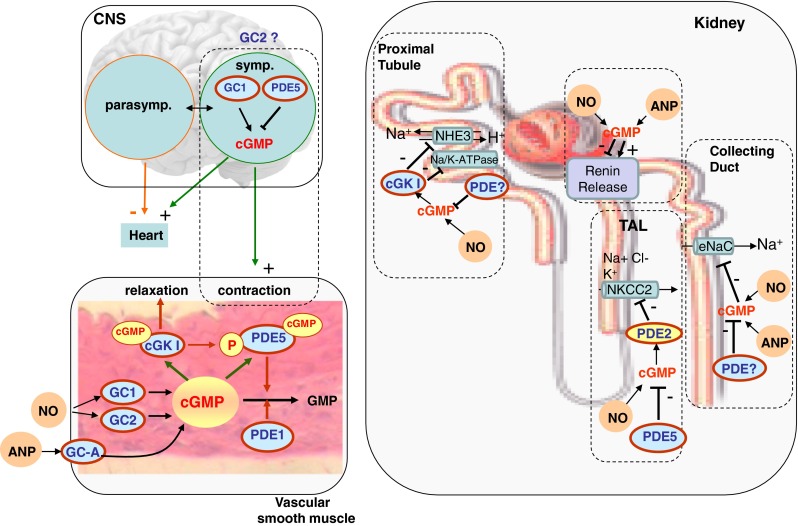
Cyclic GMP (cGMP) is a ubiquitous intracellular second messenger that mediates a wide spectrum of physiologic processes in multiple cell types within the cardiovascular and nervous systems. Synthesis of cGMP occurs either by NO-sensitive guanylyl cyclases in response to nitric oxide or by membrane-bound guanylyl cyclases in response to natriuretic peptides and has been shown to regulate blood pressure homeostasis by influencing vascular tone, sympathetic nervous system, and sodium and water handling in the kidney. Several cGMPs degrading phosphodiesterases (PDEs), including PDE1 and PDE5, play an important role in the regulation of cGMP signaling. Recent findings revealed that increased activity of cGMP-hydrolyzing PDEs contribute to the development of hypertension. In this review, we will summarize recent research findings regarding the cGMP/PDE signaling in the vasculature, the central nervous system, and the kidney which are associated with the development and maintenance of hypertension.
环磷酸鸟苷(cGMP)是一种普遍存在的细胞内第二信使,可介导心血管系统和神经系统中多种细胞类型的广泛生理过程。cGMP的合成可通过对一氧化氮敏感的鸟苷酸环化酶响应一氧化氮而发生,或通过膜结合鸟苷酸环化酶响应利钠肽而发生,并且已证明其通过影响血管张力、交感神经系统以及肾脏中的钠和水代谢来调节血压稳态。几种降解cGMP的磷酸二酯酶(PDE),包括PDE1和PDE5,在cGMP信号传导的调节中起重要作用。最近的研究发现,水解cGMP的PDE活性增加会导致高血压的发生。在这篇综述中,我们将总结关于血管系统、中枢神经系统和肾脏中与高血压的发生和维持相关的cGMP/PDE信号传导的最新研究发现。