Nutrition and Endocrine Research Center, Research Institute for Endocrine Sciences, Shahid Beheshti University of Medical Sciences, Tehran, Iran.
Department of Clinical Nutrition, Faculty of Nutrition Sciences and Food Technology, National Nutrition and Food Technology Research Institute, Shahid Beheshti University of Medical Sciences, Tehran, Iran.
Cell Death Dis. 2023 Jul 11;14(7):410. doi: 10.1038/s41419-023-05935-5.
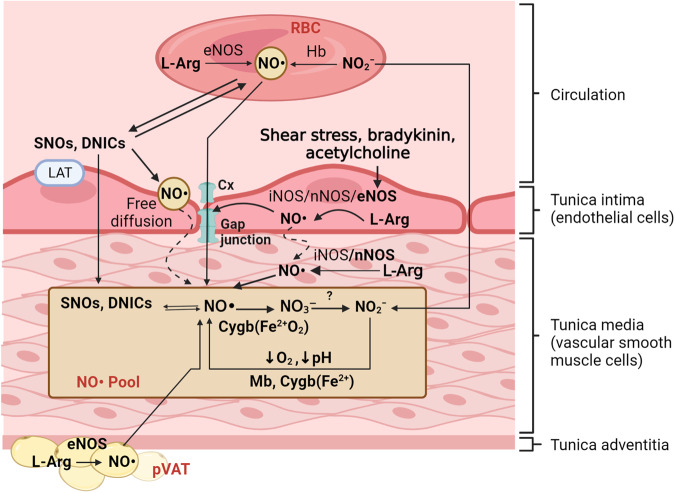
Vascular nitric oxide (NO•) resistance, manifested by an impaired vasodilator function of NO• in both the macro- and microvessels, is a common state in type 2 diabetes (T2D) associated with developing cardiovascular events and death. Here, we summarize experimental and human evidence of vascular NO• resistance in T2D and discuss its underlying mechanisms. Human studies indicate a ~ 13-94% decrease in the endothelium (ET)-dependent vascular smooth muscle (VSM) relaxation and a 6-42% reduced response to NO• donors, i.e., sodium nitroprusside (SNP) and glyceryl trinitrate (GTN), in patients with T2D. A decreased vascular NO• production, NO• inactivation, and impaired responsiveness of VSM to NO• [occurred due to quenching NO• activity, desensitization of its receptor soluble guanylate cyclase (sGC), and/or impairment of its downstream pathway, cyclic guanosine monophosphate (cGMP)-protein kinase G (PKG)] are the known mechanisms underlying the vascular NO• resistance in T2D. Hyperglycemia-induced overproduction of reactive oxygen species (ROS) and vascular insulin resistance are key players in this state. Therefore, upregulating vascular NO• availability, re-sensitizing or bypassing the non-responsive pathways to NO•, and targeting key vascular sources of ROS production may be clinically relevant pharmacological approaches to circumvent T2D-induced vascular NO• resistance.
血管一氧化氮(NO•)抵抗,表现为 NO•在大、小血管中的血管舒张功能受损,是 2 型糖尿病(T2D)的一种常见状态,与心血管事件和死亡的发生有关。在这里,我们总结了 T2D 中血管 NO•抵抗的实验和人体证据,并讨论了其潜在机制。人体研究表明,T2D 患者的内皮(ET)依赖性血管平滑肌(VSM)松弛减少了约 13-94%,对 NO•供体(如硝普钠(SNP)和三硝酸甘油酯(GTN)的反应降低了 6-42%。血管 NO•产生减少、NO•失活以及 VSM 对 NO•的反应性受损[由于 NO•活性淬灭、其受体可溶性鸟苷酸环化酶(sGC)脱敏和/或其下游途径(环鸟苷酸单磷酸(cGMP)-蛋白激酶 G(PKG))受损]是 T2D 中血管 NO•抵抗的已知机制。高血糖诱导的活性氧(ROS)产生过多和血管胰岛素抵抗是这种状态的关键因素。因此,增加血管 NO•的可用性、重新敏化或绕过对 NO•无反应的途径,以及针对关键的血管 ROS 产生源,可能是规避 T2D 诱导的血管 NO•抵抗的临床相关药理学方法。