Saad Nancy S, Floyd Kyle, Ahmed Amany A E, Mohler Peter J, Janssen Paul M L, Elnakish Mohammad T
Department of Physiology and Cell Biology, College of Medicine, The Ohio State University, Columbus, Ohio, United States of America.
Dorothy M. Davis Heart & Lung Research Institute, The Ohio State University, Columbus, Ohio, United States of America.
PLoS One. 2016 Apr 15;11(4):e0153694. doi: 10.1371/journal.pone.0153694. eCollection 2016.
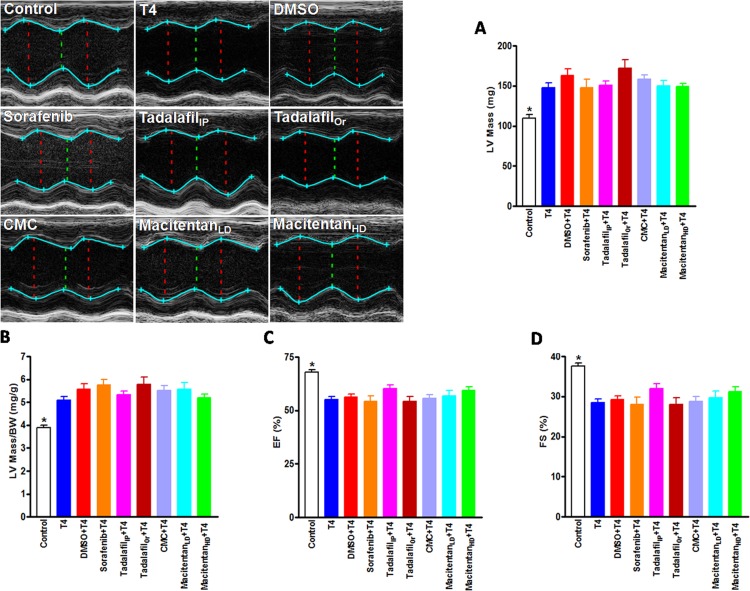
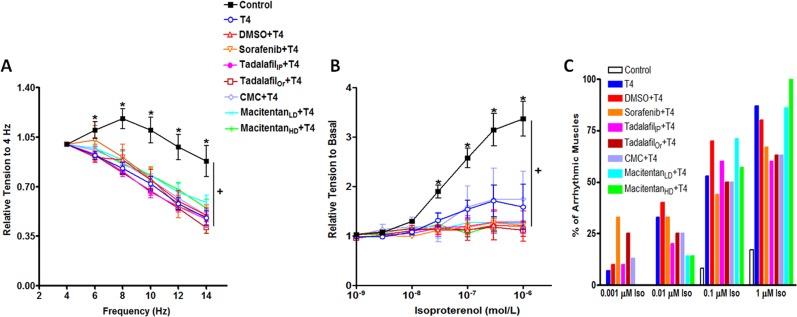
Multikinase inhibitors (e.g. Sorafenib), phosphodiesterase-5 inhibitors (e.g. Tadalafil), and endothelin-1 receptor blockers (e.g. Macitentan) exert influential protection in a variety of animal models of cardiomyopathy; however, their effects on thyroxin-induced cardiomyopathy have never been investigated. The goal of the present study was to assess the functional impact of these drugs on thyroxin-induced hemodynamic changes, cardiac hypertrophy and associated altered responses of the contractile myocardium both in-vivo at the whole heart level and ex-vivo at the cardiac tissue level. Control and thyroxin (500 μg/kg/day)-treated mice with or without 2-week treatments of sorafenib (10 mg/kg/day; I.P), tadalafil (1 mg/kg/day; I.P or 4 mg/kg/day; oral), macitentan (30 and 100 mg/kg/day; oral), and their vehicles were studied. Blood pressure, echocardiography and electrocardiogram were non-invasively evaluated, followed by ex-vivo assessments of isolated multicellular cardiac preparations. Thyroxin increased blood pressure, resulted in cardiac hypertrophy and left ventricular dysfunction in-vivo. Also, it caused contractile abnormalities in right ventricular papillary muscles ex-vivo. None of the drug treatments were able to significantly attenuate theses hemodynamic changes or cardiac abnormalities in thyroxin-treated mice. We show here for the first time that multikinase (raf1/b, VEGFR, PDGFR), phosphodiesterase-5, and endothelin-1 pathways have no major role in thyroxin-induced hemodynamic changes and cardiac abnormalities. In particular, our data show that the involvement of endothelin-1 pathway in thyroxine-induced cardiac hypertrophy/dysfunction seems to be model-dependent and should be carefully interpreted.
多激酶抑制剂(如索拉非尼)、磷酸二酯酶-5抑制剂(如他达拉非)和内皮素-1受体阻滞剂(如马西替坦)在多种心肌病动物模型中发挥显著的保护作用;然而,它们对甲状腺素诱导的心肌病的影响从未被研究过。本研究的目的是评估这些药物对甲状腺素诱导的血流动力学变化、心脏肥大以及收缩性心肌相关反应改变的功能影响,包括在体水平的全心和离体水平的心脏组织。研究了给予或未给予索拉非尼(10mg/kg/天;腹腔注射)、他达拉非(1mg/kg/天;腹腔注射或4mg/kg/天;口服)、马西替坦(30和100mg/kg/天;口服)及其溶剂处理2周的对照小鼠和甲状腺素(500μg/kg/天)处理的小鼠。对血压、超声心动图和心电图进行无创评估,随后对分离的多细胞心脏制剂进行离体评估。甲状腺素使血压升高,导致在体心脏肥大和左心室功能障碍。此外,它还导致离体右心室乳头肌收缩异常。在甲状腺素处理的小鼠中,没有一种药物治疗能够显著减轻这些血流动力学变化或心脏异常。我们首次在此表明,多激酶(raf1/b、VEGFR、PDGFR)、磷酸二酯酶-5和内皮素-1途径在甲状腺素诱导的血流动力学变化和心脏异常中没有主要作用。特别是,我们的数据表明,内皮素-1途径在甲状腺素诱导的心脏肥大/功能障碍中的参与似乎依赖于模型,应谨慎解读。