Liang Yuying, Pertzov Yoni, Nicholas Jennifer M, Henley Susie M D, Crutch Sebastian, Woodward Felix, Leung Kelvin, Fox Nick C, Husain Masud
Dementia Research Centre, Department of Neurodegenerative Diseases, UCL Institute of Neurology, London, UK.
Department of Psychology, The Hebrew University of Jerusalem, Israel.
Cortex. 2016 May;78:150-164. doi: 10.1016/j.cortex.2016.01.015. Epub 2016 Feb 6.
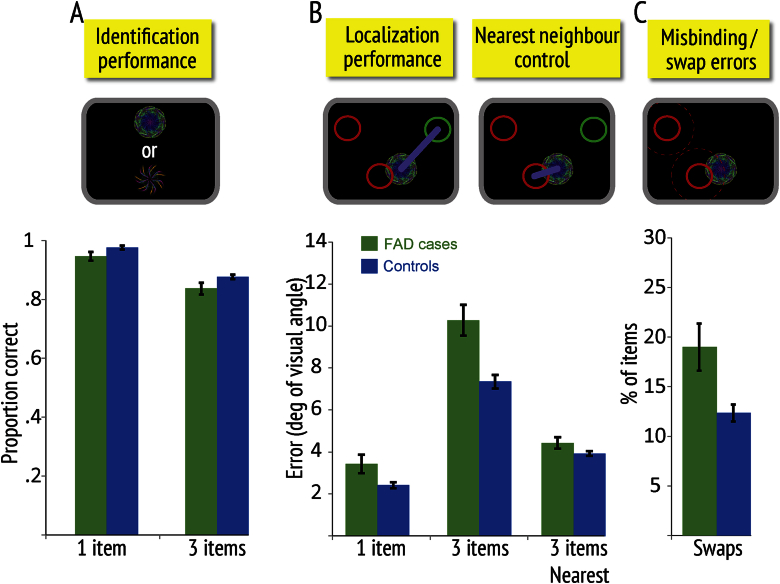
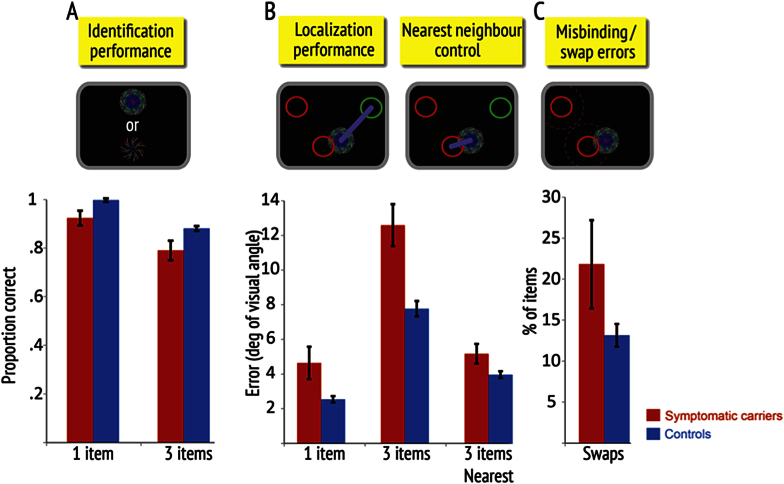
Long-term episodic memory deficits in Alzheimer's disease (AD) are well characterised but, until recently, short-term memory (STM) function has attracted far less attention. We employed a recently-developed, delayed reproduction task which requires participants to reproduce precisely the remembered location of items they had seen only seconds previously. This paradigm provides not only a continuous measure of localization error in memory, but also an index of relational binding by determining the frequency with which an object is misplaced to the location of one of the other items held in memory. Such binding errors in STM have previously been found on this task to be sensitive to medial temporal lobe (MTL) damage in focal lesion cases. Twenty individuals with pathological mutations in presenilin 1 or amyloid precursor protein genes for familial Alzheimer's disease (FAD) were tested together with 62 healthy controls. Participants were assessed using the delayed reproduction memory task, a standard neuropsychological battery and structural MRI. Overall, FAD mutation carriers were worse than controls for object identity as well as in gross localization memory performance. Moreover, they showed greater misbinding of object identity and location than healthy controls. Thus they would often mislocalize a correctly-identified item to the location of one of the other items held in memory. Significantly, asymptomatic gene carriers - who performed similarly to healthy controls on standard neuropsychological tests - had a specific impairment in object-location binding, despite intact memory for object identity and location. Consistent with the hypothesis that the hippocampus is critically involved in relational binding regardless of memory duration, decreased hippocampal volume across FAD participants was significantly associated with deficits in object-location binding but not with recall precision for object identity or localization. Object-location binding may therefore provide a sensitive cognitive biomarker for MTL dysfunction in a range of diseases including AD.
阿尔茨海默病(AD)患者的长期情景记忆缺陷已得到充分表征,但直到最近,短期记忆(STM)功能所受关注仍少得多。我们采用了一项最近开发的延迟再现任务,该任务要求参与者精确再现他们仅在几秒钟前看到的物品的记忆位置。这种范式不仅提供了对记忆中定位误差的连续测量,还通过确定一个物体被错误放置到记忆中其他物品位置之一的频率来提供关系绑定的指标。此前在局灶性病变病例中发现,STM中的这种绑定错误对内侧颞叶(MTL)损伤敏感。对20名患有家族性阿尔茨海默病(FAD)的早老素1或淀粉样前体蛋白基因病理性突变的个体与62名健康对照进行了测试。使用延迟再现记忆任务、标准神经心理测验组和结构MRI对参与者进行评估。总体而言,FAD突变携带者在物体识别以及总体定位记忆表现方面比对照组差。此外,他们在物体识别和位置的错误绑定方面比健康对照更严重。因此,他们经常会将正确识别的物品错误定位到记忆中其他物品的位置。值得注意的是,无症状基因携带者——在标准神经心理测试中表现与健康对照相似——尽管对物体识别和位置的记忆完好,但在物体-位置绑定方面存在特定损伤。与海马体无论记忆持续时间如何都在关系绑定中起关键作用的假设一致,FAD参与者海马体体积减小与物体-位置绑定缺陷显著相关,但与物体识别或定位的回忆精度无关。因此,物体-位置绑定可能为包括AD在内的一系列疾病中的MTL功能障碍提供一种敏感的认知生物标志物。