Fitzgerald Rhys, Owen Rebecca, Hargrave Catriona, Pryor David, Barry Tamara, Lehman Margot, Bernard Anne, Mai Tao, Seshadri Venkatakrishnan, Fielding Andrew
Radiation Oncology Centres Mater Private Hospital Springfield Queensland Australia; Science and Engineering Faculty Queensland University of Technology Brisbane Queensland Australia.
Faculty of Health Queensland University of Technology Brisbane Queensland Australia.
J Med Radiat Sci. 2016 Mar;63(1):23-30. doi: 10.1002/jmrs.156. Epub 2016 Jan 20.
The purpose of this study was to investigate coplanar and non-coplanar volumetric modulated arc therapy (VMAT) delivery techniques for stereotactic ablative radiation therapy (SABR) to the lung.
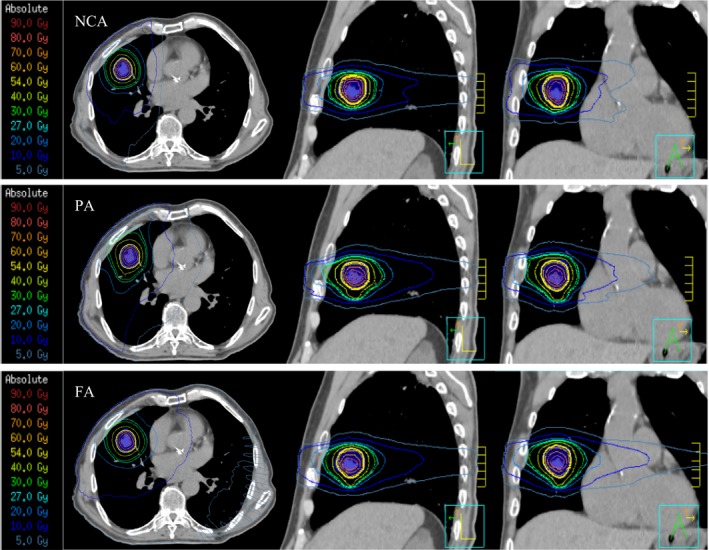
For ten patients who had already completed a course of radiation therapy for early stage lung cancer, three new SABR treatment plans were created using (1) a coplanar full arc (FA) technique, (2) a coplanar partial arc technique (PA) and (3) a non-coplanar technique utilising three partial arcs (NCA). These plans were evaluated using planning target volume (PTV) coverage, dose to organs at risk, and high and intermediate dose constraints as incorporated by radiation therapy oncology group (RTOG) 1021.
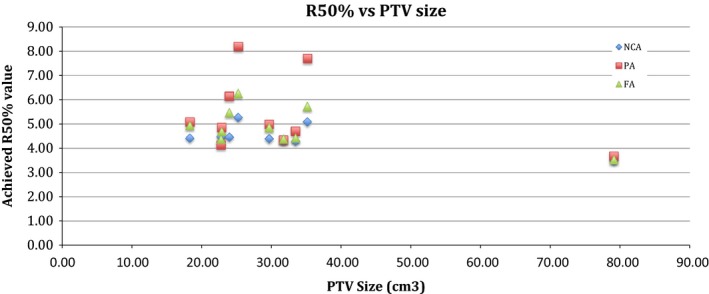
When the FA and PA techniques were compared to the NCA technique, on average the PTV coverage (V 54Gy) was similar (P = 0.15); FA (95.1%), PA (95.11%) and NCA (95.71%). The NCA resulted in a better conformity index (CI) of the prescription dose (0.89) when compared to the FA technique (0.88, P = 0.23) and the PA technique (0.83, P = 0.06). The NCA technique improved the intermediate dose constraints with a statistically significant difference for the D 2cm and R 50% when compared with the FA (P < 0.03 and <0.0001) and PA (P < 0.04 and <0.0001) techniques. The NCA technique reduced the maximum spinal cord dose by 2.72 and 4.2 Gy when compared to the PA and FA techniques respectively. Mean lung doses were 4.09, 4.31 and 3.98 Gy for the FA, PA and NCA techniques respectively.
The NCA VMAT technique provided the highest compliance to RTOG 1021 when compared to coplanar techniques for lung SABR. However, single FA coplanar VMAT was suitable for 70% of patients when minor deviations to both the intermediate dose and organ at risk (OAR) constraints were accepted.
本研究的目的是调查用于肺部立体定向消融放疗(SABR)的共面和非共面容积调强弧形放疗(VMAT)技术。
对于十名已完成早期肺癌放疗疗程的患者,使用以下方法创建了三个新的SABR治疗计划:(1)共面全弧(FA)技术,(2)共面部分弧技术(PA)和(3)使用三个部分弧的非共面技术(NCA)。这些计划使用计划靶区(PTV)覆盖范围、危及器官的剂量以及放射肿瘤学组(RTOG)1021纳入的高剂量和中剂量限制进行评估。
当将FA和PA技术与NCA技术进行比较时,平均PTV覆盖范围(V 54Gy)相似(P = 0.15);FA(95.1%)、PA(95.11%)和NCA(95.71%)。与FA技术(0.88,P = 0.23)和PA技术(0.83,P = 0.06)相比,NCA导致处方剂量的适形指数(CI)更好(0.89)。与FA(P < 0.03和<0.0001)和PA(P < 0.04和<0.0001)技术相比,NCA技术改善了中剂量限制,在D 2cm和R 50%方面具有统计学显著差异。与PA和FA技术相比,NCA技术分别将最大脊髓剂量降低了2.72 Gy和4.2 Gy。FA技术、PA技术和NCA技术的平均肺剂量分别为4.09 Gy、4.31 Gy和3.98 Gy。
与肺部SABR的共面技术相比,NCA VMAT技术对RTOG 1021的依从性最高。然而,当接受与中剂量和危及器官(OAR)限制的轻微偏差时,单一FA共面VMAT适用于70%的患者。