Winter Carla C, Katiyar Kritika S, Hernandez Nicole S, Song Yeri J, Struzyna Laura A, Harris James P, Cullen D Kacy
Center for Brain Injury & Repair, Department of Neurosurgery, Perelman School of Medicine, University of Pennsylvania, Philadelphia, PA, United States; Department of Bioengineering, School of Engineering and Applied Science, University of Pennsylvania, Philadelphia, PA, United States; Philadelphia Veterans Affairs Medical Center, Philadelphia, PA, United States.
Center for Brain Injury & Repair, Department of Neurosurgery, Perelman School of Medicine, University of Pennsylvania, Philadelphia, PA, United States; Philadelphia Veterans Affairs Medical Center, Philadelphia, PA, United States; School of Biomedical Engineering, Drexel University, Philadelphia, PA, United States.
Acta Biomater. 2016 Jul 1;38:44-58. doi: 10.1016/j.actbio.2016.04.021. Epub 2016 Apr 29.
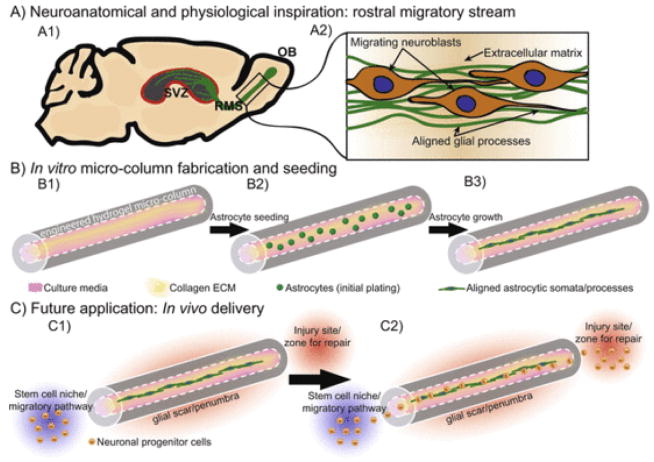
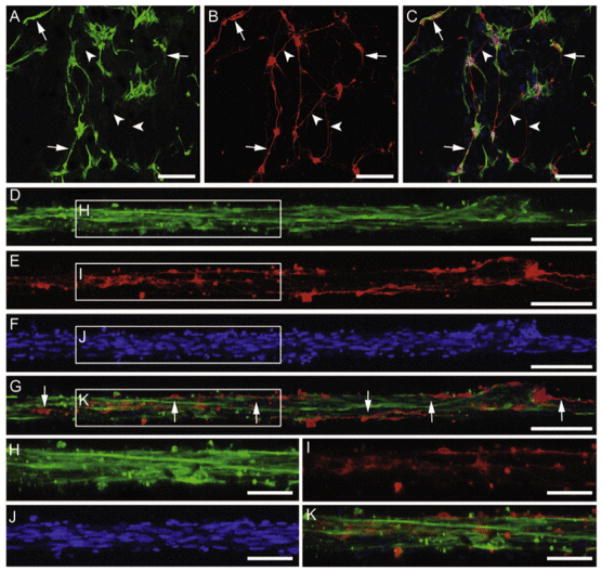
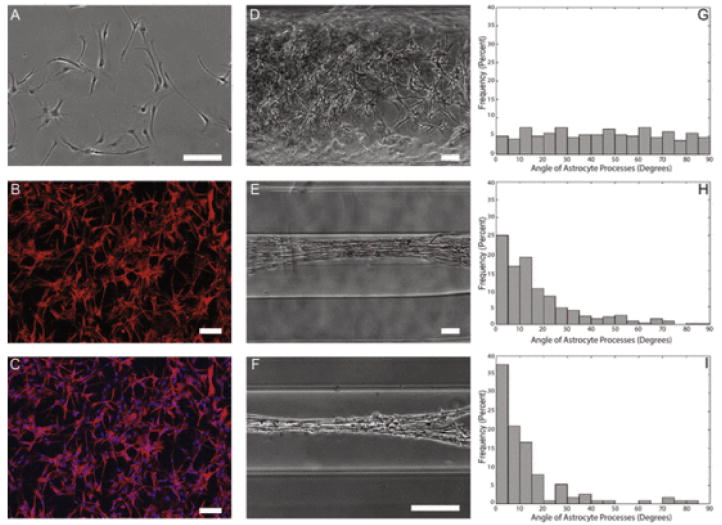
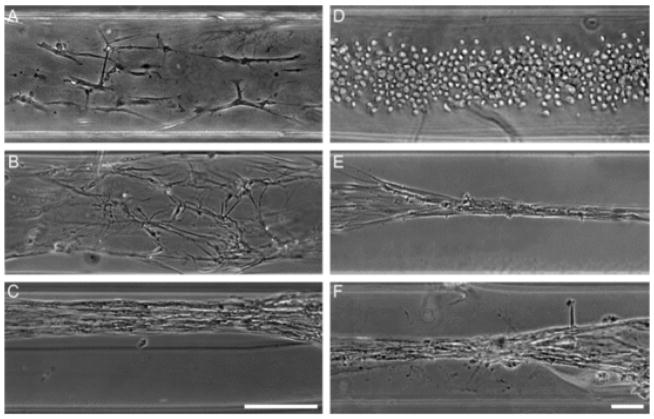
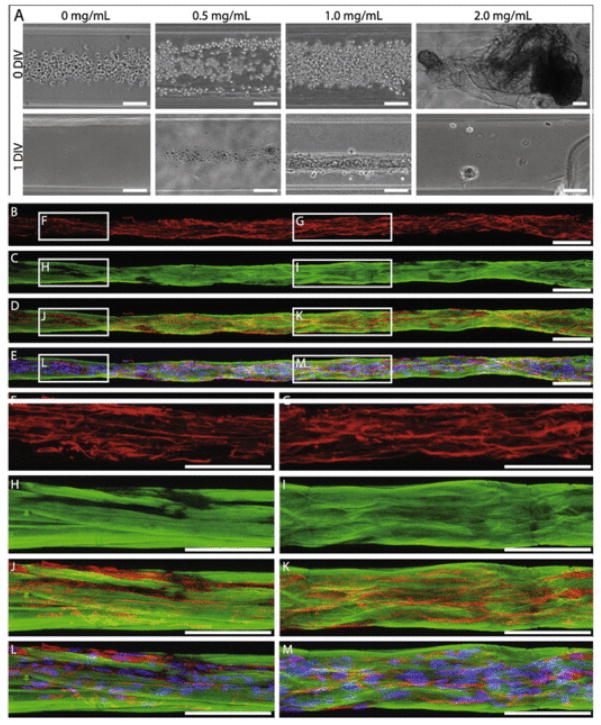
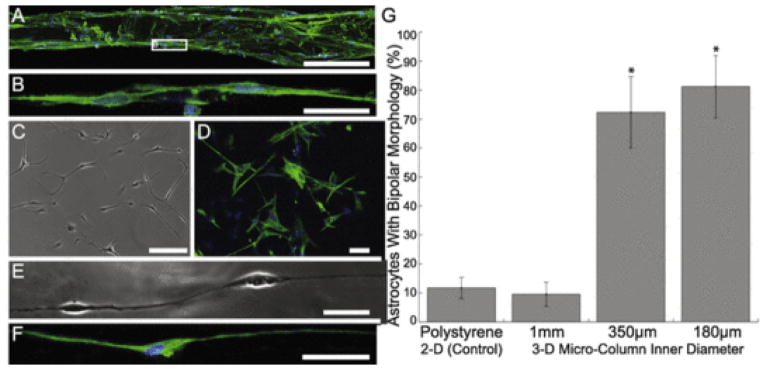
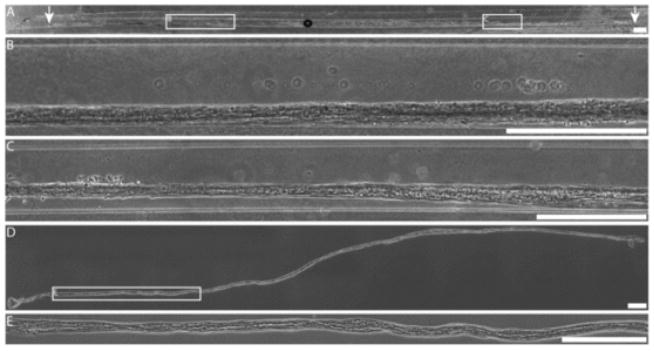
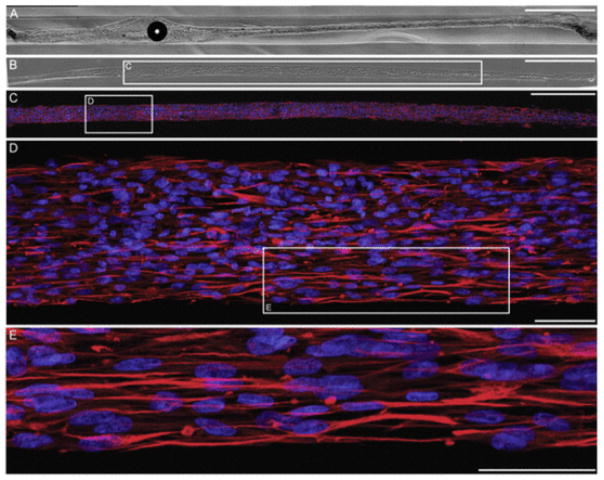
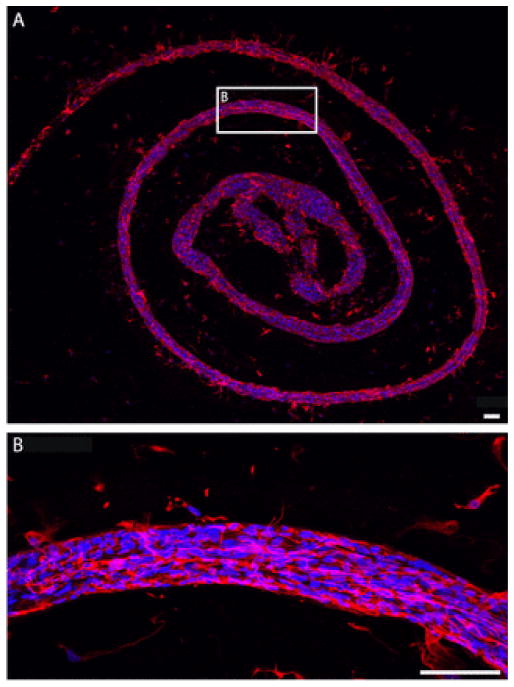
Neurotrauma, stroke, and neurodegenerative disease may result in widespread loss of neural cells as well as the complex interconnectivity necessary for proper central nervous system function, generally resulting in permanent functional deficits. Potential regenerative strategies involve the recruitment of endogenous neural stem cells and/or directed axonal regeneration through the use of tissue engineered "living scaffolds" built to mimic features of three-dimensional (3-D) in vivo migratory or guidance pathways. Accordingly, we devised a novel biomaterial encasement scheme using tubular hydrogel-collagen micro-columns that facilitated the self-assembly of seeded astrocytes into 3-D living scaffolds consisting of long, cable-like aligned astrocytic networks. Here, robust astrocyte alignment was achieved within a micro-column inner diameter (ID) of 180μm or 300-350μm but not 1.0mm, suggesting that radius of curvature dictated the extent of alignment. Moreover, within small ID micro-columns, >70% of the astrocytes assumed a bi-polar morphology, versus ∼10% in larger micro-columns or planar surfaces. Cell-cell interactions also influenced the aligned architecture, as extensive astrocyte-collagen contraction was achieved at high (9-12×10(5)cells/mL) but not lower (2-6×10(5)cells/mL) seeding densities. This high density micro-column seeding led to the formation of ultra-dense 3-D "bundles" of aligned bi-polar astrocytes within collagen measuring up to 150μm in diameter yet extending to a remarkable length of over 2.5cm. Importantly, co-seeded neurons extended neurites directly along the aligned astrocytic bundles, demonstrating permissive cues for neurite extension. These transplantable cable-like astrocytic networks structurally mimic the glial tube that guides neuronal progenitor migration in vivo along the rostral migratory stream, and therefore may be useful to guide progenitor cells to repopulate sites of widespread neurodegeneration.
This manuscript details our development of novel micro-tissue engineering techniques to generate robust networks of longitudinally aligned astrocytes within transplantable micro-column hydrogels. We report a novel biomaterial encasement scheme that facilitated the self-assembly of seeded astrocytes into long, aligned regenerative pathways. These miniature "living scaffold" constructs physically emulate the glial tube - a pathway in the brain consisting of aligned astrocytes that guide the migration of neuronal progenitor cells - and therefore may facilitate directed neuronal migration for central nervous system repair. The small size and self-contained design of these aligned astrocyte constructs will permit minimally invasive transplantation in models of central nervous system injury in future studies.
神经创伤、中风和神经退行性疾病可能导致神经细胞广泛丧失以及中枢神经系统正常功能所需的复杂相互连接性丧失,通常会导致永久性功能缺陷。潜在的再生策略包括募集内源性神经干细胞和/或通过使用组织工程“活体支架”来引导轴突再生,该“活体支架”被构建以模仿三维(3-D)体内迁移或引导途径的特征。因此,我们设计了一种新型生物材料包裹方案,使用管状水凝胶 - 胶原蛋白微柱,该微柱促进接种的星形胶质细胞自组装成由长的、电缆状排列的星形胶质细胞网络组成的3-D活体支架。在此,在180μm或300 - 350μm的微柱内径(ID)内实现了强大的星形胶质细胞排列,但在1.0mm内径时未实现,这表明曲率半径决定了排列程度。此外,在小内径微柱内,>70%的星形胶质细胞呈现双极形态,而在较大微柱或平面表面中这一比例约为10%。细胞 - 细胞相互作用也影响排列结构,因为在高接种密度(9 - 12×10⁵细胞/mL)下实现了广泛的星形胶质细胞 - 胶原蛋白收缩,而在低接种密度(2 - 6×10⁵细胞/mL)下未实现。这种高密度微柱接种导致在胶原蛋白内形成直径达150μm但长度超过2.5cm的超密集3-D双极星形胶质细胞“束”。重要的是,共接种的神经元直接沿着排列的星形胶质细胞束延伸神经突,表明对神经突延伸有允许性线索。这些可移植的电缆状星形胶质细胞网络在结构上模仿了胶质管,胶质管在体内沿着嘴侧迁移流引导神经元祖细胞迁移,因此可能有助于引导祖细胞重新填充广泛神经退行性变的部位。
本手稿详细介绍了我们开发的新型微组织工程技术,以在可移植的微柱水凝胶内生成强大的纵向排列的星形胶质细胞网络。我们报告了一种新型生物材料包裹方案,该方案促进接种的星形胶质细胞自组装成长的、排列的再生途径。这些微型“活体支架”构建体在物理上模拟了胶质管——大脑中由排列的星形胶质细胞组成的引导神经元祖细胞迁移的途径——因此可能有助于定向神经元迁移以进行中枢神经系统修复。这些排列的星形胶质细胞构建体的小尺寸和自成一体的设计将允许在未来研究的中枢神经系统损伤模型中进行微创移植。