Wendell Carrington R, Waldstein Shari R, Evans Michele K, Zonderman Alan B
Department of Psychology, University of Maryland, Baltimore County, USA; Laboratory of Epidemiology and Population Sciences, Intramural Research Program, National Institute on Aging, NIH, USA.
Department of Psychology, University of Maryland, Baltimore County, USA; Division of Gerontology & Geriatric Medicine, Department of Medicine, University of Maryland School of Medicine, USA; Geriatric Research Education and Clinical Center, Baltimore VA Medical Center, USA.
Atherosclerosis. 2016 Jun;249:125-31. doi: 10.1016/j.atherosclerosis.2016.04.009. Epub 2016 Apr 8.
Examine age, sex, race, and socioeconomic status as modifiers of the association between carotid intimal medial thickness (IMT) and neurocognitive performance in a socioeconomically diverse, biracial, urban, adult population.
Participants were 1712 community-dwelling adults (45% men, 56% African-American, 38% below poverty threshold, aged 30-64 years) enrolled in the Healthy Aging in Neighborhoods of Diversity across the Life Span (HANDLS) study. Participants underwent initial carotid ultrasonography followed by cognitive testing on up to two occasions over 4 years. Mixed-effects regression analyses were adjusted for demographic, behavioral, and biomedical covariates.
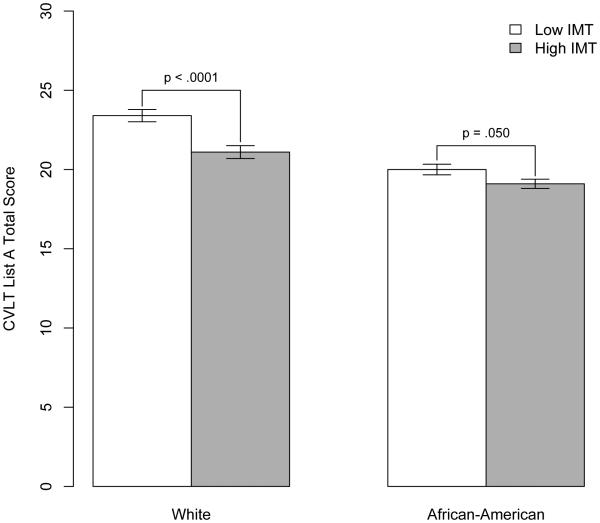
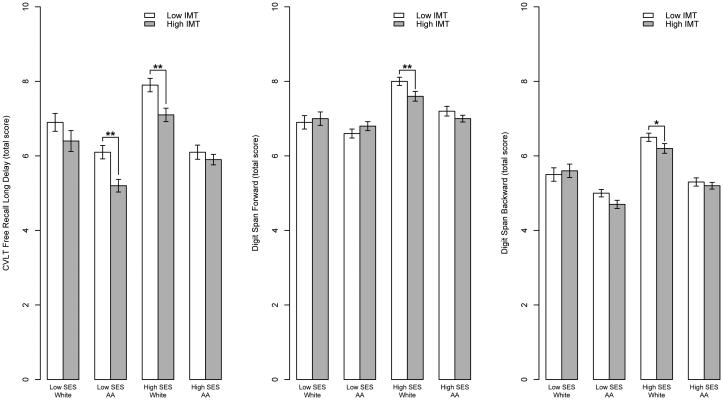
Significant cross-sectional IMT × race × poverty interactions were identified for measures of delayed recall memory, auditory-verbal attention, and working memory. An IMT × race interaction also appeared for auditory-verbal learning. Higher IMT was generally associated with worse cognitive performance, but the disadvantage was most pronounced among those with higher socioeconomic status and white participants. No longitudinal associations were identified.
Carotid IMT-cognition associations differed as a function of race and socioeconomic status and were most compelling for measures of attention, executive function, and memory. These findings highlight the possibility that subclinical atherosclerosis may be differentially informative as a predictor of cognitive performance among varied demographic subgroups.
在一个社会经济背景多样、包含两个种族的城市成年人群体中,研究年龄、性别、种族和社会经济地位作为颈动脉内膜中层厚度(IMT)与神经认知功能之间关联的调节因素。
参与者为1712名社区居住成年人(45%为男性,56%为非裔美国人,38%低于贫困线,年龄在30 - 64岁之间),他们参与了“全生命周期邻里多样性健康老龄化”(HANDLS)研究。参与者首先接受颈动脉超声检查,随后在4年时间里进行了多达两次的认知测试。混合效应回归分析对人口统计学、行为学和生物医学协变量进行了调整。
在延迟回忆记忆、听觉语言注意力和工作记忆测量中发现了显著的横断面IMT×种族×贫困交互作用。在听觉语言学习方面也出现了IMT×种族交互作用。较高的IMT通常与较差的认知表现相关,但这种劣势在社会经济地位较高的人群和白人参与者中最为明显。未发现纵向关联。
颈动脉IMT与认知的关联因种族和社会经济地位而异,在注意力、执行功能和记忆测量方面最为显著。这些发现凸显了亚临床动脉粥样硬化作为不同人口统计学亚组认知表现预测指标可能具有不同信息价值的可能性。