Ailabouni Nagham J, Nishtala Prasad S, Mangin Dee, Tordoff June M
School of Pharmacy, University of Otago, Dunedin, New Zealand.
David Braley Chair in Family Medicine, McMaster University, Hamilton, Canada and University of Otago, Christchurch, New Zealand.
PLoS One. 2016 Apr 19;11(4):e0151066. doi: 10.1371/journal.pone.0151066. eCollection 2016.
Deprescribing is the process of reducing or discontinuing medicines that are unnecessary or deemed to be harmful. We aimed to investigate general practitioner (GP) perceived challenges to deprescribing in residential care and the possible enablers that support GPs to implement deprescribing.
A qualitative study was undertaken using semi-structured, face-to-face interviews from two cities in New Zealand and a purpose-developed pilot-tested interview schedule. Interviews were recorded with permission and transcribed verbatim. Transcripts were read and re-read and themes were identified with iterative building of a coding list until all data was accounted for. Interviews continued until saturation of ideas occurred. Analysis was carried out with the assistance of a Theoretical Domains Framework (TDF) and constant comparison techniques. Several themes were identified. Challenges and enablers of deprescribing were determined based on participants' answers.
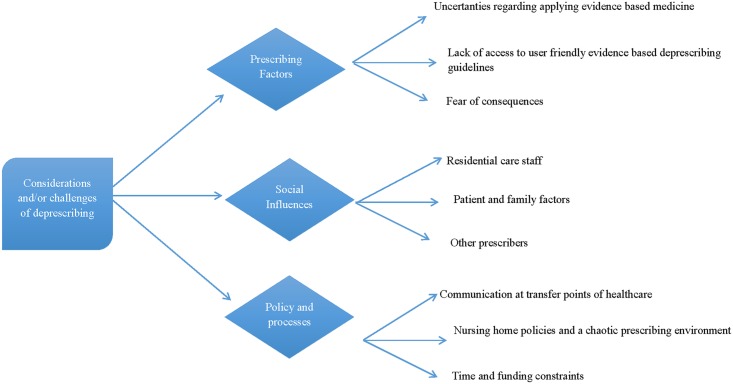
Ten GPs agreed to participate. Four themes were identified to define the issues around prescribing for older people, from the GPs' perspectives. Theme 1, the 'recognition of the problem', discusses the difficulties involved with prescribing for older people. Theme 2 outlines the identified behaviour change factors relevant to the problem. Deprescribing challenges were drawn from these factors and summarised in Theme 3 under three major headings; 'prescribing factors', 'social influences' and 'policy and processes'. Deprescribing enablers, based on the opinions and professional experience of GPs, were retrieved and summarised in Theme 4.
The process of deprescribing is laced with many challenges for GPs. The uncertainty of research evidence in older people and social factors such as specialists' and nurses' influences were among the major challenges identified. Deprescribing enablers encompassed support for GPs' awareness and knowledge, improvement of communication between multiple prescribers, adequate reimbursement and pharmacists being involved in the multidisciplinary team.
减药是指减少或停用不必要或被认为有害的药物的过程。我们旨在调查全科医生(GP)在机构护理中对减药所感知到的挑战以及支持全科医生实施减药的可能促进因素。
采用定性研究方法,对来自新西兰两个城市的全科医生进行半结构化面对面访谈,并使用专门设计并经过预测试的访谈提纲。经许可对访谈进行录音并逐字转录。对转录文本反复阅读,通过迭代构建编码列表来识别主题,直至涵盖所有数据。访谈持续进行直至观点饱和。在理论领域框架(TDF)和持续比较技术的协助下进行分析。确定了几个主题。根据参与者的回答确定了减药的挑战和促进因素。
10名全科医生同意参与。从全科医生的角度确定了四个主题来界定老年人用药方面的问题。主题1“对问题的认识”讨论了为老年人用药所涉及的困难。主题2概述了与该问题相关的已确定的行为改变因素。减药挑战源自这些因素,并在主题3中归纳为三个主要标题;“用药因素”、“社会影响”和“政策与流程”。基于全科医生的意见和专业经验,提取并在主题4中总结了减药促进因素。
减药过程给全科医生带来了诸多挑战。老年人研究证据的不确定性以及专家和护士影响等社会因素是所确定的主要挑战。减药促进因素包括支持全科医生的意识和知识、改善多名开处方者之间的沟通、充足的报销以及药剂师参与多学科团队。