Anderson Kristen, Stowasser Danielle, Freeman Christopher, Scott Ian
Centre of Research Excellence in Quality & Safety in Integrated Primary-Secondary Care, School of Medicine, The University of Queensland, Brisbane, Queensland, Australia Charming Institute, Camp Hill, Brisbane, Queensland, Australia.
School of Pharmacy, The University of Queensland, Brisbane, Queensland, Australia.
BMJ Open. 2014 Dec 8;4(12):e006544. doi: 10.1136/bmjopen-2014-006544.
To synthesise qualitative studies that explore prescribers' perceived barriers and enablers to minimising potentially inappropriate medications (PIMs) chronically prescribed in adults.
A qualitative systematic review was undertaken by searching PubMed, EMBASE, Scopus, PsycINFO, CINAHL and INFORMIT from inception to March 2014, combined with an extensive manual search of reference lists and related citations. A quality checklist was used to assess the transparency of the reporting of included studies and the potential for bias. Thematic synthesis identified common subthemes and descriptive themes across studies from which an analytical construct was developed. Study characteristics were examined to explain differences in findings.
All healthcare settings.
Medical and non-medical prescribers of medicines to adults.
Prescribers' perspectives on factors which shape their behaviour towards continuing or discontinuing PIMs in adults.
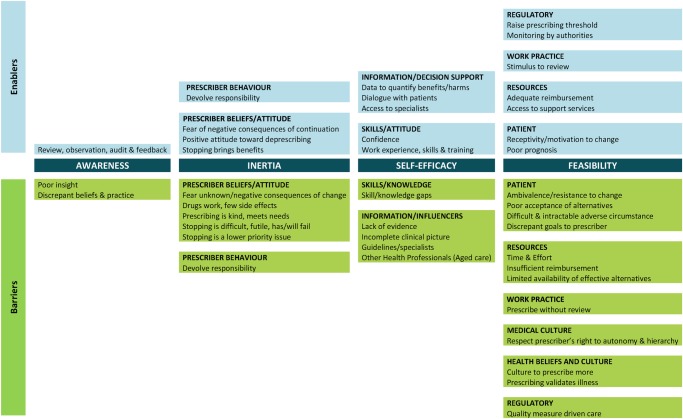
21 studies were included; most explored primary care physicians' perspectives on managing older, community-based adults. Barriers and enablers to minimising PIMs emerged within four analytical themes: problem awareness; inertia secondary to lower perceived value proposition for ceasing versus continuing PIMs; self-efficacy in regard to personal ability to alter prescribing; and feasibility of altering prescribing in routine care environments given external constraints. The first three themes are intrinsic to the prescriber (eg, beliefs, attitudes, knowledge, skills, behaviour) and the fourth is extrinsic (eg, patient, work setting, health system and cultural factors). The PIMs examined and practice setting influenced the themes reported.
A multitude of highly interdependent factors shape prescribers' behaviour towards continuing or discontinuing PIMs. A full understanding of prescriber barriers and enablers to changing prescribing behaviour is critical to the development of targeted interventions aimed at deprescribing PIMs and reducing the risk of iatrogenic harm.
综合定性研究,探讨开处方者在减少成人长期使用的潜在不适当药物(PIM)方面所感知到的障碍和促成因素。
通过检索PubMed、EMBASE、Scopus、PsycINFO、CINAHL和INFORMIT数据库,从建库至2014年3月进行定性系统评价,并结合对参考文献列表和相关引文的广泛手工检索。使用质量清单评估纳入研究报告的透明度和偏倚可能性。主题综合确定了各研究中的共同子主题和描述性主题,并据此构建了一个分析框架。研究特征经审查以解释研究结果的差异。
所有医疗环境。
为成人开处方的医学和非医学开处方者。
纳入21项研究;大多数研究探讨了基层医疗医生对管理社区老年成人的看法。减少PIM的障碍和促成因素出现在四个分析主题中:问题意识;因停止使用PIM与继续使用PIM相比感知价值主张较低而产生的惯性;个人改变处方能力方面的自我效能感;以及在外部限制条件下常规护理环境中改变处方的可行性。前三个主题是开处方者内在的(如信念、态度、知识、技能、行为),第四个主题是外在的(如患者、工作环境、卫生系统和文化因素)。所研究的PIM和实践环境影响了所报告的主题。
众多高度相互依存的因素塑造了开处方者在继续或停止使用PIM方面的行为。全面了解开处方者改变处方行为的障碍和促成因素对于制定旨在减少PIM使用和降低医源性伤害风险的针对性干预措施至关重要。