Jönsson Bror F, Watson James R
Department of Geosciences, Princeton University, Princeton, New Jersey 08544, USA.
College of Earth, Ocean and Atmospheric Sciences, Oregon State University, Corvallis, Oregon 97331-5503, USA.
Nat Commun. 2016 Apr 19;7:11239. doi: 10.1038/ncomms11239.
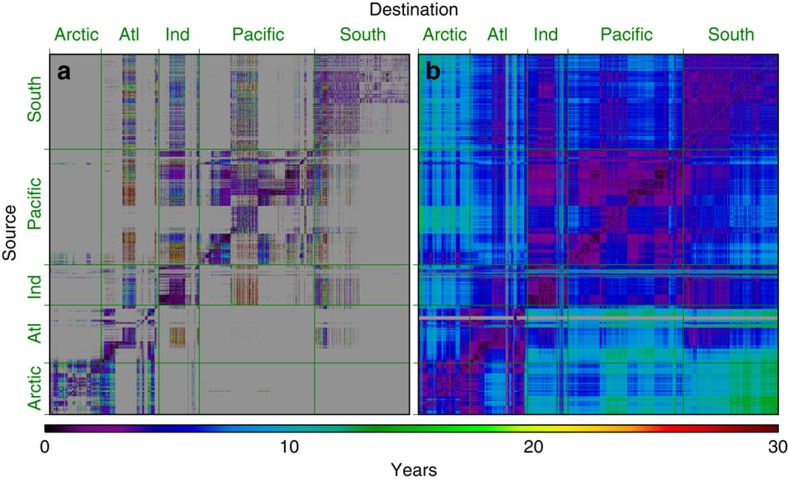
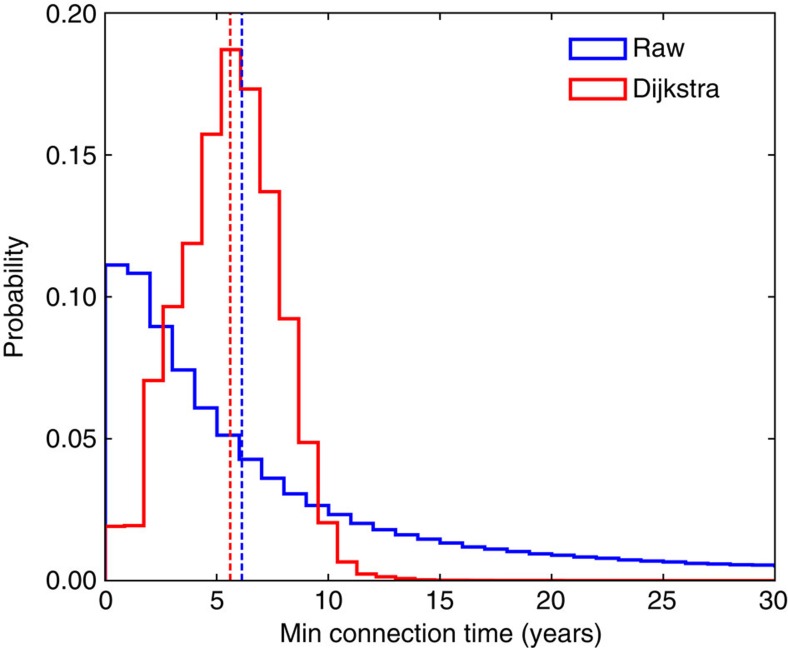
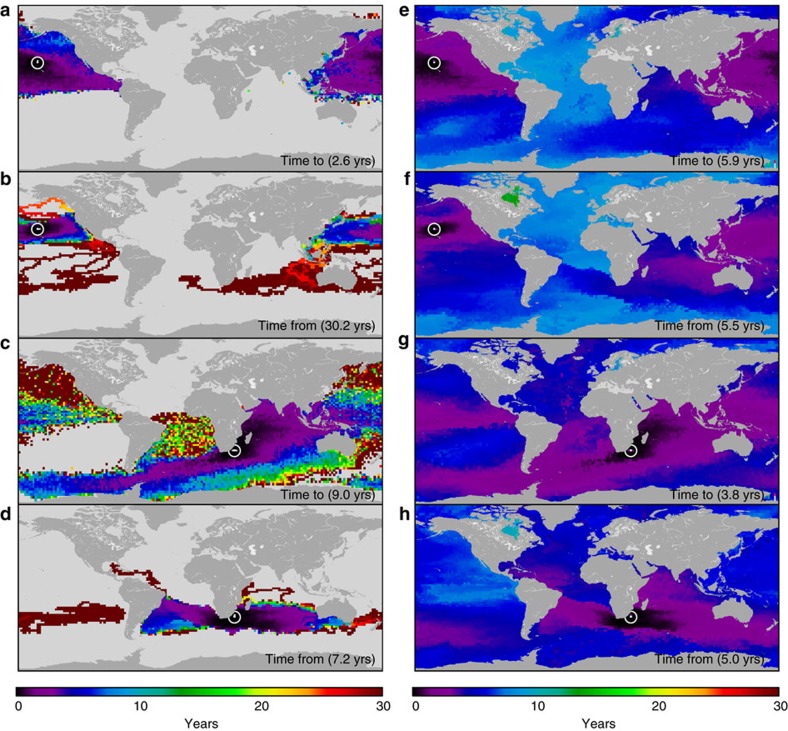
Planktonic communities are shaped through a balance of local evolutionary adaptation and ecological succession driven in large part by migration. The timescales over which these processes operate are still largely unresolved. Here we use Lagrangian particle tracking and network theory to quantify the timescale over which surface currents connect different regions of the global ocean. We find that the fastest path between two patches--each randomly located anywhere in the surface ocean--is, on average, less than a decade. These results suggest that marine planktonic communities may keep pace with climate change--increasing temperatures, ocean acidification and changes in stratification over decadal timescales--through the advection of resilient types.
浮游生物群落是通过局部进化适应和生态演替之间的平衡形成的,而这种平衡在很大程度上是由迁移驱动的。这些过程运作的时间尺度在很大程度上仍未得到解决。在这里,我们使用拉格朗日粒子追踪和网络理论来量化表面洋流连接全球海洋不同区域的时间尺度。我们发现,两个斑块(每个斑块随机位于海洋表面的任何位置)之间的最快路径平均不到十年。这些结果表明,海洋浮游生物群落可能通过适应性强的类型的平流,在十年时间尺度上跟上气候变化的步伐,包括气温上升、海洋酸化和分层变化。