Pereira Jussyêgles Niedja da Paz, Rabelo Marcelle Aquino, Lima Jailton Lobo da Costa, Neto Armando Monteiro Bezerra, Lopes Ana Catarina de Souza, Maciel Maria Amélia Vieira
Department of Tropical Medicine, Universidade Federal de Pernambuco, Recife, PE, Brasil.
Department of Tropical Medicine, Universidade Federal de Pernambuco, Recife, PE, Brasil.
Braz J Infect Dis. 2016 May-Jun;20(3):276-81. doi: 10.1016/j.bjid.2016.03.003. Epub 2016 Apr 16.
There is a mechanism of macrolide resistance in Staphylococcus spp. which also affects the lincosamides and type B streptogramins characterizing the so-called MLSB resistance, whose expression can be constitutive (cMLSB) or inducible (iMLSB) and is encoded mainly by ermA and ermC genes. The cMLSB resistance is easily detected by susceptibility testing used in the laboratory routine, but iMLSB resistance is not. Therapy with clindamycin in cases of infection with isolated iMLSB resistance may fail.
To characterize the phenotypic (occurrence of cMLSB and iMLSB phenotypes) and molecular (occurrence of ermA and ermC genes) profiles of MLSB resistance of clinical isolates of susceptible and methicillin-resistant Staphylococcus aureus and CNS (coagulase-negative Staphylococcus) from patients of a university hospital, in Pernambuco.
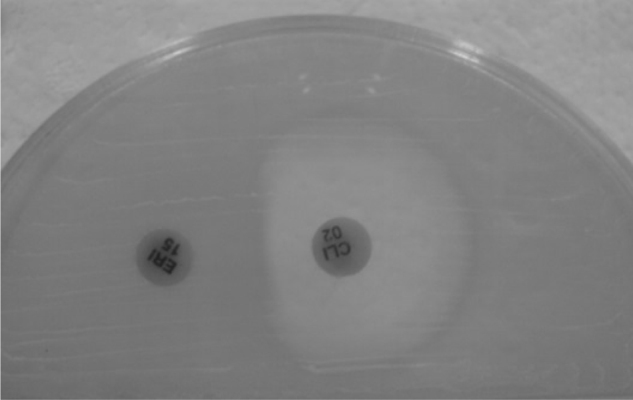
The antimicrobial susceptibility of 103 isolates was determined by the disk diffusion technique in Mueller-Hinton agar followed by oxacillin screening. The iMLSB phenotype was detected by D test. Isolates with cMLSB and iMLSB phenotypes were subjected to polymerase chain reaction (PCR) for the detection of ermA and ermC genes.
The cMLSB and iMLSB phenotypes were respectively identified in 39 (37.9%) and five (4.9%) isolates. The iMLSB phenotype was found only in four (10.8%) methicillin-susceptible S. aureus and one (4.5%) methicillin-resistant S. aureus. In the 44 isolates subjected to PCR, four (9.1%) only ermA gene was detected, a lower frequency when compared to only ermC 17 (38.6%) gene and to one (2.3%) isolate presenting both genes.
In the Staphylococcus spp. analyzed, the ermC gene was found more often than the ermA, although the iMLSB phenotype had been less frequent than the cMLSB. It was important to perform the D test for its detection to guide therapeutic approaches.
葡萄球菌属存在一种大环内酯类耐药机制,该机制也会影响林可酰胺类和B型链阳菌素,其特征为所谓的MLSB耐药,其表达可以是组成型(cMLSB)或诱导型(iMLSB),主要由ermA和ermC基因编码。实验室常规药敏试验很容易检测到cMLSB耐药,但iMLSB耐药则不然。在分离出iMLSB耐药的感染病例中,使用克林霉素治疗可能会失败。
对伯南布哥州一家大学医院患者的敏感和耐甲氧西林金黄色葡萄球菌及凝固酶阴性葡萄球菌(CNS)临床分离株的MLSB耐药的表型(cMLSB和iMLSB表型的出现情况)和分子特征(ermA和ermC基因的出现情况)进行表征。
采用纸片扩散法在穆勒-欣顿琼脂中测定103株分离株的抗菌药敏性,随后进行苯唑西林筛选。通过D试验检测iMLSB表型。对具有cMLSB和iMLSB表型的分离株进行聚合酶链反应(PCR)以检测ermA和ermC基因。
分别在39株(37.9%)和5株(4.9%)分离株中鉴定出cMLSB和iMLSB表型。仅在4株(10.8%)甲氧西林敏感金黄色葡萄球菌和1株(4.5%)耐甲氧西林金黄色葡萄球菌中发现iMLSB表型。在进行PCR的44株分离株中,检测到4株(9.1%)仅含有ermA基因,与仅含有ermC基因的17株(38.6%)以及同时含有这两种基因的1株(2.3%)分离株相比,频率较低。
在所分析的葡萄球菌属中,尽管iMLSB表型的频率低于cMLSB,但ermC基因的出现频率高于ermA。进行D试验以检测iMLSB表型对于指导治疗方法很重要。