Powell Curtis, Cornblath Eli, Elsaeidi Fairouz, Wan Jin, Goldman Daniel
Molecular and Behavioral Neuroscience Institute, Department of Biological Chemistry, University of Michigan, Ann Arbor, MI 48109 USA.
Sci Rep. 2016 Apr 20;6:24851. doi: 10.1038/srep24851.
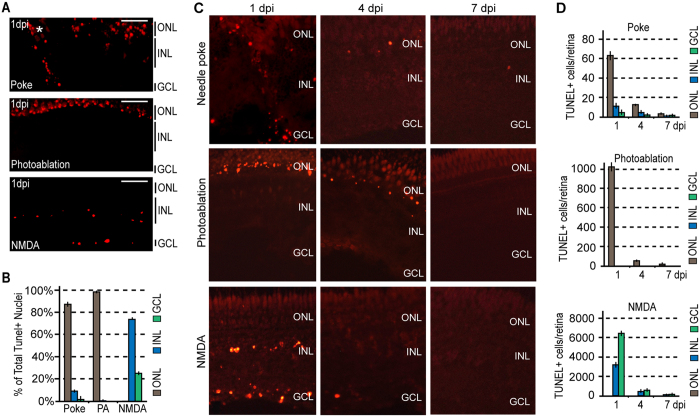
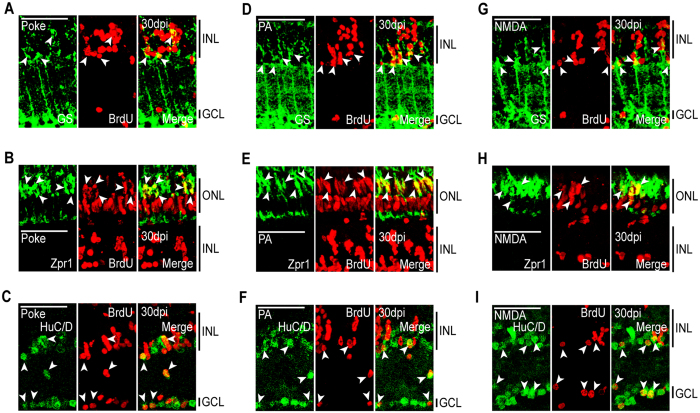
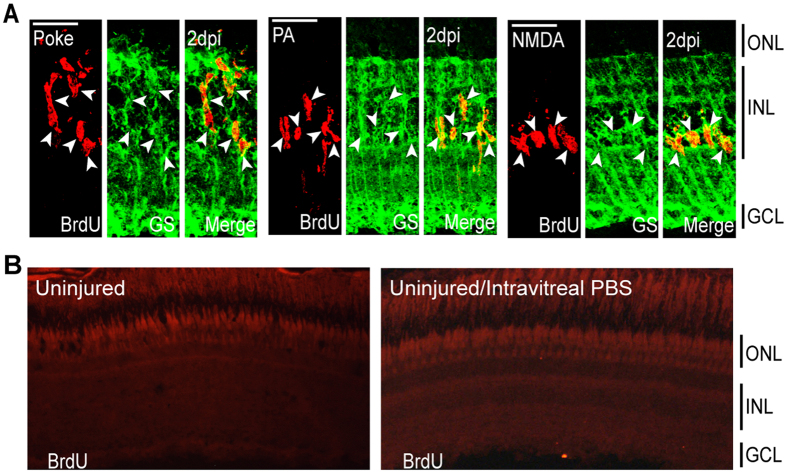
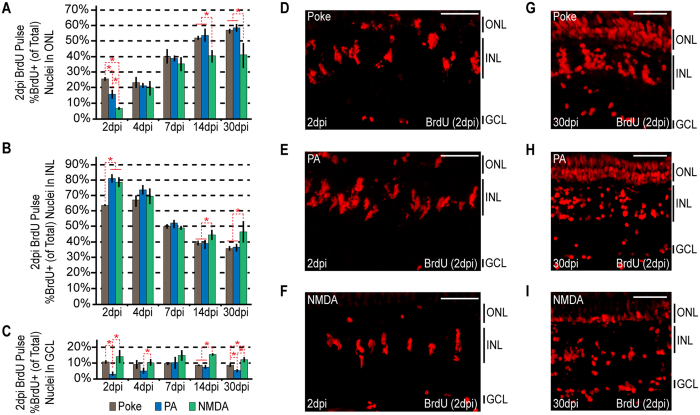
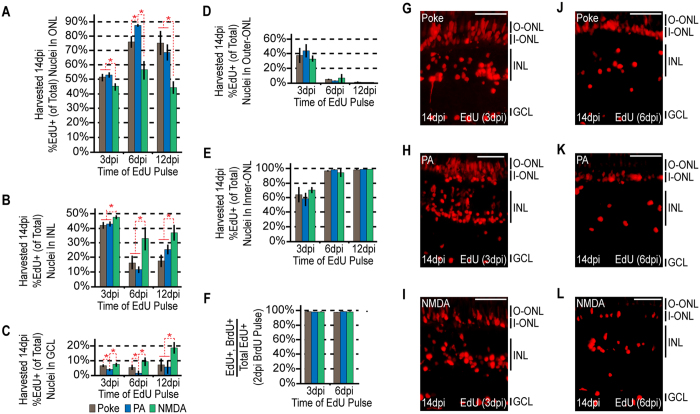
Unlike mammals, zebrafish can regenerate a damaged retina. Key to this regenerative response are Müller glia (MG) that respond to injury by reprogramming and adopting retinal stem cell properties. These reprogrammed MG divide to produce a proliferating population of retinal progenitors that migrate to areas of retinal damage and regenerate lost neurons. Previous studies have suggested that MG-derived progenitors may be biased to produce that are lost with injury. Here we investigated MG multipotency using injury paradigms that target different retinal nuclear layers for cell ablation. Our data indicate that regardless of which nuclear layer was damaged, MG respond by generating multipotent progenitors that migrate to all nuclear layers and differentiate into layer-specific cell types, suggesting that MG-derived progenitors in the injured retina are intrinsically multipotent. However, our analysis of progenitor proliferation reveals a proliferative advantage in nuclear layers where neurons were ablated. This suggests that feedback inhibition from surviving neurons may skew neuronal regeneration towards ablated cell types.
与哺乳动物不同,斑马鱼能够再生受损的视网膜。这种再生反应的关键是穆勒胶质细胞(MG),它们通过重新编程并获得视网膜干细胞特性来对损伤做出反应。这些重新编程的MG进行分裂,产生一群增殖的视网膜祖细胞,这些祖细胞迁移到视网膜损伤区域并再生丢失的神经元。先前的研究表明,MG衍生的祖细胞可能倾向于产生因损伤而丢失的细胞。在这里,我们使用针对不同视网膜核层进行细胞消融的损伤模型来研究MG的多能性。我们的数据表明,无论哪个核层受损,MG都会通过产生多能祖细胞做出反应,这些祖细胞迁移到所有核层并分化为层特异性细胞类型,这表明受损视网膜中MG衍生的祖细胞本质上是多能的。然而,我们对祖细胞增殖的分析揭示了神经元被消融的核层中存在增殖优势。这表明存活神经元的反馈抑制可能会使神经元再生偏向于被消融的细胞类型。