Department of Biological Sciences, University of Idaho, Moscow, Idaho; Department of Biological Sciences, Graduate Program in Neuroscience, University of Idaho, Moscow, Idaho.
Dev Neurobiol. 2014 Sep;74(9):851-76. doi: 10.1002/dneu.22167. Epub 2014 Feb 18.
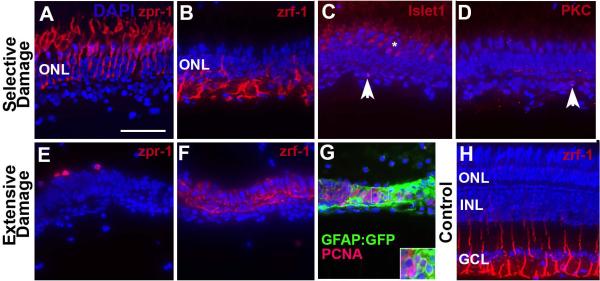
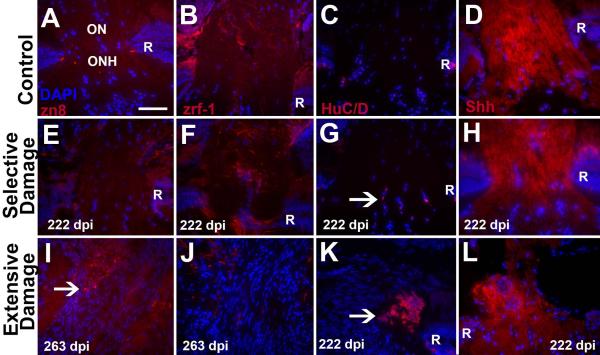
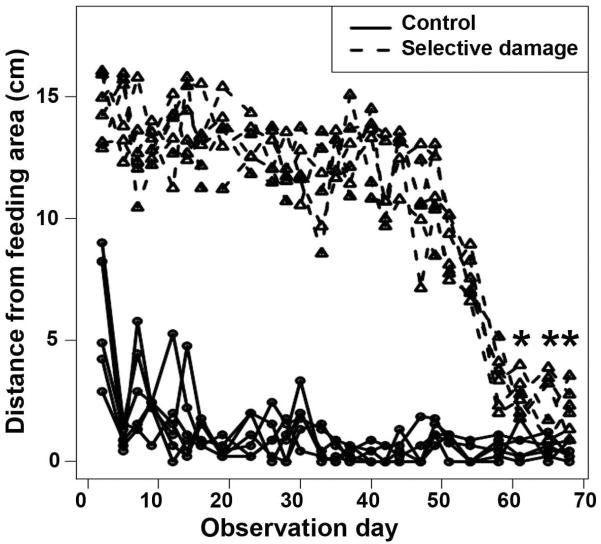
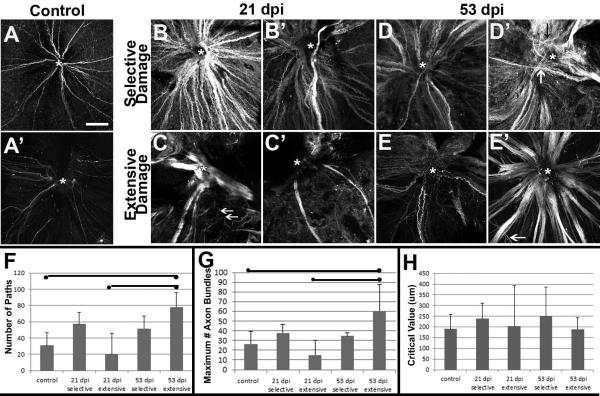
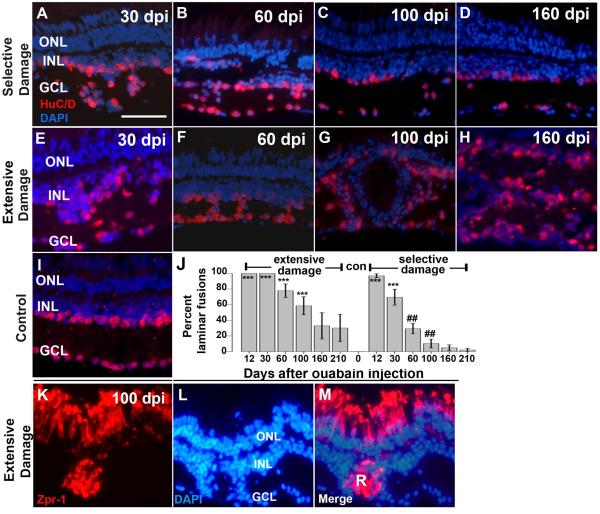
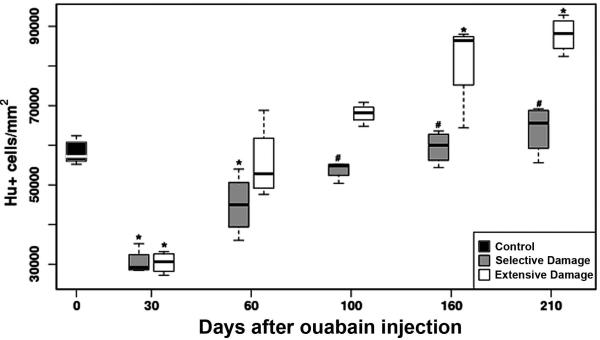
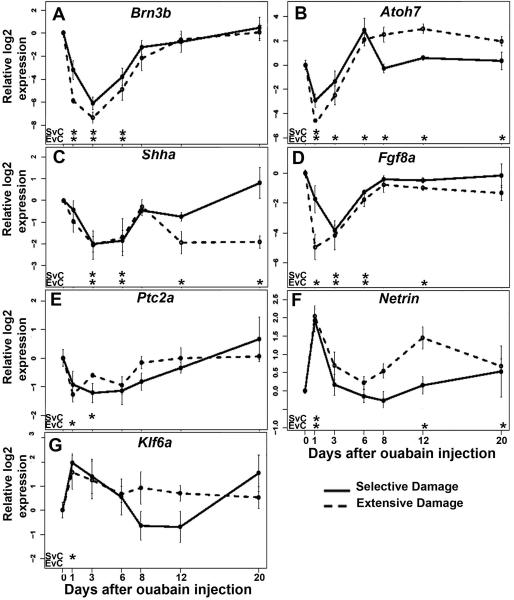
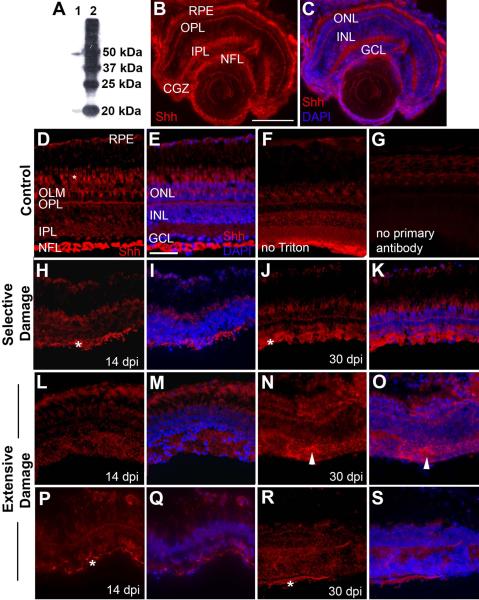
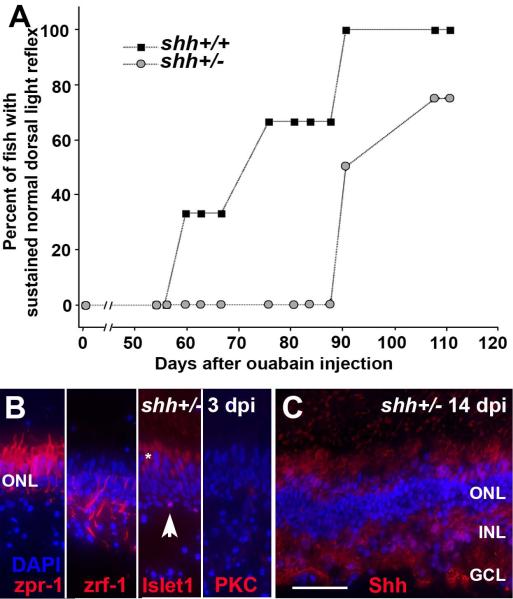
Teleost fish regenerate their retinas after damage, in contrast to mammals. In zebrafish subjected to an extensive ouabain-induced lesion that destroys all neurons and spares Müller glia, functional recovery and restoration of normal optic nerve head (ONH) diameter take place at 100 days postinjury. Subsequently, regenerated retinas overproduce cells in the retinal ganglion cell (RGC) layer, and the ONH becomes enlarged. Here, we test the hypothesis that a selective injury, which spares photoreceptors and Müller glia, results in faster functional recovery and fewer long-term histological abnormalities. Following this selective retinal damage, recovery of visual function required 60 days, consistent with this hypothesis. In contrast to extensively damaged retinas, selectively damaged retinas showed fewer histological errors and did not overproduce neurons. Extensively damaged retinas had RGC axons that were delayed in pathfinding to the ONH, and showed misrouted axons within the ONH, suggesting that delayed functional recovery following an extensive lesion is related to defects in RGC axons exiting the eye and/or reaching their central targets. The atoh7, fgf8a, Sonic hedgehog (shha), and netrin-1 genes were differentially expressed, and the distribution of hedgehog protein was disrupted after extensive damage as compared with selective damage. Confirming a role for Shh signaling in supporting rapid regeneration, shha(t4) +/- zebrafish showed delayed functional recovery after selective damage. We suggest that surviving retinal neurons provide structural/molecular information to regenerating neurons, and that this patterning mechanism regulates factors such as Shh. These factors in turn control neuronal number, retinal lamination, and RGC axon pathfinding during retinal regeneration.
硬骨鱼在受损后会再生其视网膜,这与哺乳动物形成了鲜明对比。在斑马鱼中,广泛的哇巴因诱导损伤会破坏所有神经元并保留 Muller 胶质细胞,在损伤后 100 天,会发生功能恢复和视神经头(ONH)直径的正常化。随后,再生的视网膜过度产生视网膜神经节细胞(RGC)层中的细胞,并且 ONH 增大。在这里,我们检验了这样一种假设,即选择性损伤会保留光感受器和 Muller 胶质细胞,从而导致更快的功能恢复和更少的长期组织学异常。在这种选择性视网膜损伤之后,视觉功能的恢复需要 60 天,这与该假设一致。与广泛受损的视网膜相比,选择性受损的视网膜显示出较少的组织学错误,并且不会过度产生神经元。广泛受损的视网膜中的 RGC 轴突在向 ONH 进行路径寻迹时延迟,并且在 ONH 内显示出错误导向的轴突,这表明广泛损伤后功能恢复延迟与 RGC 轴突离开眼睛和/或到达其中枢靶标时的缺陷有关。在广泛损伤后,atroh7、fgf8a、Sonic hedgehog(shha)和 netrin-1 基因的表达存在差异,并且 hedgehog 蛋白的分布被破坏。与选择性损伤相比,在广泛损伤后,shha(t4) +/- 斑马鱼的功能恢复延迟。我们认为,存活的视网膜神经元为再生神经元提供结构/分子信息,并且这种模式形成机制调节了 Shh 等因素。这些因素反过来又控制着神经元数量、视网膜分层和 RGC 轴突路径寻迹,在视网膜再生过程中发挥作用。