Özen Mehmet, Üstün Celalettin, Öztürk Bengi, Topçuoğlu Pervin, Arat Mutlu, Gündüz Mehmet, Atilla Erden, Bolat Gülşen, Arslan Önder, Demirer Taner, Akan Hamdi, İlhan Osman, Beksaç Meral, Gürman Günhan, Özcan Muhit
Ankara University Faculty of Medicine, Department of Hematology and Bone Marrow Transplantation Unit, Ankara, Turkey Phone: +90-312-466 3550 E-mail:
Turk J Haematol. 2017 Mar 1;34(1):16-26. doi: 10.4274/tjh.2015.0346. Epub 2016 Apr 18.
Tyrosine kinase inhibitors (TKIs) have changed the indications for allogeneic hematopoietic stem cell transplantation (allo-HSCT) in chronic myeloid leukemia (CML). Therefore, we aimed to evaluate the effect of TKIs on allo-HSCT in CML.
In this quasi-experimental study, we compared patient, disease, and transplantation characteristics as well as allo-HSCT outcomes between the pre-TKI era (before 2002) and the post-TKI era (2002 and later) in patients with CML. A total of 193 allo-HSCTs were performed between 1989 and 2012.
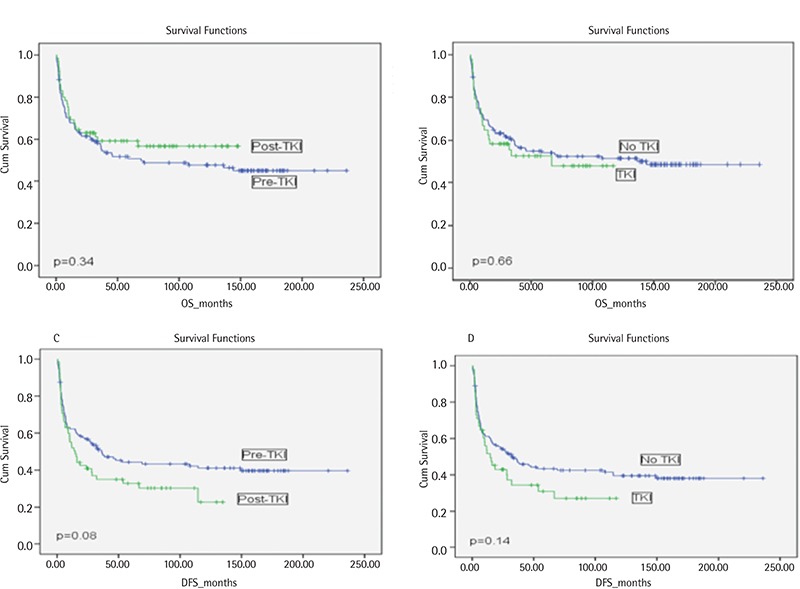
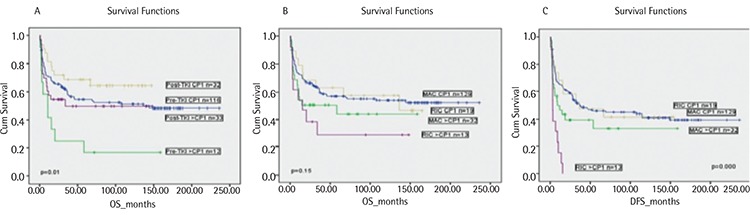
Patients in the post-TKI era had more advanced disease (>chronic phase 1) at the time of transplant and more frequently received reduced-intensity conditioning compared to patients in the pre-TKI era. Relapse/progression occurred more frequently in the year ≥2002 group than in the year <2002 group (48% vs. 32% at 5 years, p=0.01); however, overall survival (OS) was similar in these two groups (5-year survival was 50.8% vs. 59.5%, respectively; p=0.3). TKIs (with donor lymphocyte infusions or alone) for treatment of relapse after allo-HSCT were available in the post-TKI era and were associated with improved OS. While the rates of hematologic remission at 3 months after allo-HSCT were similar between TKI eras, patients having remission had better disease-free survival (DFS) [relative risk (RR): 0.15, confidence interval (CI) 95%: 0.09-0.24, p<0.001] and OS (RR: 0.14, CI 95%: 0.09-0.23, p<0.001). Male allo-HSCT recipients had worse DFS (RR: 1.7, CI 95%: 1.2-2.5, p=0.007) and OS (RR: 1.7, CI 95%: 1.1-2.6, p=0.02) than females.
TKIs are an effective option for the treatment of relapse after allo-HSCT in CML. Hematologic remission after allo-HSCT is also an important factor for survival in CML patients.
酪氨酸激酶抑制剂(TKIs)改变了慢性髓性白血病(CML)异基因造血干细胞移植(allo-HSCT)的适应证。因此,我们旨在评估TKIs对CML患者allo-HSCT的影响。
在这项准实验研究中,我们比较了CML患者在TKI应用前时代(2002年以前)和TKI应用后时代(2002年及以后)的患者、疾病和移植特征以及allo-HSCT结果。1989年至2012年间共进行了193例allo-HSCT。
与TKI应用前时代的患者相比,TKI应用后时代的患者在移植时疾病进展更严重(>慢性期1),且更频繁地接受减低强度预处理。2002年及以后组的复发/进展发生率高于2002年以前组(5年时分别为48%和32%,p=0.01);然而,这两组的总生存期(OS)相似(5年生存率分别为50.8%和59.5%;p=0.3)。在TKI应用后时代,有用于治疗allo-HSCT后复发的TKIs(联合供者淋巴细胞输注或单独使用),且与OS改善相关。虽然不同TKI时代allo-HSCT后3个月时的血液学缓解率相似,但获得缓解的患者无病生存期(DFS)更好[相对危险度(RR):0.15,95%置信区间(CI):0.09-0.24,p<0.001],OS也更好(RR:0.14,CI 95%:0.09-0.23,p<0.001)。男性allo-HSCT受者的DFS(RR:1.7,CI 95%:1.2-2.5,p=0.007)和OS(RR:1.7,CI 95%:1.1-2.6,p=0.02)比女性差。
TKIs是治疗CML患者allo-HSCT后复发的有效选择。allo-HSCT后的血液学缓解也是CML患者生存的重要因素。