Jiang Baoen, Mu Weidong, Wang Jiangquan, Lu Jianshu, Jiang Shanyong, Li Liang, Xu Haining, Tian Hongyan
Department of Traumatic Orthopaedics, The People 's Hospital of Dongying City of Shandong Province, No 317 Nanyi Road, Dongying, 257091, Shandong, China.
Department of Traumatic Orthopaedics, Shandong Provincial Hospital Affiliated to Shandong University, No 324 Jingwuweiqi Road, Jinan, 250021, Shandong, China.
J Exp Clin Cancer Res. 2016 Apr 19;35:69. doi: 10.1186/s13046-016-0348-5.
MicroRNA-138 (miR-138) has been proven to be a tumor suppressor gene in various types of tumors. However, the expression and the role of miR-138 in human osteosarcoma are still poorly understood. We investigated the function and the underlying mechanism of miR-138 in osteosarcoma.
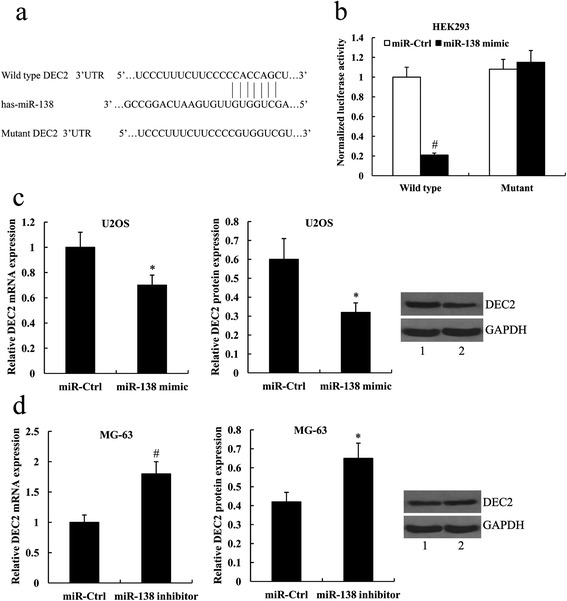
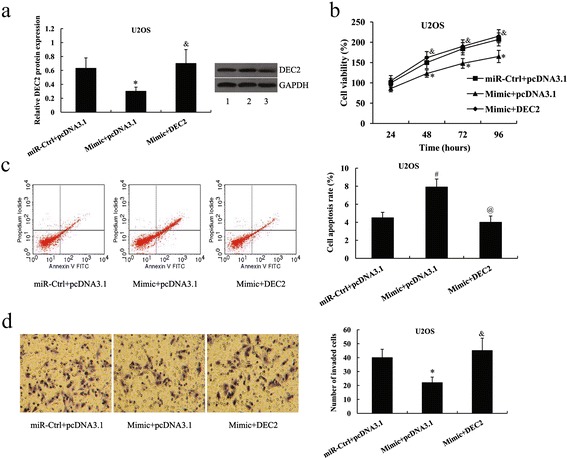
The expression of miR-138 in human osteosarcoma tissues and cell lines was detected by real-time PCR analysis. The gain-of-function and loss-of-function experiments were performed on osteosarcoma cell lines to investigate the effects of miR-138 on osteosarcoma progression, and to determine whether differentiated embryonic chondrocyte gene 2 (DEC2) mediates these effects. Cell proliferation, apoptosis and invasion were assessed by MTT, flow cytometry and transwell-matrigel assays. Dual-luciferase reporter assay was used to identify whether DEC2 is a direct target of miR-138.
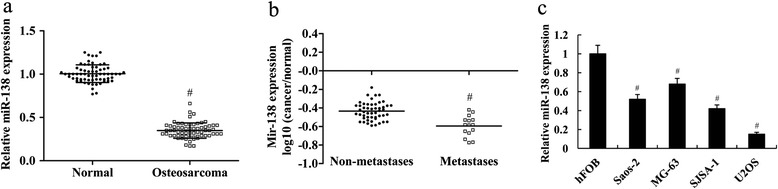
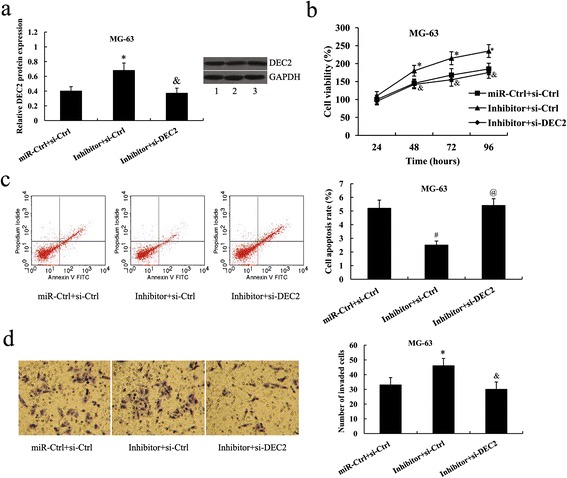
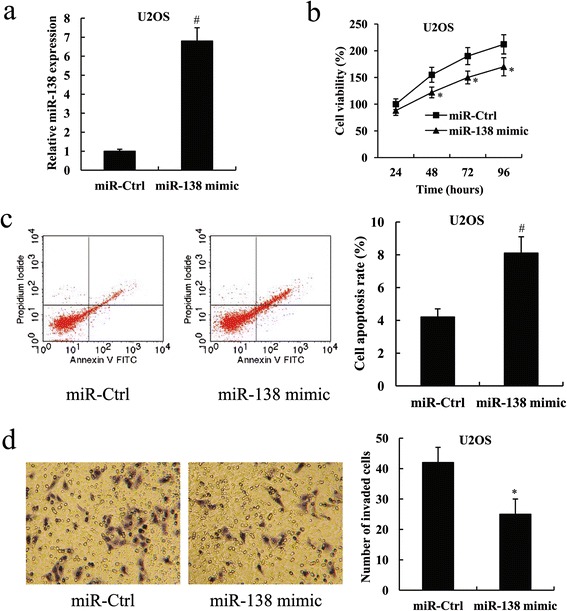
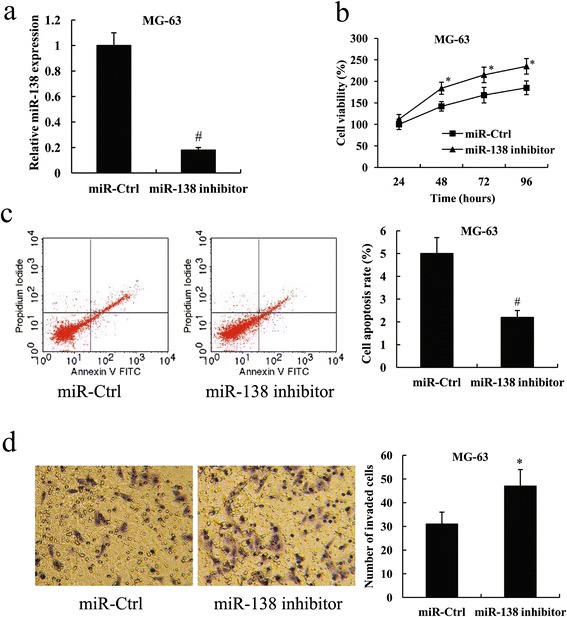
MiR-138 was significantly downregulated in human osteosarcoma tissues and cell lines. Moreover, miR-138 expression was significantly lower in metastatic osteosarcoma tissues than that in non-metastatic tissues. The in vitro gain-of-function and loss-of-function experiments demonstrated that miR-138 inhibited cell proliferation and invasion, and promoted cell apoptosis of human osteosarcoma cells. DEC2 was verified as a direct target of miR-138, and DEC2 could reverse the inhibitory effect of miR-138 on osteosarcoma progression.
These findings suggested that miR-138 acts as a tumor suppressor in osteosarcoma.miR-138 inhibited cell proliferation and invasion, as well as promoted cell apoptosis of human osteosarcoma cells, at least partially, by inhibiting the expression of DEC2. MiR-138/DEC2 may be a novel therapeutic target in osteosarcoma.
MicroRNA-138(miR-138)已被证明是多种肿瘤中的肿瘤抑制基因。然而,miR-138在人类骨肉瘤中的表达及作用仍知之甚少。我们研究了miR-138在骨肉瘤中的功能及潜在机制。
通过实时PCR分析检测miR-138在人类骨肉瘤组织和细胞系中的表达。在骨肉瘤细胞系上进行功能获得和功能缺失实验,以研究miR-138对骨肉瘤进展的影响,并确定分化胚胎软骨细胞基因2(DEC2)是否介导这些作用。通过MTT、流式细胞术和Transwell-基质胶实验评估细胞增殖、凋亡和侵袭。采用双荧光素酶报告基因实验鉴定DEC2是否为miR-138的直接靶点。
miR-138在人类骨肉瘤组织和细胞系中显著下调。此外,转移性骨肉瘤组织中miR-138的表达明显低于非转移性组织。体外功能获得和功能缺失实验表明,miR-138抑制人类骨肉瘤细胞的增殖和侵袭,并促进细胞凋亡。DEC2被证实为miR-138的直接靶点,DEC2可逆转miR-138对骨肉瘤进展的抑制作用。
这些发现表明miR-138在骨肉瘤中起肿瘤抑制作用。miR-138至少部分通过抑制DEC2的表达来抑制人类骨肉瘤细胞的增殖和侵袭,并促进细胞凋亡。miR-138/DEC2可能是骨肉瘤的一个新的治疗靶点。