D'Alessandro Giuseppina, Grimaldi Alfonso, Chece Giuseppina, Porzia Alessandra, Esposito Vincenzo, Santoro Antonio, Salvati Maurizio, Mainiero Fabrizio, Ragozzino Davide, Di Angelantonio Silvia, Wulff Heike, Catalano Myriam, Limatola Cristina
Department of Physiology and Pharmacology, Sapienza University of Rome, Rome, Italy.
IRCCS Neuromed, Pozzilli, Italy.
Oncotarget. 2016 May 24;7(21):30781-96. doi: 10.18632/oncotarget.8761.
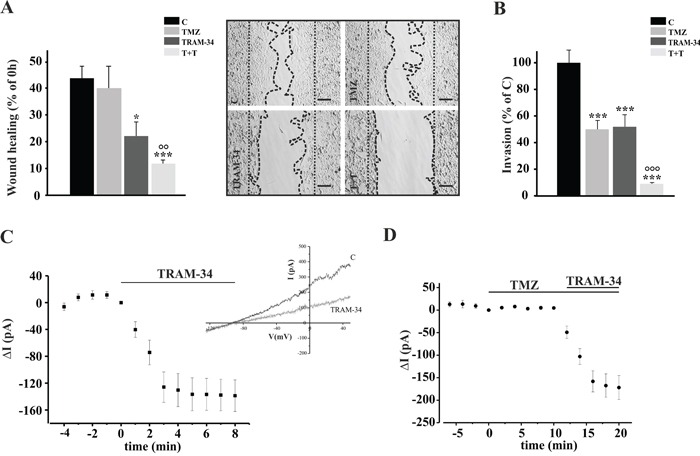
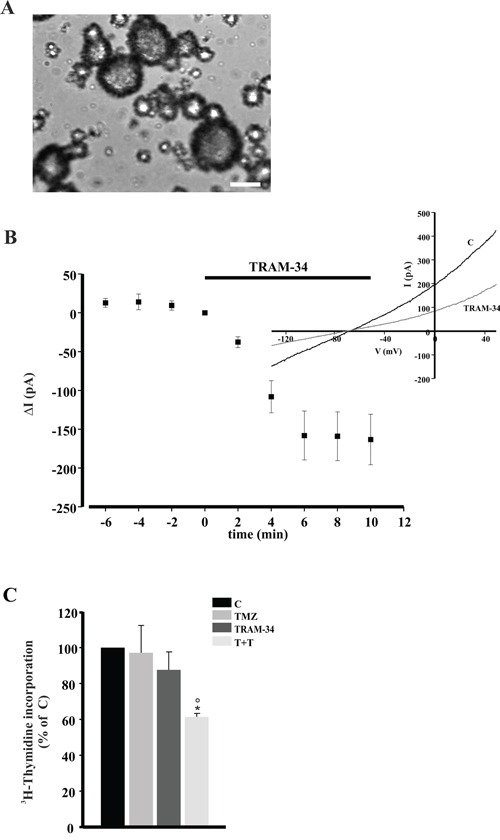
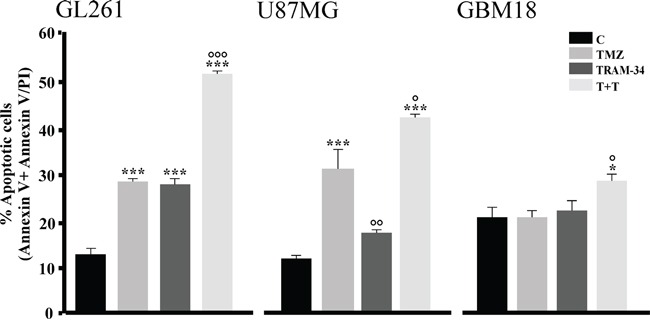
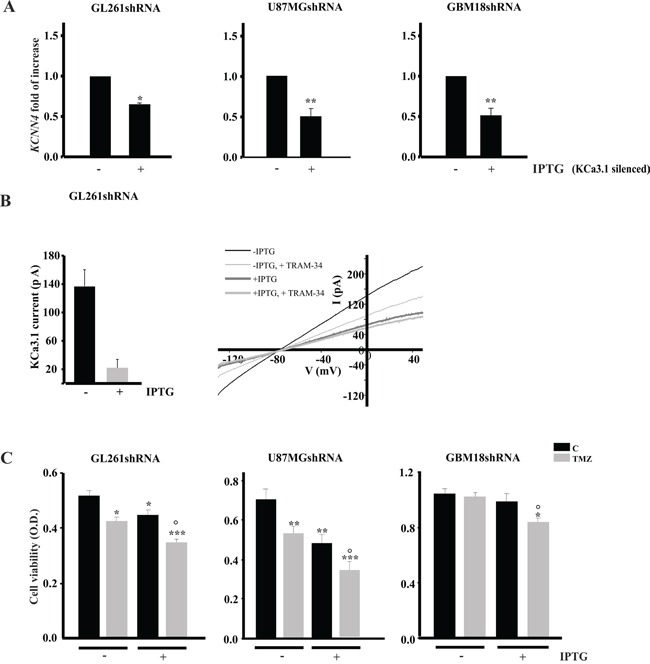
Malignant gliomas are among the most frequent and aggressive cerebral tumors, characterized by high proliferative and invasive indexes. Standard therapy for patients, after surgery and radiotherapy, consists of temozolomide (TMZ), a methylating agent that blocks tumor cell proliferation. Currently, there are no therapies aimed at reducing tumor cell invasion. Ion channels are candidate molecular targets involved in glioma cell migration and infiltration into the brain parenchyma. In this paper we demonstrate that: i) blockade of the calcium-activated potassium channel KCa3.1 with TRAM-34 has co-adjuvant effects with TMZ, reducing GL261 glioma cell migration, invasion and colony forming activity, increasing apoptosis, and forcing cells to pass the G2/M cell cycle phase, likely through cdc2 de-phosphorylation; ii) KCa3.1 silencing potentiates the inhibitory effect of TMZ on glioma cell viability; iii) the combination of TMZ/TRAM-34 attenuates the toxic effects of glioma conditioned medium on neuronal cultures, through a microglia dependent mechanism since the effect is abolished by clodronate-induced microglia killing; iv) TMZ/TRAM-34 co-treatment increases the number of apoptotic tumor cells, and the mean survival time in a syngeneic mouse glioma model (C57BL6 mice implanted with GL261 cells); v) TMZ/TRAM-34 co-treatment reduces cell viability of GBM cells and cancer stem cells (CSC) freshly isolated from patients.Taken together, these data suggest a new therapeutic approach for malignant glioma, targeting both glioma cell proliferating and migration, and demonstrate that TMZ/TRAM-34 co-treatment affects both glioma cells and infiltrating microglia, resulting in an overall reduction of tumor cell progression.
恶性胶质瘤是最常见且侵袭性最强的脑肿瘤之一,其特征为高增殖指数和侵袭指数。患者术后及放疗后的标准治疗方案为使用替莫唑胺(TMZ),这是一种能阻断肿瘤细胞增殖的甲基化剂。目前,尚无旨在减少肿瘤细胞侵袭的治疗方法。离子通道是参与胶质瘤细胞迁移和浸润至脑实质的候选分子靶点。在本文中,我们证明:i)用TRAM - 34阻断钙激活钾通道KCa3.1与TMZ具有协同辅助作用,可减少GL261胶质瘤细胞的迁移、侵袭和集落形成活性,增加细胞凋亡,并促使细胞通过G2/M细胞周期阶段,可能是通过细胞周期蛋白依赖性激酶2(cdc2)去磷酸化实现;ii)KCa3.1基因沉默增强了TMZ对胶质瘤细胞活力的抑制作用;iii)TMZ/TRAM - 34组合通过小胶质细胞依赖性机制减弱了胶质瘤条件培养基对神经元培养物的毒性作用,因为氯膦酸盐诱导的小胶质细胞杀伤可消除该作用;iv)TMZ/TRAM - 34联合治疗增加了同基因小鼠胶质瘤模型(植入GL261细胞的C57BL6小鼠)中凋亡肿瘤细胞的数量及平均生存时间;v)TMZ/TRAM - 34联合治疗降低了从患者新鲜分离的胶质母细胞瘤细胞和癌症干细胞(CSC)的细胞活力。综上所述,这些数据提示了一种针对恶性胶质瘤的新治疗方法,同时靶向胶质瘤细胞的增殖和迁移,并证明TMZ/TRAM - 34联合治疗对胶质瘤细胞和浸润性小胶质细胞均有影响,从而整体减少肿瘤细胞进展。