Institute Pasteur, Cenci Bolognetti Foundation, Department of Physiology and Pharmacology, Sapienza University of Rome, Rome, Italy.
Cell Death Dis. 2013 Aug 15;4(8):e773. doi: 10.1038/cddis.2013.279.
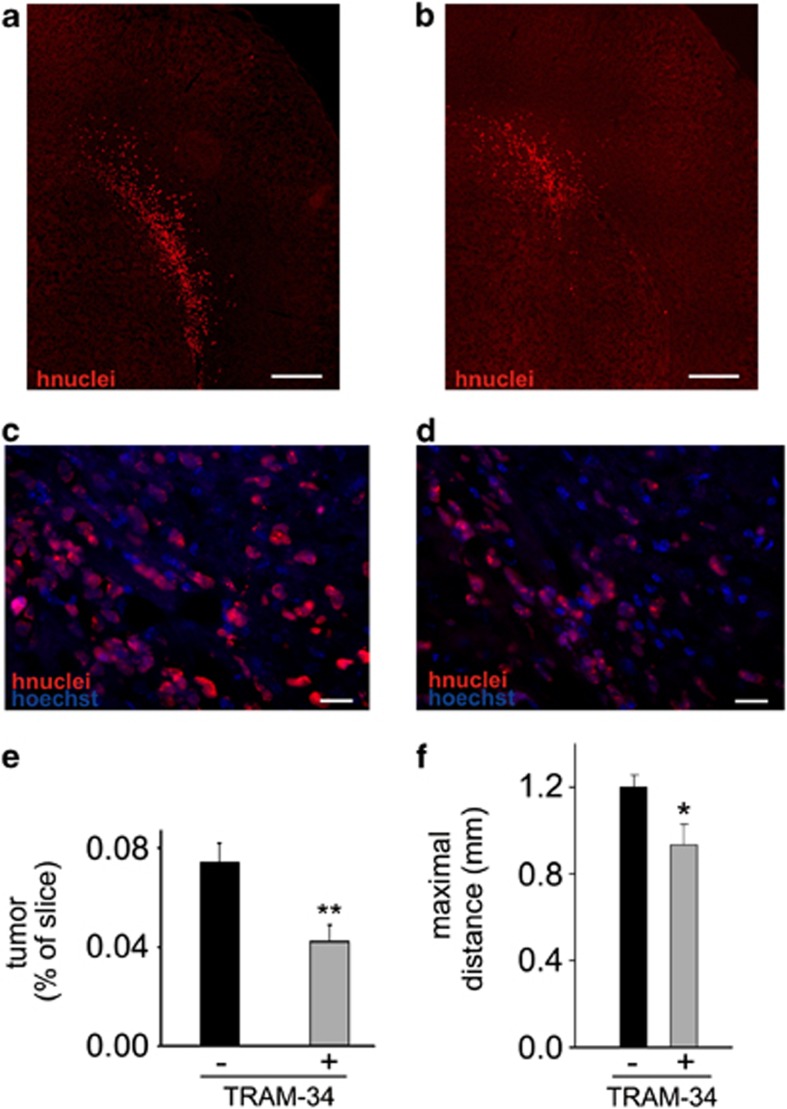
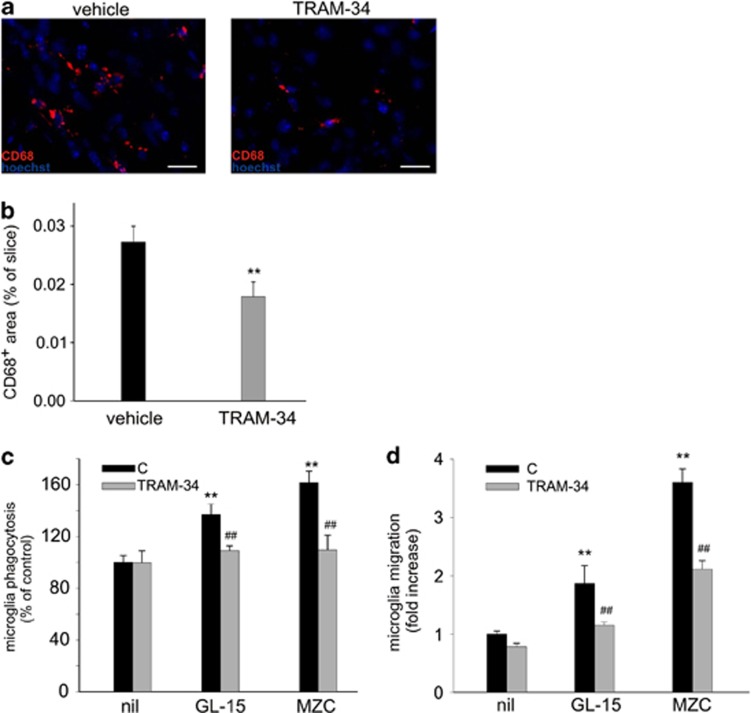
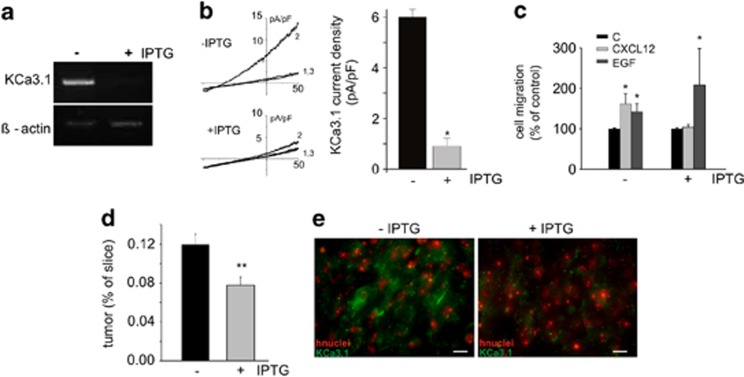
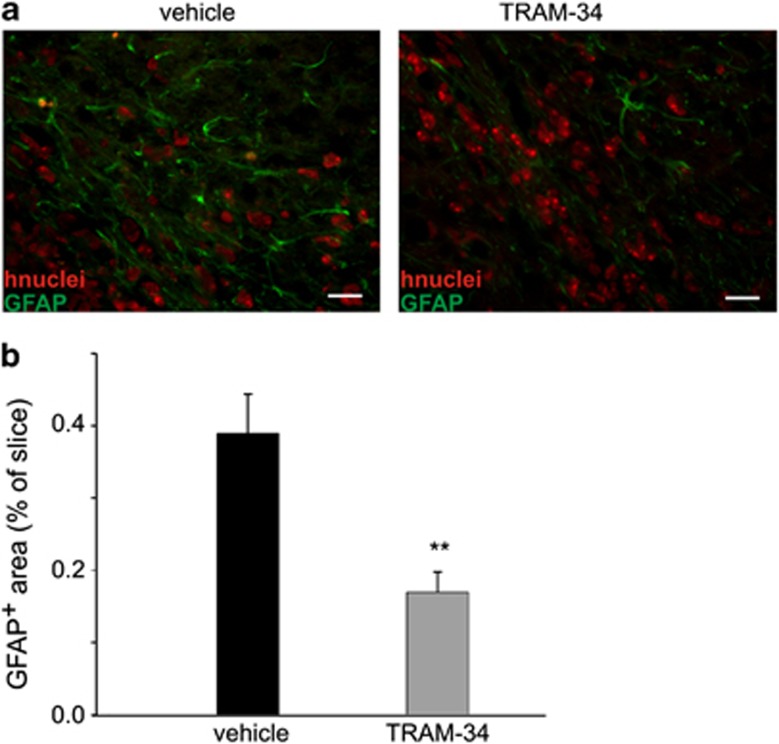
Glioblastoma multiforme (GBM) is a diffuse brain tumor characterized by high infiltration in the brain parenchyma rendering the tumor difficult to eradicate by neurosurgery. Efforts to identify molecular targets involved in the invasive behavior of GBM suggested ion channel inhibition as a promising therapeutic approach. To determine if the Ca(2+)-dependent K(+) channel KCa3.1 could represent a key element for GBM brain infiltration, human GL-15 cells were xenografted into the brain of SCID mice that were then treated with the specific KCa3.1 blocker TRAM-34 (1-((2-chlorophenyl) (diphenyl)methyl)-1H-pyrazole). After 5 weeks of treatment, immunofluorescence analyses of cerebral slices revealed reduced tumor infiltration and astrogliosis surrounding the tumor, compared with untreated mice. Significant reduction of tumor infiltration was also observed in the brain of mice transplanted with KCa3.1-silenced GL-15 cells, indicating a direct effect of TRAM-34 on GBM-expressed KCa3.1 channels. As KCa3.1 channels are also expressed on microglia, we investigated the effects of TRAM-34 on microglia activation in GL-15 transplanted mice and found a reduction of CD68 staining in treated mice. Similar results were observed in vitro where TRAM-34 reduced both phagocytosis and chemotactic activity of primary microglia exposed to GBM-conditioned medium. Taken together, these results indicate that KCa3.1 activity has an important role in GBM invasiveness in vivo and that its inhibition directly affects glioma cell migration and reduces astrocytosis and microglia activation in response to tumor-released factors. KCa3.1 channel inhibition therefore constitutes a potential novel therapeutic approach to reduce GBM spreading into the surrounding tissue.
多形性胶质母细胞瘤(GBM)是一种弥漫性脑肿瘤,其特征是在脑实质中有很高的浸润性,使得神经外科难以将其切除。为了确定是否钙离子依赖性钾通道 KCa3.1 可能是 GBM 脑浸润的关键因素,我们将人 GL-15 细胞异种移植到 SCID 小鼠的大脑中,然后用特异性 KCa3.1 阻断剂 TRAM-34(1-((2-氯苯基)(二苯基)甲基)-1H-吡唑)进行治疗。在治疗 5 周后,对大脑切片进行免疫荧光分析显示,与未治疗的小鼠相比,肿瘤浸润和肿瘤周围的星形胶质增生减少。在移植了沉默 KCa3.1 的 GL-15 细胞的小鼠的大脑中也观察到肿瘤浸润的显著减少,这表明 TRAM-34 对 GBM 表达的 KCa3.1 通道有直接作用。由于 KCa3.1 通道也在小胶质细胞上表达,我们研究了 TRAM-34 对 GL-15 移植小鼠中小胶质细胞激活的影响,发现治疗小鼠的 CD68 染色减少。在体外也观察到类似的结果,TRAM-34 减少了暴露于 GBM 条件培养基的原代小胶质细胞的吞噬作用和趋化活性。综上所述,这些结果表明 KCa3.1 活性在体内 GBM 的侵袭性中起着重要作用,其抑制直接影响神经胶质瘤细胞的迁移,并减少星形胶质细胞增生和对肿瘤释放因子的小胶质细胞激活。因此,KCa3.1 通道抑制构成了减少 GBM 扩散到周围组织的潜在新的治疗方法。