Jung Chan Kwon, Jung Seung-Hyun, Yim Seon-Hee, Jung Ji-Han, Choi Hyun Joo, Kang Won-Kyung, Park Sung-Won, Oh Seong-Taek, Kim Jun-Gi, Lee Sug Hyung, Chung Yeun-Jun
Department of Hospital Pathology, College of Medicine, The Catholic University of Korea, Seoul 06591, Republic of Korea.
Department of Microbiology, College of Medicine, The Catholic University of Korea, Seoul 06591, Republic of Korea.
Oncotarget. 2016 May 31;7(22):32902-15. doi: 10.18632/oncotarget.8766.
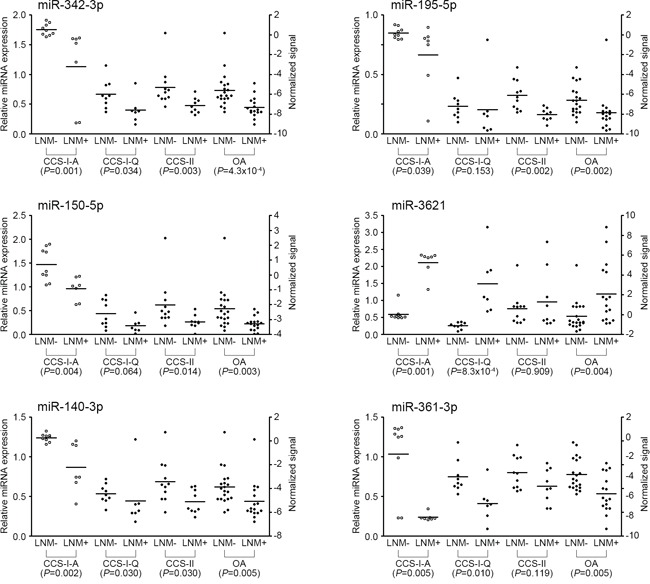
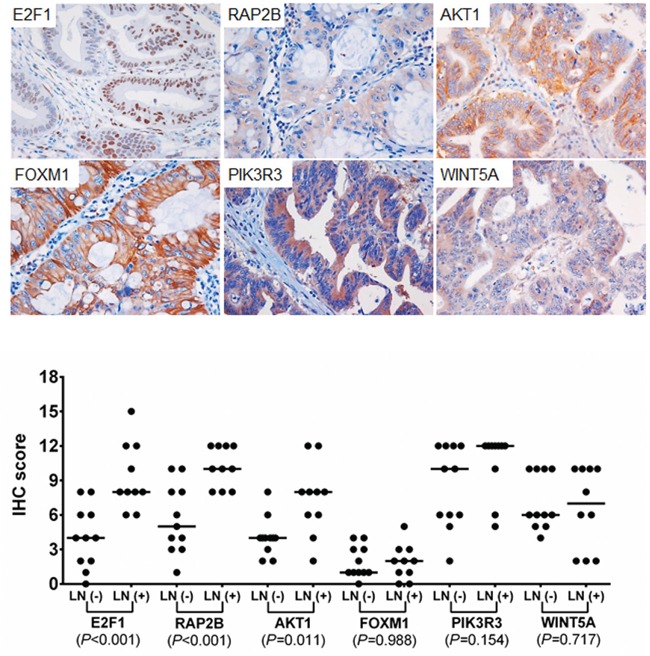
Accurate prediction of regional lymph node metastasis (LNM) in endoscopically resected T1-stage colorectal cancers (CRCs) can reduce unnecessary surgeries. To identify miRNA markers that can predict LNM in T1-stage CRCs, the study was conducted in two phases; (I) miRNA classifier construction by miRNA-array and quantitative reverse transcription PCR (qRT-PCR) using 36 T1-stage CRC samples; (II) miRNA classifier validation in an independent set of 20 T1-stage CRC samples. The expression of potential downstream target genes of miRNAs was assessed by immunohistochemistry. In the discovery analysis by miRNA microarray, expression of 66 miRNAs were significantly different between LNM-positive and negative CRCs. After qRT-PCR validation, 11 miRNAs were consistently significant in the combined classifier construction set. Among them, miR-342-3p was the most significant one (P=4.3×10⁻⁴). Through logistic regression analysis, we developed a three-miRNA classifier (miR-342-3p, miR-361-3p, and miR-3621) for predicting LNM in T1-stage CRCs, yielding the area under the curve of 0.947 (94% sensitivity, 85% specificity and 89% accuracy). The discriminative ability of this system was consistently reliable in the independent validation set (83% sensitivity, 64% specificity and 70% of accuracy). Of the potential downstream targets of the three-miRNAs, expressions of E2F1, RAP2B, and AKT1 were significantly associated with LNM. In conclusion, this classifier can predict LNM more accurately than conventional pathologic criteria and our study results may be helpful to avoid unnecessary bowel surgery after endoscopic resection in early CRC.
准确预测经内镜切除的T1期结直肠癌(CRC)区域淋巴结转移(LNM)可减少不必要的手术。为了识别可预测T1期CRC中LNM的miRNA标志物,本研究分两个阶段进行:(I)使用36个T1期CRC样本,通过miRNA阵列和定量逆转录PCR(qRT-PCR)构建miRNA分类器;(II)在一组独立的20个T1期CRC样本中验证miRNA分类器。通过免疫组织化学评估miRNA潜在下游靶基因的表达。在miRNA微阵列的发现分析中,LNM阳性和阴性CRC之间66种miRNA的表达存在显著差异。经过qRT-PCR验证,11种miRNA在组合分类器构建集中始终具有显著性。其中,miR-342-3p最为显著(P=4.3×10⁻⁴)。通过逻辑回归分析,我们开发了一种用于预测T1期CRC中LNM的三miRNA分类器(miR-342-3p、miR-361-3p和miR-3621),曲线下面积为0.947(敏感性94%,特异性85%,准确性89%)。该系统的判别能力在独立验证集中始终可靠(敏感性83%,特异性64%,准确性70%)。在这三种miRNA的潜在下游靶标中,E2F1、RAP2B和AKT1的表达与LNM显著相关。总之,该分类器比传统病理标准能更准确地预测LNM,我们的研究结果可能有助于避免早期CRC内镜切除术后不必要的肠道手术。