
不同光照条件下越橘(Vaccinium myrtillus L.)果实发育过程中的类胡萝卜素代谢受生物合成和降解的调控。
Carotenoid metabolism during bilberry (Vaccinium myrtillus L.) fruit development under different light conditions is regulated by biosynthesis and degradation.
作者信息
Karppinen Katja, Zoratti Laura, Sarala Marian, Carvalho Elisabete, Hirsimäki Jenni, Mentula Helmi, Martens Stefan, Häggman Hely, Jaakola Laura
机构信息
Genetics and Physiology Unit, University of Oulu, P.O. Box 3000, FI-90014, Oulu, Finland.
Climate laboratory Holt, Department of Arctic and Marine Biology, UiT the Arctic University of Norway, NO-9037, Tromsø, Norway.
出版信息
BMC Plant Biol. 2016 Apr 21;16:95. doi: 10.1186/s12870-016-0785-5.
BACKGROUND
Carotenoids are important pigments and precursors for central signaling molecules associated in fruit development and ripening. Carotenoid metabolism has been studied especially in the climacteric tomato fruit but the content of carotenoids and the regulation of their metabolism have been shown to be highly variable between fruit species. Non-climacteric berries of the genus Vaccinium are among the best natural sources of health-beneficial flavonoids but not studied previously for carotenoid biosynthesis.
RESULTS
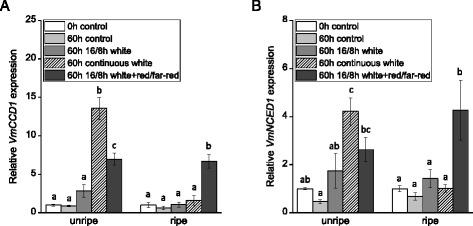
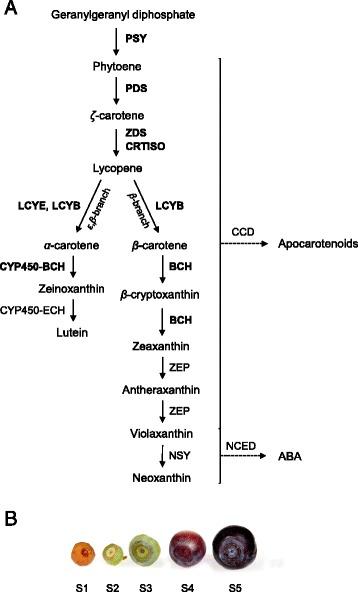
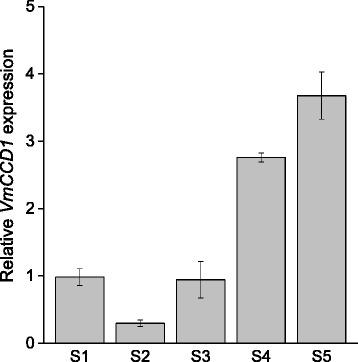
In this study, carotenoid biosynthetic genes, PSY, PDS, ZDS, CRTISO, LCYB, LCYE, BCH and CYP450-BCH, as well as a carotenoid cleavage dioxygenase CCD1 were identified from bilberry (V. myrtillus L.) fruit and their expression was studied along with carotenoid composition during fruit development under different photoperiod and light quality conditions. Bilberry was found to be a good source of carotenoids among fruits and berries. The most abundant carotenoids throughout the berry development were lutein and β-carotene, which were accompanied by lower amounts of 9Z-β-carotene, violaxanthin, neoxanthin, zeaxanthin, antheraxanthin and β-cryptoxanthin. The expression patterns of the biosynthetic genes in ripening fruits indicated a metabolic flux towards β-branch of the carotenoid pathway. However, the carotenoid levels decreased in both the β-branch and ε,β-branch towards bilberry fruit ripening along with increased VmCCD1 expression, similarly to VmNCED1, indicating enzymatic carotenoid cleavage and degradation. Intense white light conditions increased the expression of the carotenoid biosynthetic genes but also the expression of the cleavage genes VmCCD1 and VmNCED1, especially in unripe fruits. Instead, mature bilberry fruits responded specifically to red/far-red light wavelengths by inducing the expression of both the carotenoid biosynthetic and the cleavage genes indicating tissue and developmental stage specific regulation of apocarotenoid formation by light quality.
CONCLUSIONS
This is the first report of carotenoid biosynthesis in Vaccinium berries. Our results indicate that both transcriptional regulation of the key biosynthetic genes and the enzymatic degradation of the produced carotenoids to apocarotenoids have significant roles in the determination of the carotenoid content and have overall effect on the metabolism during the bilberry fruit ripening.
背景
类胡萝卜素是重要的色素,也是与果实发育和成熟相关的中心信号分子的前体。类胡萝卜素代谢尤其在跃变型番茄果实中得到了研究,但已表明类胡萝卜素的含量及其代谢调控在不同果实种类间存在很大差异。越橘属的非跃变型浆果是对健康有益的黄酮类化合物的最佳天然来源之一,但此前尚未对其类胡萝卜素生物合成进行研究。
结果
在本研究中,从欧洲越橘(V. myrtillus L.)果实中鉴定出类胡萝卜素生物合成基因PSY、PDS、ZDS、CRTISO、LCYB、LCYE、BCH和CYP450 - BCH,以及类胡萝卜素裂解双加氧酶CCD1,并在不同光周期和光质条件下,研究了它们在果实发育过程中的表达以及类胡萝卜素组成。结果发现,在水果和浆果中,欧洲越橘是类胡萝卜素的良好来源。在整个浆果发育过程中,最丰富的类胡萝卜素是叶黄素和β - 胡萝卜素,同时还伴有少量的9Z - β - 胡萝卜素、紫黄质、新黄质、玉米黄质、花药黄质和β - 隐黄质。成熟果实中生物合成基因的表达模式表明类胡萝卜素途径的代谢通量朝着β分支方向。然而,随着欧洲越橘果实成熟,β分支和ε,β分支中的类胡萝卜素水平均下降,同时VmCCD1表达增加,与VmNCED1情况类似,表明存在类胡萝卜素的酶促裂解和降解。强光条件下,类胡萝卜素生物合成基因的表达增加,但裂解基因VmCCD1和VmNCED1的表达也增加,尤其是在未成熟果实中。相反,成熟的欧洲越橘果实对红/远红光波长有特异性反应,通过诱导类胡萝卜素生物合成基因和裂解基因的表达,表明光质对脱辅基类胡萝卜素形成具有组织和发育阶段特异性调控。
结论
这是关于越橘属浆果类胡萝卜素生物合成的首次报道。我们的结果表明,关键生物合成基因的转录调控以及所产生的类胡萝卜素向脱辅基类胡萝卜素的酶促降解在类胡萝卜素含量的决定中具有重要作用,并对欧洲越橘果实成熟过程中的整体代谢产生影响。



 Zotero 插件