Coulombe Geneviève, Langlois Ariane, De Palma Giada, Langlois Marie-Josée, McCarville Justin L, Gagné-Sanfaçon Jessica, Perreault Nathalie, Feng Gen-Sheng, Bercik Premysl, Boudreau François, Verdu Elena F, Rivard Nathalie
Faculty of Medicine and Health Sciences, Department of Anatomy and Cell Biology, Cancer Research Pavilion, Université de Sherbrooke, Sherbrooke, Quebec, Canada.
Farncombe Family Digestive Health Research Institute, McMaster University, Hamilton, Ontario, Canada.
J Cell Physiol. 2016 Nov;231(11):2529-40. doi: 10.1002/jcp.25407. Epub 2016 May 8.
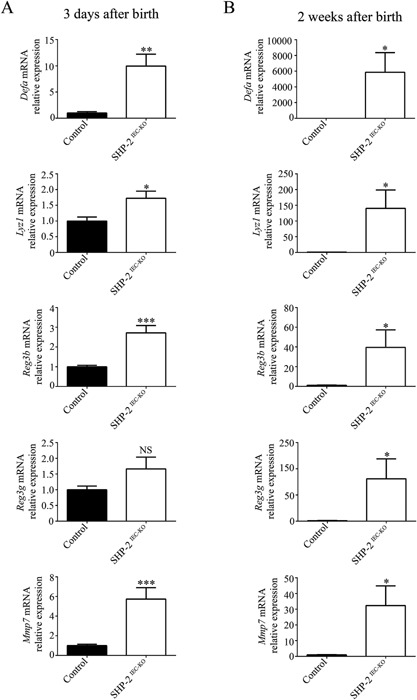
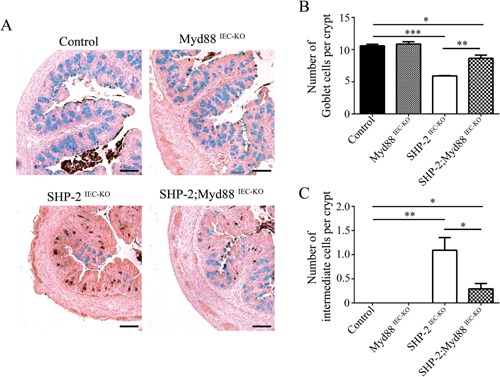
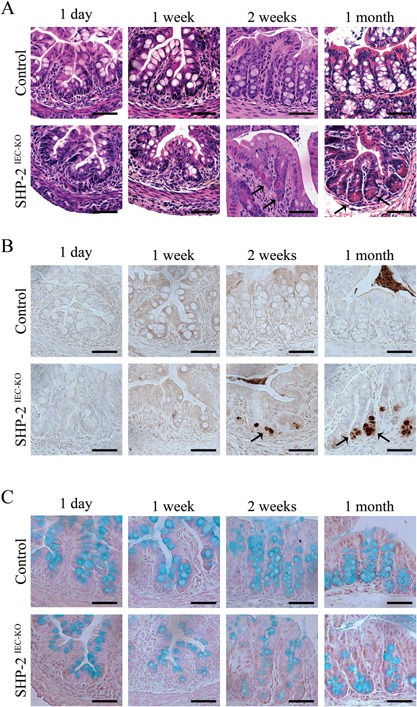
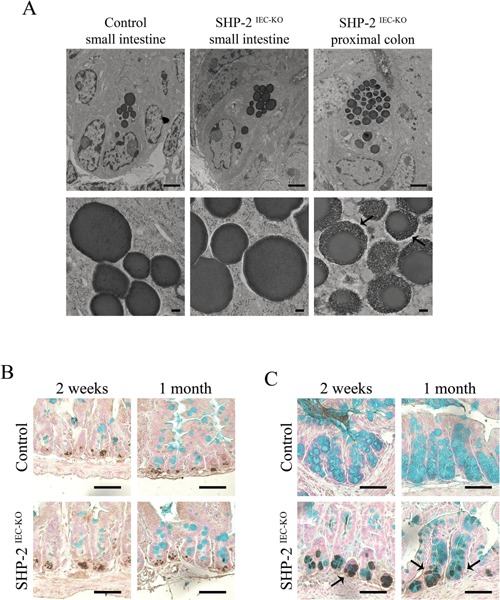
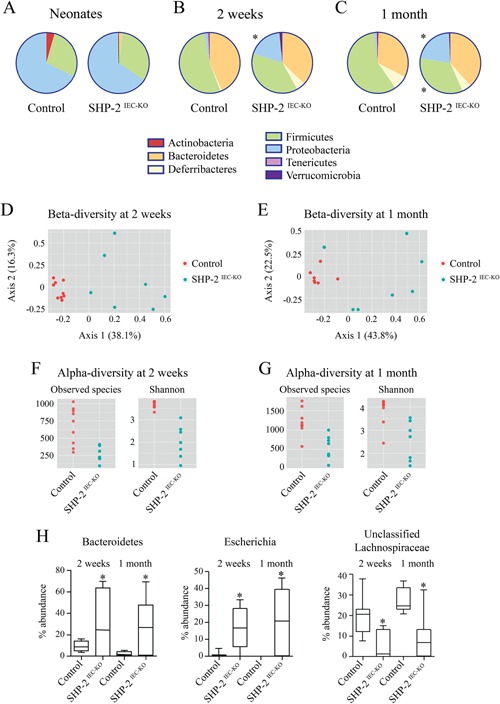
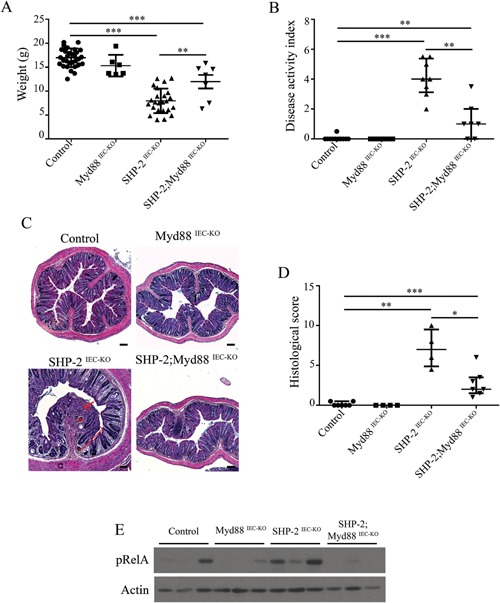
Polymorphisms in the PTPN11 gene encoding for the tyrosine phosphatase SHP-2 were described in patients with ulcerative colitis. We have recently demonstrated that mice with an intestinal epithelial cell-specific deletion of SHP-2 (SHP-2(IEC-KO) ) develop severe colitis 1 month after birth. However, the mechanisms by which SHP-2 deletion induces colonic inflammation remain to be elucidated. We generated SHP-2(IEC-KO) mice lacking Myd88 exclusively in the intestinal epithelium. The colonic phenotype was histologically analyzed and cell differentiation was determined by electron microscopy and lysozyme or Alcian blue staining. Microbiota composition was analyzed by 16S sequencing. Results show that innate defense genes including those specific to Paneth cells were strongly up-regulated in SHP-2-deficient colons. Expansion of intermediate cells (common progenitors of the Goblet and Paneth cell lineages) was found in the colon of SHP-2(IEC-KO) mice whereas Goblet cell number was clearly diminished. These alterations in Goblet/intermediate cell ratio were noticed 2 weeks after birth, before the onset of inflammation and were associated with significant alterations in microbiota composition. Indeed, an increase in Enterobacteriaceae and a decrease in Firmicutes were observed in the colon of these mice, indicating that dysbiosis also occurred prior to inflammation. Importantly, loss of epithelial Myd88 expression inhibited colitis development in SHP-2(IEC-KO) mice, rescued Goblet/intermediate cell ratio, and prevented NFκB hyperactivation and inflammation. These data indicate that SHP-2 is functionally important for the maintenance of appropriate barrier function and host-microbiota homeostasis in the large intestine. J. Cell. Physiol. 231: 2529-2540, 2016. © 2016 The Authors. Journal of Cellular Physiology published by Wiley Periodicals, Inc.
溃疡性结肠炎患者中已发现编码酪氨酸磷酸酶SHP-2的PTPN11基因存在多态性。我们最近证明,肠道上皮细胞特异性缺失SHP-2的小鼠(SHP-2(IEC-KO))在出生后1个月会发生严重的结肠炎。然而,SHP-2缺失诱导结肠炎症的机制仍有待阐明。我们构建了仅在肠道上皮中缺乏Myd88的SHP-2(IEC-KO)小鼠。对结肠表型进行组织学分析,并通过电子显微镜以及溶菌酶或阿尔辛蓝染色来确定细胞分化。通过16S测序分析微生物群组成。结果表明,包括那些潘氏细胞特异性基因在内的固有防御基因在SHP-2缺陷的结肠中强烈上调。在SHP-2(IEC-KO)小鼠的结肠中发现中间细胞(杯状细胞和潘氏细胞谱系的共同祖细胞)扩增,而杯状细胞数量明显减少。杯状细胞/中间细胞比例的这些改变在出生后2周就已出现,在炎症发作之前,并且与微生物群组成的显著改变有关。事实上,在这些小鼠的结肠中观察到肠杆菌科增加而厚壁菌门减少,这表明在炎症之前也发生了生态失调。重要的是,上皮Myd88表达的缺失抑制了SHP-2(IEC-KO)小鼠的结肠炎发展,挽救了杯状细胞/中间细胞比例,并防止了NFκB过度激活和炎症。这些数据表明,SHP-2对于维持大肠中适当的屏障功能和宿主-微生物群稳态在功能上很重要。《细胞生理学杂志》231: 2529 - 2540, 2016。© 2016作者。由威利期刊公司出版的《细胞生理学杂志》