Boos Christopher John, O'Hara John Paul, Mellor Adrian, Hodkinson Peter David, Tsakirides Costas, Reeve Nicola, Gallagher Liam, Green Nicholas Donald Charles, Woods David Richard
Department of Cardiology, Poole Hospital NHS Foundation trust, Poole, United Kingdom.
Dept of Postgraduate Medical Education, Bournemouth University, Bournemouth, United Kingdom.
PLoS One. 2016 Apr 21;11(4):e0152868. doi: 10.1371/journal.pone.0152868. eCollection 2016.
There has been considerable debate as to whether different modalities of simulated hypoxia induce similar cardiac responses.
This was a prospective observational study of 14 healthy subjects aged 22-35 years. Echocardiography was performed at rest and at 15 and 120 minutes following two hours exercise under normobaric normoxia (NN) and under similar PiO2 following genuine high altitude (GHA) at 3,375 m, normobaric hypoxia (NH) and hypobaric hypoxia (HH) to simulate the equivalent hypoxic stimulus to GHA.
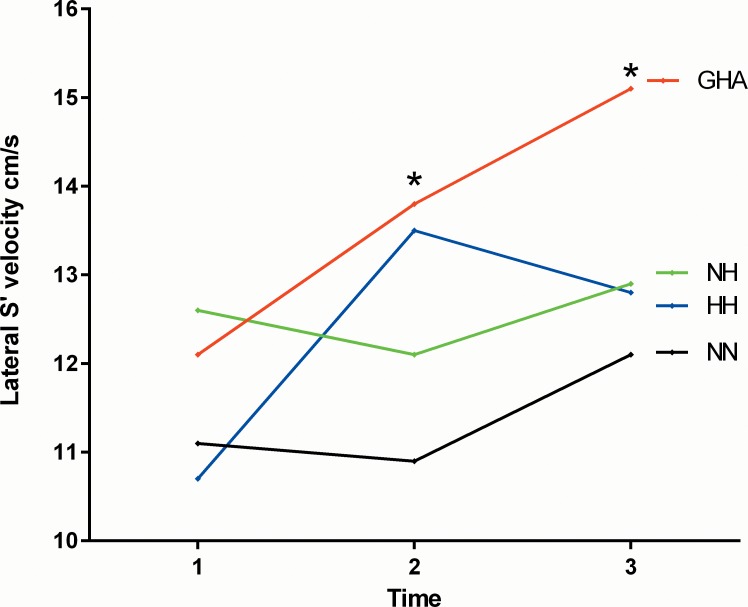
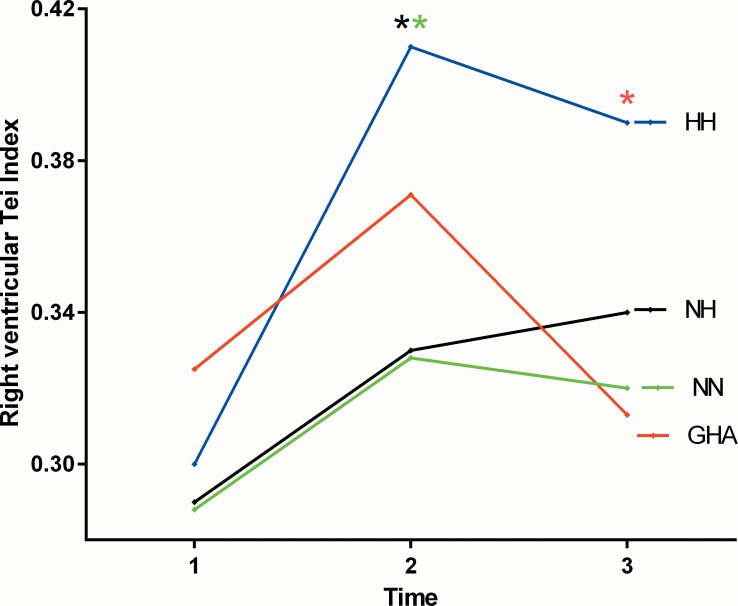
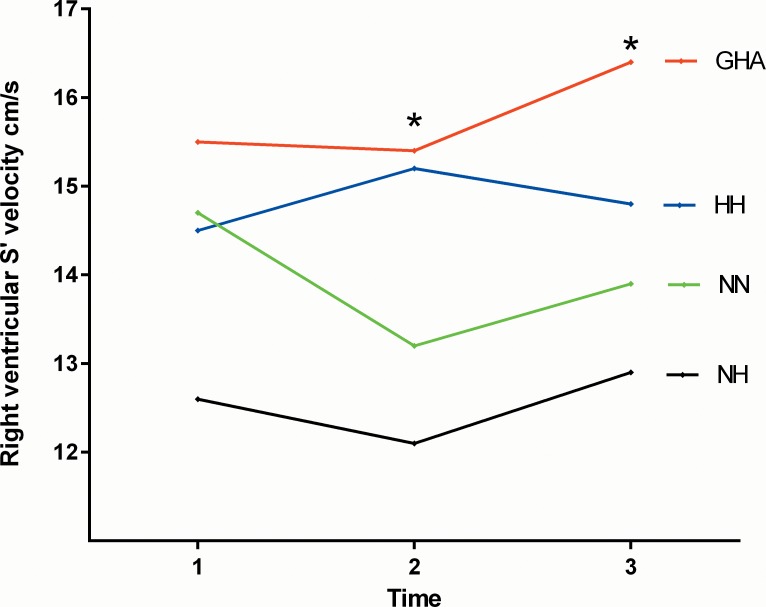
All 14 subjects completed the experiment at GHA, 11 at NN, 12 under NH, and 6 under HH. The four groups were similar in age, sex and baseline demographics. At baseline rest right ventricular (RV) systolic pressure (RVSP, p = 0.0002), pulmonary vascular resistance (p = 0.0002) and acute mountain sickness (AMS) scores were higher and the SpO2 lower (p<0.0001) among all three hypoxic groups (GHA, NH and HH) compared with NN. At both 15 minutes and 120 minutes post exercise, AMS scores, Cardiac output, septal S', lateral S', tricuspid S' and A' velocities and RVSP were higher and SpO2 lower with all forms of hypoxia compared with NN. On post-test analysis, among the three hypoxia groups, SpO2 was lower at baseline and 15 minutes post exercise with GHA (89.3±3.4% and 89.3±2.2%) and HH (89.0±3.1 and (89.8±5.0) compared with NH (92.9±1.7 and 93.6±2.5%). The RV Myocardial Performance (Tei) Index and RVSP were significantly higher with HH than NH at 15 and 120 minutes post exercise respectively and tricuspid A' was higher with GHA compared with NH at 15 minutes post exercise.
GHA, NH and HH produce similar cardiac adaptations over short duration rest despite lower SpO2 levels with GHA and HH compared with NH. Notable differences emerge following exercise in SpO2, RVSP and RV cardiac function.
关于不同形式的模拟低氧是否会引发相似的心脏反应,一直存在大量争论。
这是一项针对14名年龄在22 - 35岁的健康受试者的前瞻性观察研究。在常压低氧(NN)状态下以及在海拔3375米的真实高原(GHA)、常压低氧(NH)和低压低氧(HH)条件下,于静息状态以及两小时运动后的15分钟和120分钟进行超声心动图检查,以模拟与GHA等效的低氧刺激。
所有14名受试者均在GHA条件下完成实验,11名在NN条件下,12名在NH条件下,6名在HH条件下。四组在年龄、性别和基线人口统计学特征方面相似。在基线静息状态下,与NN组相比,所有三个低氧组(GHA、NH和HH)的右心室(RV)收缩压(RVSP,p = 0.0002)、肺血管阻力(p = 0.0002)和急性高山病(AMS)评分更高,而血氧饱和度(SpO2)更低(p<0.0001)。在运动后15分钟和120分钟时,与NN组相比,所有形式的低氧状态下,AMS评分、心输出量、室间隔S'、侧壁S'、三尖瓣S'和A'速度以及RVSP更高,而SpO2更低。在测试后分析中,在三个低氧组中,与NH组(92.9±1.7和93.6±2.5%)相比,GHA组(89.3±3.4%和89.3±2.2%)和HH组(89.0±3.1和89.8±5.0)在基线和运动后15分钟时的SpO2更低。运动后15分钟和120分钟时,HH组的RV心肌性能(Tei)指数和RVSP分别显著高于NH组,运动后15分钟时,GHA组的三尖瓣A'高于NH组。
尽管与NH组相比,GHA组和HH组的SpO2水平较低,但在短时间静息状态下,GHA、NH和HH会产生相似的心脏适应性变化。运动后,在SpO2、RVSP和RV心脏功能方面出现了显著差异。