Tanaka Tsutomu, Kutomi Goro, Kajiwara Toshimitsu, Kukita Kazuharu, Kochin Vitaly, Kanaseki Takayuki, Tsukahara Tomohide, Hirohashi Yoshihiko, Torigoe Toshihiko, Okamoto Yoshiharu, Hirata Koichi, Sato Noriyuki, Tamura Yasuaki
Department of Pathology, Sapporo Medical University, S1W17, Chuo-ku, Sapporo 060-8556, Japan.
The United Graduate School of Veterinary Sciences, Yamaguchi University, 1677-1, Yoshida, Yamaguchi 753-8511, Japan.
Br J Cancer. 2016 May 24;114(11):1227-34. doi: 10.1038/bjc.2016.105. Epub 2016 Apr 21.
Endoplasmic reticulum disulfide oxidase 1-α (ERO1-α) is an oxidase that exists in the endoplasmic reticulum and has a role in the formation of disulfide bonds of secreted proteins and cell-surface proteins. Recently, we reported that ERO1-α is present in high levels in various types of tumours, and that ERO1-α is a novel factor of poor prognosis. However, how ERO1-α affects a tumour in vivo and why patients who have a tumour with a high expression level of ERO1-α have a poor prognosis are still unknown. Therefore, to clarify the mechanism, we investigated the effect of ERO1-α on a tumour from the point of view of angiogenesis.
The effect of ERO1-α on tumour growth and angiogenesis was analysed by using non-obese diabetic-severe combined immunodeficient mice. The production of vascular endothelial growth factor (VEGF) in MDA-MB-231 cells with ERO1-α- overexpression or with ERO1-α knockdown was measured. The role of ERO1-α on VEGF expression was investigated. In triple-negative breast cancer cases, the relationship between expression of ERO1-α and angiogenesis was analysed.
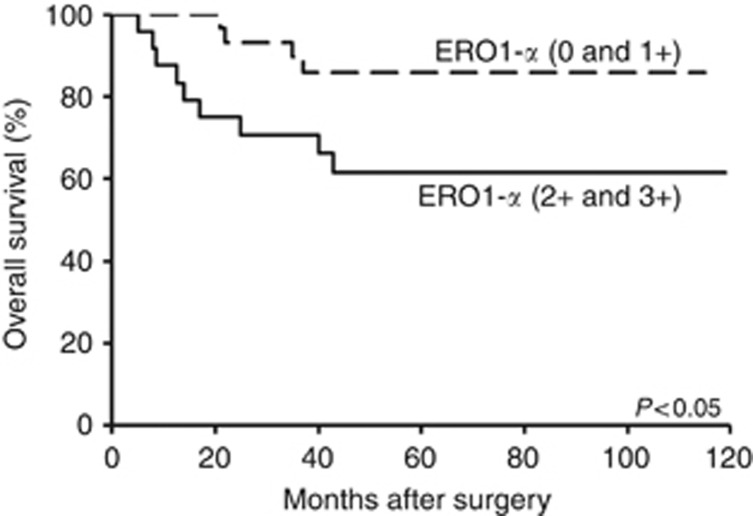
We found that the expression of ERO1-α promoted tumour growth in a mouse study and angiogenesis. The effects of ERO1-α on angiogenesis were mediated via oxidative protein folding of VEGF and enhancement of VEGF mRNA expression by using MDA-MB-231. In triple-negative breast cancer cases, the expression of ERO1-α related to the number of the blood vessel. Furthermore, we found that ERO1-α was a poor prognosis factor in triple-negative breast cancer.
Our study has established a novel link between expression of ERO1-α and secretion of VEGF, providing new evidence for the effectiveness of ERO1-α-targeted therapy in patients with ERO1-α-expressed cancer.
内质网二硫键氧化酶1-α(ERO1-α)是一种存在于内质网中的氧化酶,在分泌蛋白和细胞表面蛋白的二硫键形成中发挥作用。最近,我们报道ERO1-α在多种类型肿瘤中高表达,且是预后不良的新因素。然而,ERO1-α如何在体内影响肿瘤以及ERO1-α高表达的肿瘤患者预后不良的原因仍不清楚。因此,为阐明其机制,我们从血管生成角度研究了ERO1-α对肿瘤的影响。
利用非肥胖糖尿病-严重联合免疫缺陷小鼠分析ERO1-α对肿瘤生长和血管生成的影响。检测过表达或敲低ERO1-α的MDA-MB-231细胞中血管内皮生长因子(VEGF)的产生。研究ERO1-α对VEGF表达的作用。在三阴性乳腺癌病例中,分析ERO1-α表达与血管生成之间的关系。
我们发现在小鼠研究中ERO1-α的表达促进肿瘤生长和血管生成。ERO1-α对血管生成的影响是通过VEGF的氧化蛋白折叠以及利用MDA-MB-231增强VEGF mRNA表达介导的。在三阴性乳腺癌病例中,ERO1-α的表达与血管数量相关。此外,我们发现ERO1-α是三阴性乳腺癌预后不良的因素。
我们的研究建立了ERO1-α表达与VEGF分泌之间的新联系,为ERO1-α靶向治疗在ERO1-α表达型癌症患者中的有效性提供了新证据。