Liu Lihui, Li Sini, Qu Yan, Bai Hua, Pan Xiangyu, Wang Jian, Wang Zhijie, Duan Jianchun, Zhong Jia, Wan Rui, Fei Kailun, Xu Jiachen, Yuan Li, Wang Chao, Xue Pei, Zhang Xue, Ma Zixiao, Wang Jie
State Key Laboratory of Molecular Oncology, Department of Medical Oncology, National Cancer Center/National Clinical Research Center for Cancer/Cancer Hospital, Chinese Academy of Medical Sciences and Peking Union Medical College, Beijing 100021, China; CAMS Key Laboratory of Translational Research on Lung Cancer, State Key Laboratory of Molecular Oncology, Department of Medical Oncology, National Cancer Center/National Clinical Research Center for Cancer/Cancer Hospital, Chinese Academy of Medical Sciences and Peking Union Medical College, Beijing 100021, China.
State Key Laboratory of Molecular Oncology, Department of Medical Oncology, National Cancer Center/National Clinical Research Center for Cancer/Cancer Hospital, Chinese Academy of Medical Sciences and Peking Union Medical College, Beijing 100021, China; CAMS Key Laboratory of Translational Research on Lung Cancer, State Key Laboratory of Molecular Oncology, Department of Medical Oncology, National Cancer Center/National Clinical Research Center for Cancer/Cancer Hospital, Chinese Academy of Medical Sciences and Peking Union Medical College, Beijing 100021, China; Department of Medical Thoracic Oncology, Zhejiang Cancer Hospital, Hangzhou Institute of Medicine (HIM), Chinese Academy of Sciences, Hangzhou, Zhejiang 310022, China.
Cell Rep Med. 2023 Oct 17;4(10):101206. doi: 10.1016/j.xcrm.2023.101206. Epub 2023 Sep 27.
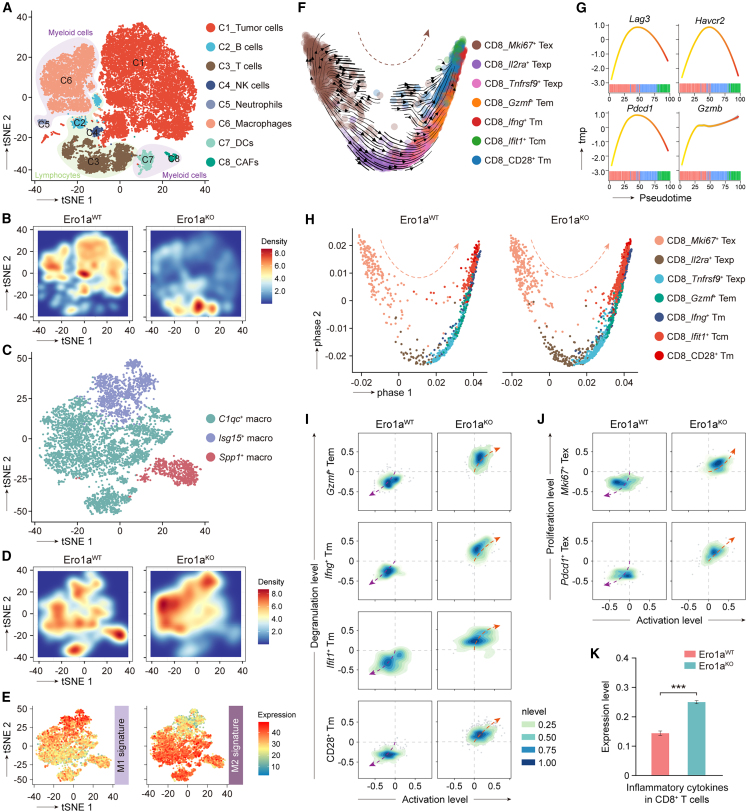
Immunophenotyping of the tumor microenvironment (TME) is essential for enhancing immunotherapy efficacy. However, strategies for characterizing the TME exhibit significant heterogeneity. Here, we show that endoplasmic reticular oxidoreductase-1α (ERO1A) mediates an immune-suppressive TME and attenuates the response to PD-1 blockade. Ablation of ERO1A in tumor cells substantially incites anti-tumor T cell immunity and promotes the efficacy of aPD-1 in therapeutic models. Single-cell RNA-sequencing analyses confirm that ERO1A correlates with immunosuppression and dysfunction of CD8 T cells along anti-PD-1 treatment. In human lung cancer, high ERO1A expression is associated with a higher risk of recurrence following neoadjuvant immunotherapy. Mechanistically, ERO1A ablation impairs the balance between IRE1α and PERK signaling activities and induces lethal unfolded protein responses in tumor cells undergoing endoplasmic reticulum stress, thereby enhancing anti-tumor immunity via immunogenic cell death. These findings reveal how tumor ERO1A induces immunosuppression, highlighting its potential as a therapeutic target for cancer immunotherapy.
肿瘤微环境(TME)的免疫表型分析对于提高免疫治疗疗效至关重要。然而,表征TME的策略存在显著异质性。在此,我们表明内质网氧化还原酶-1α(ERO1A)介导免疫抑制性TME并减弱对PD-1阻断的反应。肿瘤细胞中ERO1A的缺失显著激发抗肿瘤T细胞免疫,并促进aPD-1在治疗模型中的疗效。单细胞RNA测序分析证实,ERO1A与抗PD-1治疗期间CD8 T细胞的免疫抑制和功能障碍相关。在人类肺癌中,ERO1A高表达与新辅助免疫治疗后复发风险较高相关。从机制上讲,ERO1A缺失会损害IRE1α和PERK信号活性之间的平衡,并在经历内质网应激的肿瘤细胞中诱导致命的未折叠蛋白反应,从而通过免疫原性细胞死亡增强抗肿瘤免疫。这些发现揭示了肿瘤ERO1A如何诱导免疫抑制,突出了其作为癌症免疫治疗靶点的潜力。