Bento-Torres Natáli Valim Oliver, Rodrigues Anderson Raiol, Côrtes Maria Izabel Tentes, Bonci Daniela Maria de Oliveira, Ventura Dora Fix, Silveira Luiz Carlos de Lima
Instituto de Ciências Biológicas, Universidade Federal do Pará, Belém, Pará, Brazil.
Instituto de Ciências da Saúde, Universidade Federal do Pará, Belém, Pará, Brazil.
PLoS One. 2016 Apr 21;11(4):e0152214. doi: 10.1371/journal.pone.0152214. eCollection 2016.
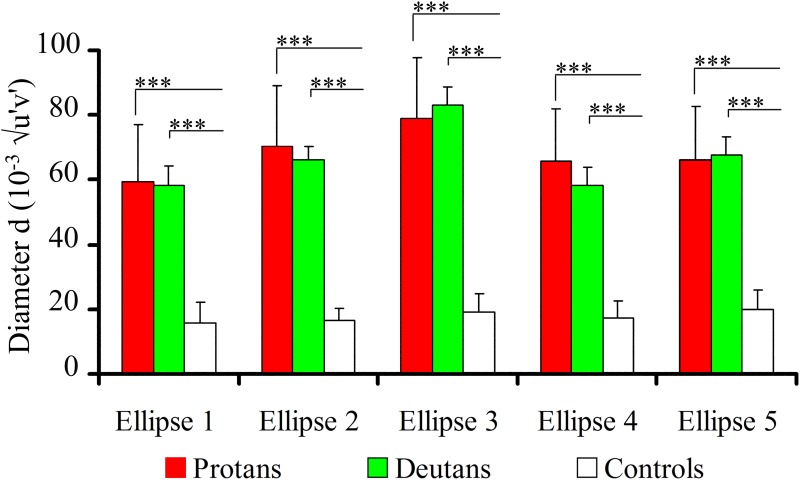
We have used the Farnsworth-Munsell 100-hue (FM 100) test and Mollon-Reffin (MR) test to evaluate the colour vision of 93 subjects, 30.4 ± 9.7 years old, who had red-green congenital colour vision deficiencies. All subjects lived in Belém (State of Pará, Brazil) and were selected by the State of Pará Traffic Department. Selection criteria comprised the absence of visual dysfunctions other than Daltonism and no history of systemic diseases that could impair the visual system performance. Results from colour vision deficient were compared with those from 127 normal trichromats, 29.3 ± 10.3 years old. For the MR test, measurements were taken around five points of the CIE 1976 colour space, along 20 directions irradiating from each point, in order to determine with high-resolution the corresponding colour discrimination ellipses (MacAdam ellipses). Three parameters were used to compare results obtained from different subjects: diameter of circle with same ellipse area, ratio between ellipse's long and short axes, and ellipse long axis angle. For the FM 100 test, the parameters were: logarithm of the total number of mistakes and positions of mistakes in the FM diagram. Data were also simultaneously analysed in two or three dimensions as well as by using multidimensional cluster analysis. For the MR test, Mollon-Reffin Ellipse #3 (u' = 0.225, v' = 0.415) discriminated more efficiently than the other four ellipses between protans and deutans once it provided larger angular difference in the colour space between protan and deutan confusion lines. The MR test was more sensitive than the FM 100 test. It separated individuals by dysfunctional groups with greater precision, provided a more sophisticated quantitative analysis, and its use is appropriate for a more refined evaluation of different phenotypes of red-green colour vision deficiencies.
我们使用了 Farnsworth-Munsell 100 色调(FM 100)测试和 Mollon-Reffin(MR)测试,对 93 名年龄在 30.4 ± 9.7 岁之间、患有红绿色先天性色觉缺陷的受试者的色觉进行评估。所有受试者均居住在贝伦(巴西帕拉州),并由帕拉州交通部门挑选。入选标准包括除色盲外无其他视觉功能障碍,且无可能损害视觉系统性能的全身性疾病史。将色觉缺陷者的测试结果与 127 名年龄在 29.3 ± 10.3 岁之间的正常三色视者的结果进行比较。对于 MR 测试,在 CIE 1976 颜色空间的五个点周围,沿着从每个点辐射出的 20 个方向进行测量,以便高分辨率地确定相应的颜色辨别椭圆(麦克亚当椭圆)。使用三个参数来比较不同受试者的测试结果:具有相同椭圆面积的圆的直径、椭圆长轴与短轴的比值以及椭圆长轴角度。对于 FM 100 测试,参数为:错误总数的对数以及 FM 图表中错误的位置。数据还同时进行了二维或三维分析以及多维聚类分析。对于 MR 测试,Mollon-Reffin 椭圆 #3(u' = 0.225,v' = 0.415)在区分红色盲和绿色盲方面比其他四个椭圆更有效,因为它在红色盲和绿色盲混淆线之间的颜色空间中提供了更大的角度差异。MR 测试比 FM 100 测试更敏感。它能更精确地按功能障碍组区分个体,提供更复杂的定量分析,并且适用于对红绿色觉缺陷的不同表型进行更精细的评估。