Sachwani Gul R, Jaehne Anja K, Jayaprakash Namita, Kuzich Mark, Onkoba Violet, Blyden Dione, Rivers Emanuel P
Henry Ford Hospital, 2799 W Grand Blvd, Detroit, MI 48202 USA.
J Inflamm (Lond). 2016 Apr 22;13:13. doi: 10.1186/s12950-016-0122-7. eCollection 2016.
Hyperglycemia is a frequent and important metabolic derangement that accompanies severe sepsis and septic shock. Matrix-Metalloproteinase 9 (MMP-9) has been shown to be elevated in acute stress hyperglycemia, chronic hyperglycemia, and in patient with sepsis. The objective of this study was to examine the clinical and pathogenic link between MMP-9 and blood glucose (BG) levels in patients with early severe sepsis and septic shock.
We prospectively examined 230 patients with severe sepsis and septic shock immediately upon hospital presentation and before any treatment including insulin administration. Clinical and laboratory data were obtained along with blood samples for the purpose of this study. Univariate tests for mean and median distribution using Spearman correlation and analysis of variance (ANOVA) were performed. A p value ≤ 0.05 was considered statistically significant.
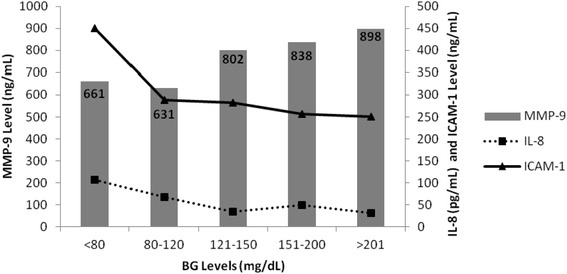
Patients were grouped based on their presenting BG level (mg/dL): BG <80 (n = 32), 80-120 (n = 53), 121-150 (n = 38), 151-200 (n = 23), and > 201 (n = 84). Rising MMP-9 levels were significantly associated with rising BG levels (p = 0.043). A corresponding increase in the prevalence of diabetes for each glucose grouping from 6.3 to 54.1 % (p = 0.0001) was also found. As MMP-9 levels increased a significantly (p < 0.001) decreases in IL-8 (pg/mL) and ICAM-1 (ng/mL) were noted.
This is the first study in humans demonstrating a significant and early association between MMP-9 and BG levels in in patients with severe sepsis and septic shock. Neutrophil affecting biomarkers such as IL-8 and ICAM-1 are noted to decrease as MMP-9 levels increase. Clinical risk stratification using MMP-9 levels could potentially help determine which patients would benefit from intensive versus conventional insulin therapy. In addition, antagonizing the up-regulation of MMP-9 could serve as a potential treatment option in severe sepsis or septic shock patients.
高血糖是严重脓毒症和脓毒性休克常见且重要的代谢紊乱。基质金属蛋白酶9(MMP-9)在急性应激性高血糖、慢性高血糖以及脓毒症患者中均有升高。本研究旨在探讨早期严重脓毒症和脓毒性休克患者中MMP-9与血糖(BG)水平之间的临床及病理联系。
我们前瞻性地研究了230例严重脓毒症和脓毒性休克患者,患者入院后立即进行研究,且在包括胰岛素治疗在内的任何治疗之前。为了本研究的目的,获取了临床和实验室数据以及血样。使用Spearman相关性和方差分析(ANOVA)对均值和中位数分布进行单变量检验。p值≤0.05被认为具有统计学意义。
根据患者就诊时的BG水平(mg/dL)进行分组:BG<80(n = 32),80 - 120(n = 53),121 - 150(n = 38),151 - 200(n = 23),以及>201(n = 84)。MMP-9水平升高与BG水平升高显著相关(p = 0.043)。还发现每个血糖分组中糖尿病患病率相应增加,从6.3%至54.1%(p = 0.0001)。随着MMP-9水平升高,IL-8(pg/mL)和ICAM-1(ng/mL)显著降低(p<0.001)。
这是第一项在人类中证明严重脓毒症和脓毒性休克患者中MMP-9与BG水平之间存在显著且早期关联的研究。随着MMP-9水平升高,诸如IL-8和ICAM-1等影响中性粒细胞的生物标志物会降低。使用MMP-9水平进行临床风险分层可能有助于确定哪些患者将从强化胰岛素治疗与常规胰岛素治疗中获益。此外,拮抗MMP-9的上调可能作为严重脓毒症或脓毒性休克患者的一种潜在治疗选择。