Guan Chengran, Cui Wenjing, Cheng Jintao, Zhou Li, Liu Zhongmei, Zhou Zhemin
School of Biotechnology, Key Laboratory of Industrial Biotechnology (Ministry of Education), Jiangnan University, 1800 Lihu Avenue, Wuxi, 214122, Jiangsu, China.
Microb Cell Fact. 2016 Apr 25;15:66. doi: 10.1186/s12934-016-0464-0.
Bacillus subtilis, a Gram-positive organism, has been developed to be an attractive expression platform to produce both secreted and cytoplasmic proteins owing to its prominent biological characteristics. We previously developed an auto-inducible expression system containing the srfA promoter (PsrfA) which was activated by the signal molecules acting in the quorum-sensing pathway for competence. The P srfA promoter exhibited the unique property of inducer-free activity that is closely correlated with cell density.
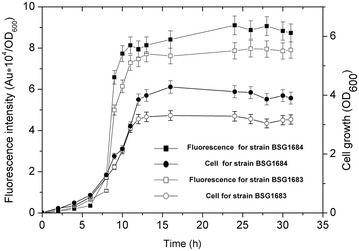
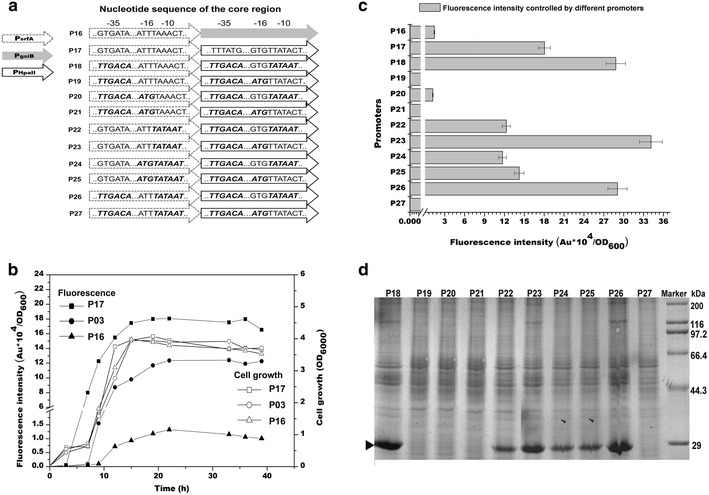
To improve the PsrfA-mediated expression system to the high-cell-density fermentation for industrial production in the B. subtilis mutant strain that is unable to sporulate, a spore mutant strain BSG1682 was developed, and the PsrfA promoter was enhanced by promoter engineering. Using green fluorescent protein (GFP) as the reporter, higher fluorescent intensity was observed in BSG1682 with expression from either plasmid or chromosome than that of the wild type B. subtilis 168. Thereafter, the PsrfA was engineered, yielding a library of PsrfA derivatives varied in the strength of GFP expression. The P23 promoter exhibited the best performance, almost twofold stronger than that of P srfA. Two heterologous proteins, aminopeptidase (AP) and nattokinase (NK), were successfully overproduced under the control of P23 in BSG1682. Finally, the capacity of the expression system was demonstrated in batch fermentation in a 5-L fermenter.
The expression system demonstrates prominence in the activity of the auto-inducible promoter. Desired proteins could be highly and stably produced by integrating the corresponding genes downstream of the promoter on the plasmid or the chromosome in strain BSG1682. The expression system is conducive to the industrial production of pharmaceuticals and heterologous proteins in high-cell-density fermentation in BSG1682.
枯草芽孢杆菌是一种革兰氏阳性菌,由于其突出的生物学特性,已被开发成为一个有吸引力的表达平台,用于生产分泌型和胞质蛋白。我们之前开发了一种自动诱导表达系统,该系统包含srfA启动子(PsrfA),它可被群体感应途径中用于感受态的信号分子激活。PsrfA启动子表现出与细胞密度密切相关的无诱导剂活性这一独特特性。
为了在无法形成芽孢的枯草芽孢杆菌突变株中,将基于PsrfA的表达系统改进为用于工业生产的高细胞密度发酵系统,构建了一个芽孢突变株BSG1682,并通过启动子工程增强了PsrfA启动子。以绿色荧光蛋白(GFP)作为报告基因,观察到在BSG1682中,无论是质粒表达还是染色体表达,其荧光强度都高于野生型枯草芽孢杆菌168。此后,对PsrfA进行工程改造,产生了一系列GFP表达强度不同的PsrfA衍生物文库。P23启动子表现最佳,其活性几乎是PsrfA的两倍。在BSG1682中,两种异源蛋白氨基肽酶(AP)和纳豆激酶(NK)在P23的控制下成功实现了过量表达。最后,在5-L发酵罐的分批发酵中展示了该表达系统的能力。
该表达系统在自动诱导启动子的活性方面表现突出。通过将相应基因整合到BSG1682菌株质粒或染色体上启动子的下游,可高效稳定地生产所需蛋白质。该表达系统有利于在BSG1682中进行高细胞密度发酵来工业化生产药物和异源蛋白。