Chang Yu-Che, Lee Ching-Hsing, Chen Chien-Kuang, Liao Chien-Hung, Ng Chip-Jin, Chen Jih-Chang, Chaou Chung-Hsien
Chang Gung Medical Education Research Center, CGMERC, No. 5, Fusing St., Gueishan Township, 333, Taoyuan city, Taiwan (R.O.C.).
Department of Emergency Medicine, Chang Gung Memorial Hospital, Linkou, and Chang Gung University College of Medicine, Taoyuan City, Taiwan (R.O.C.).
Adv Health Sci Educ Theory Pract. 2017 Mar;22(1):57-67. doi: 10.1007/s10459-016-9682-9. Epub 2016 Apr 25.
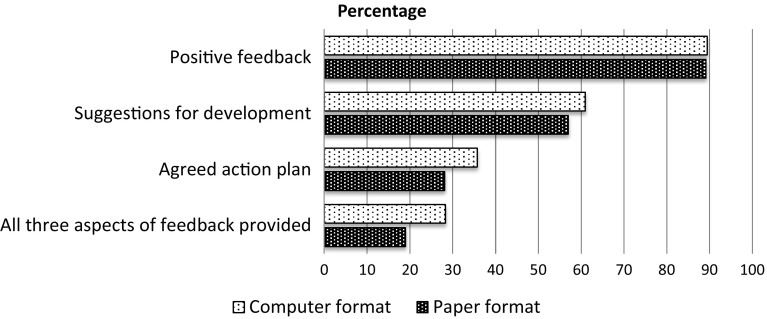
The mini-clinical evaluation exercise (mini-CEX) is a well-established method of assessing trainees' clinical competence in the workplace. In order to improve the quality of clinical learning, factors that influence the provision of feedback are worthy of further investigation. A retrospective data analysis of documented feedback provided by assessors using the mini-CEX in a busy emergency department (ED) was conducted. The assessors comprised emergency physicians (EPs) and trauma surgeons. The trainees were all postgraduate year one (PGY1) residents. The completion rate and word count for each of three feedback components (positive feedback, suggestions for development, and an agreed action plan) were recorded. Other variables included observation time, feedback time, the format used (paper versus computer-based), the seniority of the assessor, the gender of the assessor and the specialty of the assessor. The components of feedback provided by the assessors and the influence of these contextual and demographic factors were also analyzed. During a 26-month study period, 1101 mini-CEX assessments (from 273 PGY1 residents and 67 assessors) were collected. The overall completion rate for the feedback components was 85.3 % (positive feedback), 54.8 % (suggestions for development), and 29.5 % (agreed action plan). In only 22.9 % of the total mini-CEX assessments were all three aspects of feedback completed, and 7.4 % contained no feedback. In the univariate analysis, the mini-CEX format, the seniority of the assessor and the specialty of the assessor were identified as influencing the completion of all three components of feedback. In the multivariate analysis, only the mini-CEX format and the seniority of the assessor were statistically significant. In a subgroup analysis, the feedback-facilitating effect of the computer-based format was uneven across junior and senior EPs. In addition, feedback provision showed a primacy effect: assessors tended to provide only the first or second feedback components in a busy ED setting. In summary, the authors explored the influence of gender, seniority and specialty on paper and computer-based feedback provision during mini-CEX assessments for PGY1 residency training in a busy ED. It was shown that junior assessors were more likely to provide all three aspects of written feedback in the mini-CEX than were senior assessors. The computer-based format facilitated the completion of feedback among EPs.
迷你临床评估练习(mini-CEX)是一种成熟的评估实习生在工作场所临床能力的方法。为了提高临床学习质量,影响反馈提供的因素值得进一步研究。我们对繁忙急诊科(ED)中评估者使用mini-CEX提供的书面反馈进行了回顾性数据分析。评估者包括急诊医师(EPs)和创伤外科医生。实习生均为一年级住院医师(PGY1)。记录了三个反馈部分(正面反馈、发展建议和商定的行动计划)各自的完成率和字数。其他变量包括观察时间、反馈时间、使用的格式(纸质版与基于计算机的)、评估者的资历、评估者的性别以及评估者的专业。还分析了评估者提供的反馈内容以及这些背景和人口统计学因素的影响。在为期26个月的研究期间,收集了1101份mini-CEX评估(来自273名PGY1住院医师和67名评估者)。反馈部分的总体完成率分别为85.3%(正面反馈)、54.8%(发展建议)和29.5%(商定的行动计划)。在所有mini-CEX评估中,仅22.9%的评估完成了反馈的所有三个方面,7.4%的评估没有反馈。在单变量分析中,mini-CEX格式、评估者的资历和评估者的专业被确定为影响反馈所有三个部分的完成情况。在多变量分析中,只有mini-CEX格式和评估者的资历具有统计学意义。在亚组分析中,基于计算机的格式对初级和高级急诊医师的反馈促进效果不均衡。此外,反馈提供呈现出首因效应:在繁忙的急诊科环境中,评估者倾向于只提供前两个反馈部分。总之,作者探讨了在繁忙急诊科PGY1住院医师培训的mini-CEX评估中,性别、资历和专业对纸质版和基于计算机的反馈提供的影响。结果表明,与高级评估者相比,初级评估者在mini-CEX中更有可能提供书面反馈的所有三个方面。基于计算机的格式有助于急诊医师完成反馈。