Baurley James W, Edlund Christopher K, Pardamean Carissa I, Conti David V, Krasnow Ruth, Javitz Harold S, Hops Hyman, Swan Gary E, Benowitz Neal L, Bergen Andrew W
BioRealm, LLC , Culver City , CA.
SRI International , Menlo Park , CA.
Nicotine Tob Res. 2016 Sep;18(9):1837-1844. doi: 10.1093/ntr/ntw117. Epub 2016 Apr 25.
Metabolic enzyme variation and other patient and environmental characteristics influence smoking behaviors, treatment success, and risk of related disease. Population-specific variation in metabolic genes contributes to challenges in developing and optimizing pharmacogenetic interventions. We applied a custom genome-wide genotyping array for addiction research (Smokescreen), to three laboratory-based studies of nicotine metabolism with oral or venous administration of labeled nicotine and cotinine, to model nicotine metabolism in multiple populations. The trans-3'-hydroxycotinine/cotinine ratio, the nicotine metabolite ratio (NMR), was the nicotine metabolism measure analyzed.
Three hundred twelve individuals of self-identified European, African, and Asian American ancestry were genotyped and included in ancestry-specific genome-wide association scans (GWAS) and a meta-GWAS analysis of the NMR. We modeled natural-log transformed NMR with covariates: principal components of genetic ancestry, age, sex, body mass index, and smoking status.
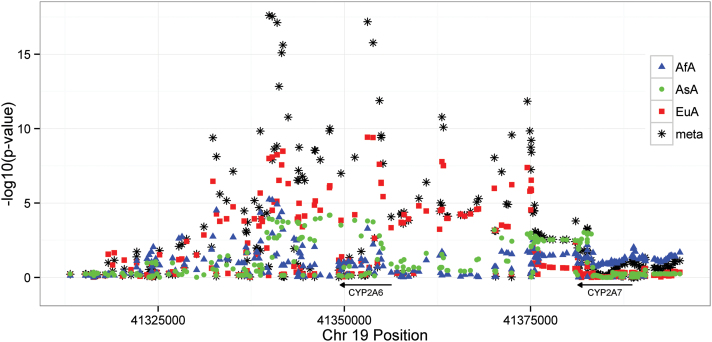
African and Asian American NMRs were statistically significantly (P values ≤ 5E-5) lower than European American NMRs. Meta-GWAS analysis identified 36 genome-wide significant variants over a 43 kilobase pair region at CYP2A6 with minimum P = 2.46E-18 at rs12459249, proximal to CYP2A6. Additional minima were located in intron 4 (rs56113850, P = 6.61E-18) and in the CYP2A6-CYP2A7 intergenic region (rs34226463, P = 1.45E-12). Most (34/36) genome-wide significant variants suggested reduced CYP2A6 activity; functional mechanisms were identified and tested in knowledge-bases. Conditional analysis resulted in intergenic variants of possible interest (P values < 5E-5).
This meta-GWAS of the NMR identifies CYP2A6 variants, replicates the top-ranked single nucleotide polymorphism from a recent Finnish meta-GWAS of the NMR, identifies functional mechanisms, and provides pan-continental population biomarkers for nicotine metabolism.
This multiple ancestry meta-GWAS of the laboratory study-based NMR provides novel evidence and replication for genome-wide association of CYP2A6 single nucleotide and insertion-deletion polymorphisms. We identify three regions of genome-wide significance: proximal, intronic, and distal to CYP2A6. We replicate the top-ranking single nucleotide polymorphism from a recent GWAS of the NMR in Finnish smokers, identify a functional mechanism for this intronic variant from in silico analyses of RNA-seq data that is consistent with CYP2A6 expression measured in postmortem lung and liver, and provide additional support for the intergenic region between CYP2A6 and CYP2A7.
代谢酶变异以及其他患者和环境特征会影响吸烟行为、治疗效果和相关疾病风险。代谢基因在不同人群中的特异性变异给开发和优化药物遗传学干预措施带来了挑战。我们将一种定制的全基因组基因分型芯片(烟幕芯片)应用于三项基于实验室的尼古丁代谢研究,这些研究通过口服或静脉注射标记的尼古丁和可替宁来模拟多人群中的尼古丁代谢。反式3'-羟基可替宁/可替宁比值,即尼古丁代谢物比值(NMR),是所分析的尼古丁代谢指标。
对312名自我认定为欧洲、非洲和亚裔美国人血统的个体进行基因分型,并将其纳入特定血统的全基因组关联扫描(GWAS)以及对NMR的荟萃GWAS分析。我们用协变量对自然对数转换后的NMR进行建模:遗传血统的主成分、年龄、性别、体重指数和吸烟状况。
非洲裔和亚裔美国人的NMR在统计学上显著低于欧裔美国人的NMR(P值≤5E - 5)。荟萃GWAS分析在CYP2A6基因的一个43千碱基对区域内鉴定出36个全基因组显著变异,其中rs12459249处的最小P值为2.46E - 18,靠近CYP2A6。其他最小值位于内含子4(rs56113850,P = 6.61E - 18)和CYP2A6 - CYP2A7基因间区域(rs34226463,P = 1.45E - 12)。大多数(34/36)全基因组显著变异表明CYP2A6活性降低;在知识库中鉴定并测试了功能机制。条件分析产生了可能感兴趣的基因间变异(P值<5E - 5)。
这项对NMR的荟萃GWAS鉴定出CYP2A6变异,重复了近期芬兰对NMR的荟萃GWAS中排名靠前的单核苷酸多态性,鉴定出功能机制,并为尼古丁代谢提供了泛大陆人群生物标志物。
这项基于实验室研究的NMR的多血统荟萃GWAS为CYP2A6单核苷酸和插入缺失多态性的全基因组关联提供了新的证据和重复验证。我们鉴定出三个全基因组显著区域:CYP2A6的近端、内含子和远端区域。我们在芬兰吸烟者中重复了近期NMR的GWAS中排名第一的单核苷酸多态性,通过对RNA测序数据的计算机分析鉴定出该内含子变异的功能机制,这与死后肺和肝脏中测量的CYP2A6表达一致,并为CYP2A6和CYP2A7之间的基因间区域提供了额外支持。