Harvey Adam, Montezano Augusto C, Lopes Rheure Alves, Rios Francisco, Touyz Rhian M
Institute of Cardiovascular and Medical Sciences, BHF Glasgow Cardiovascular Research Centre, University of Glasgow, Glasgow, Scotland.
Institute of Cardiovascular and Medical Sciences, BHF Glasgow Cardiovascular Research Centre, University of Glasgow, Glasgow, Scotland.
Can J Cardiol. 2016 May;32(5):659-68. doi: 10.1016/j.cjca.2016.02.070. Epub 2016 Mar 3.
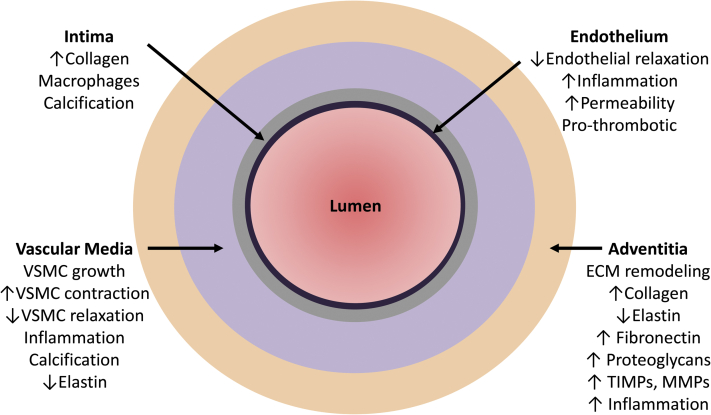
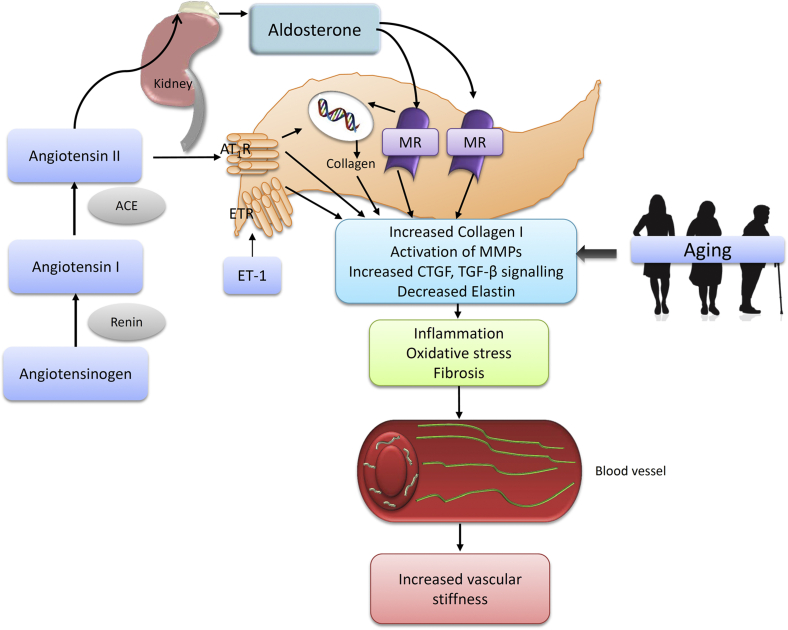
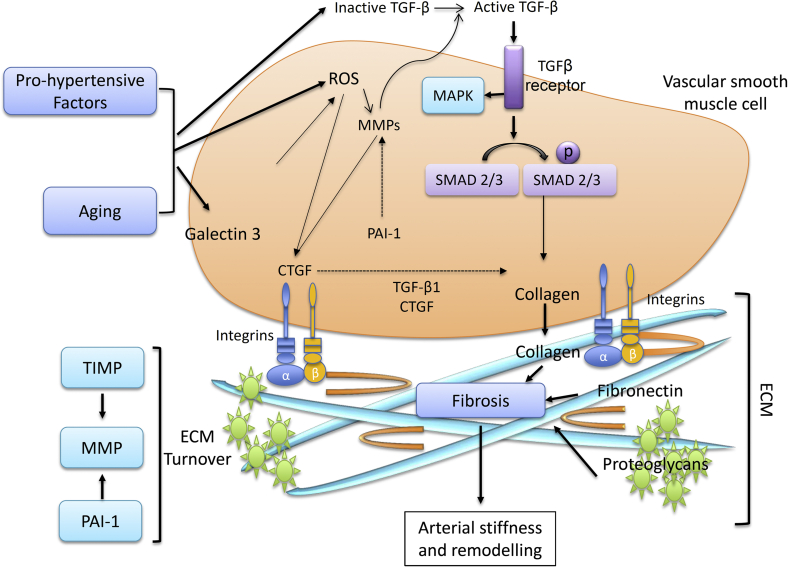
Aging is the primary risk factor underlying hypertension and incident cardiovascular disease. With aging, the vasculature undergoes structural and functional changes characterized by endothelial dysfunction, wall thickening, reduced distensibility, and arterial stiffening. Vascular stiffness results from fibrosis and extracellular matrix (ECM) remodelling, processes that are associated with aging and are amplified by hypertension. Some recently characterized molecular mechanisms underlying these processes include increased expression and activation of matrix metalloproteinases, activation of transforming growth factor-β1/SMAD signalling, upregulation of galectin-3, and activation of proinflammatory and profibrotic signalling pathways. These events can be induced by vasoactive agents, such as angiotensin II, endothelin-1, and aldosterone, which are increased in the vasculature during aging and hypertension. Complex interplay between the "aging process" and prohypertensive factors results in accelerated vascular remodelling and fibrosis and increased arterial stiffness, which is typically observed in hypertension. Because the vascular phenotype in a young hypertensive individual resembles that of an elderly otherwise healthy individual, the notion of "early" or "premature" vascular aging is now often used to describe hypertension-associated vascular disease. We review the vascular phenotype in aging and hypertension, focusing on arterial stiffness and vascular remodelling. We also highlight the clinical implications of these processes and discuss some novel molecular mechanisms of fibrosis and ECM reorganization.
衰老为高血压及心血管疾病发病的主要危险因素。随着年龄增长,血管系统会发生结构和功能变化,其特征为内皮功能障碍、血管壁增厚、扩张性降低及动脉僵硬。血管僵硬源于纤维化和细胞外基质(ECM)重塑,这些过程与衰老相关,并因高血压而加剧。这些过程背后一些最近得以明确的分子机制包括基质金属蛋白酶表达和激活增加、转化生长因子-β1/SMAD信号通路激活、半乳糖凝集素-3上调以及促炎和促纤维化信号通路激活。这些事件可由血管活性物质诱导,如血管紧张素II、内皮素-1和醛固酮,这些物质在衰老和高血压过程中在血管系统中含量增加。“衰老过程”与高血压相关因素之间的复杂相互作用导致血管重塑和纤维化加速以及动脉僵硬增加,这在高血压中较为常见。由于年轻高血压个体的血管表型类似于老年健康个体,“早期”或“过早”血管衰老的概念现在常被用于描述高血压相关的血管疾病。我们综述衰老和高血压中的血管表型,重点关注动脉僵硬和血管重塑。我们还强调这些过程的临床意义,并讨论纤维化和ECM重组的一些新分子机制。