Han Jichang, Zhang Lin, Wang Song, Yang Guanpin, Zhao Lu, Pan Kehou
Laboratory of Applied Microalgae Biology, Ocean University of China, Qingdao, 266003 China.
Laboratory of Applied Microalgae Biology, Ocean University of China, Qingdao, 266003 China ; Key Laboratory of Marine Biotechnology, Ningbo University, Ningbo, 315211 China.
J Biol Res (Thessalon). 2016 Apr 26;23:8. doi: 10.1186/s40709-016-0047-6. eCollection 2016 Dec.
Microalgae frequently grow in natural environment and long-term laboratory cultures in association with bacteria. Bacteria benefit the oxygen and extracellular substances generated by microalgae, and reimburse microalgae with carbon dioxide, vitamins and so on. Such synergistic relationship has aided in establishing an efficient microalga-bacterium co-culturing mode. Obviously, the mutually beneficial relationship can be strengthened with the increase of the densities of microalgae and bacteria. However, nearly all of the early co-cultures were performed under photoautotrophic conditions, thus both microalgae and bacteria were at relatively low densities. In this study, the feasibility of bacteria-microalgae co-cultured under mixotrophic conditions was studied.
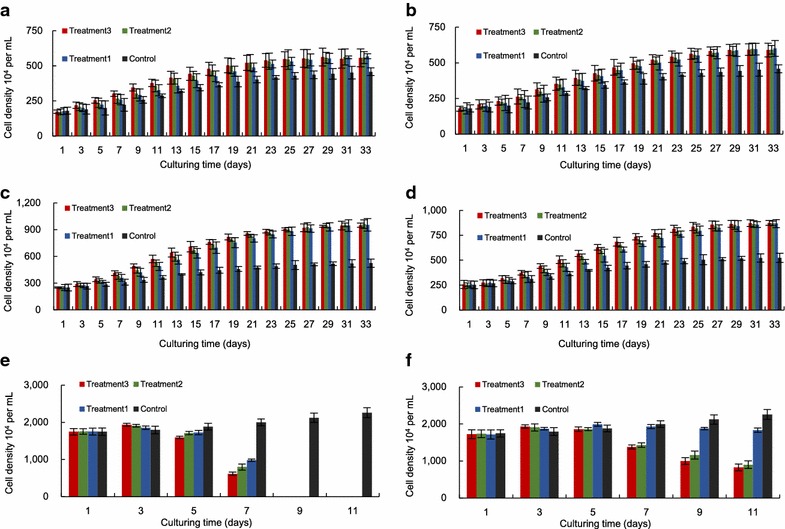
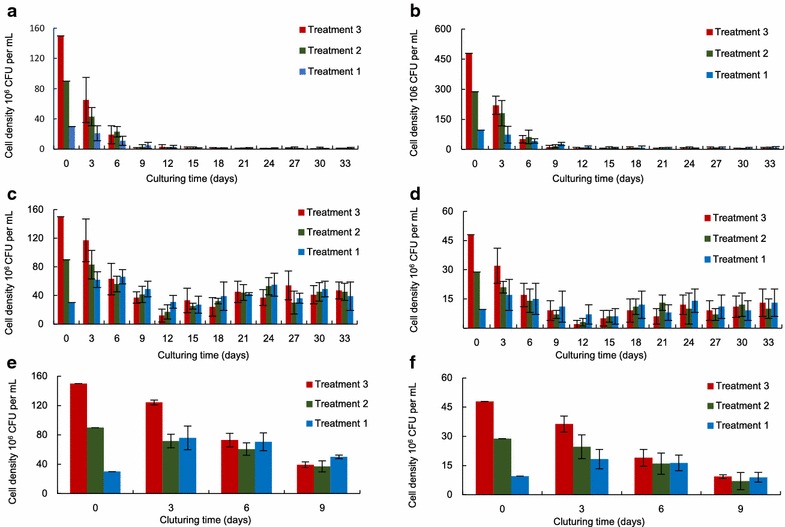
Firstly, bacteria mingled with xenic microalgae were isolated and identified based on their 16S rRNA gene sequence (16S rDNA hereafter). Then, the two most frequently found strains of Muricauda sp. were co-cultured with axenic microalga (Tetraselmis chuii, Cylindrotheca fusiformis and Nannochloropsis gaditana) in extra organic carbon containing medium. At the end of a co-culture period of 33 days, we found that the final cell density of T. chuii and C. fusiformis of various treatments was remarkably higher than that of controls (21.37-31.18 and 65.42-83.47 %, respectively); on the contrary, the growth of N. gaditana was markedly inhibited. During the co-culture of bacteria with C. fusiformis, the cell density of two strains of bacteria firstly decreased, then increased and maintained at a relatively steady level. However, the cell density of bacteria performed a sustaining downward trend when they were co-cultured with T. chuii and N. gaditana.
Our findings proved that microalgae-bacteria co-cultures under mixotrophic conditions are quite effective strategy for microalgal cultivation.
微藻在自然环境以及长期实验室培养中常与细菌共生。细菌受益于微藻产生的氧气和胞外物质,并为微藻提供二氧化碳、维生素等作为回报。这种协同关系有助于建立一种高效的微藻 - 细菌共培养模式。显然,随着微藻和细菌密度的增加,这种互利关系会得到加强。然而,几乎所有早期的共培养都是在光合自养条件下进行的,因此微藻和细菌的密度都相对较低。在本研究中,我们研究了在混合营养条件下细菌 - 微藻共培养的可行性。
首先,基于16S rRNA基因序列(以下简称16S rDNA)对与混合微藻混合的细菌进行了分离和鉴定。然后,将两种最常见的Muricauda sp.菌株与无菌微藻(杜氏盐藻、梭形筒柱藻和加的斯拟微绿球藻)在含有额外有机碳的培养基中共培养。在33天的共培养期结束时,我们发现各处理组的杜氏盐藻和梭形筒柱藻的最终细胞密度显著高于对照组(分别为21.37 - 31.18%和65.42 - 83.47%);相反,加的斯拟微绿球藻的生长受到显著抑制。在细菌与梭形筒柱藻共培养过程中,两种细菌菌株的细胞密度先下降,然后上升并维持在相对稳定的水平。然而,当它们与杜氏盐藻和加的斯拟微绿球藻共培养时,细菌的细胞密度呈持续下降趋势。
我们的研究结果证明,在混合营养条件下微藻 - 细菌共培养是微藻培养的一种非常有效的策略。