CAS Key Laboratory of Bio-Based Materials, Qingdao Institute of Bioenergy and Bioprocess Technology, Chinese Academy of Sciences, Qingdao, 266101, China.
Microb Cell Fact. 2021 Jan 7;20(1):6. doi: 10.1186/s12934-020-01498-8.
The majority of microbial fermentations are currently performed in the batch or fed-batch manner with the high process complexity and huge water consumption. The continuous microbial production can contribute to the green sustainable development of the fermentation industry. The co-culture systems of photo-autotrophic and heterotrophic species can play important roles in establishing the continuous fermentation mode for the bio-based chemicals production.
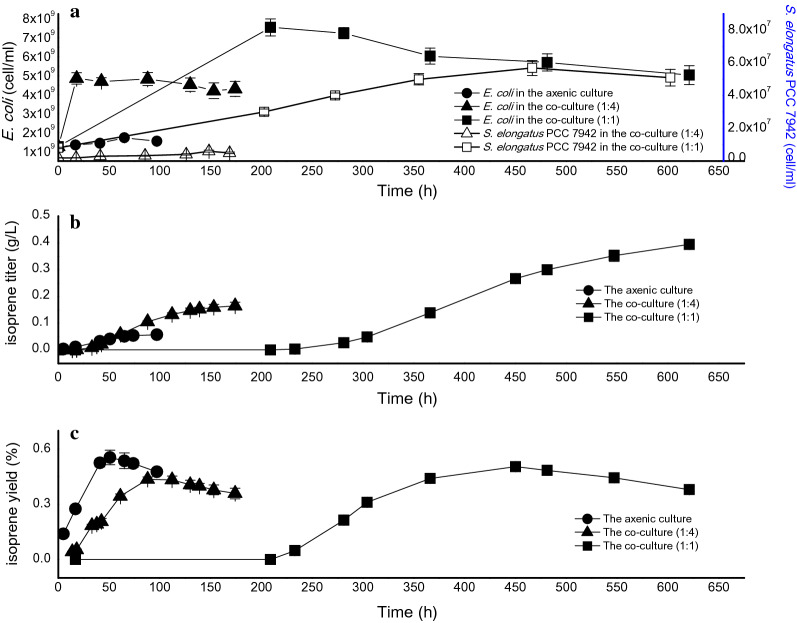
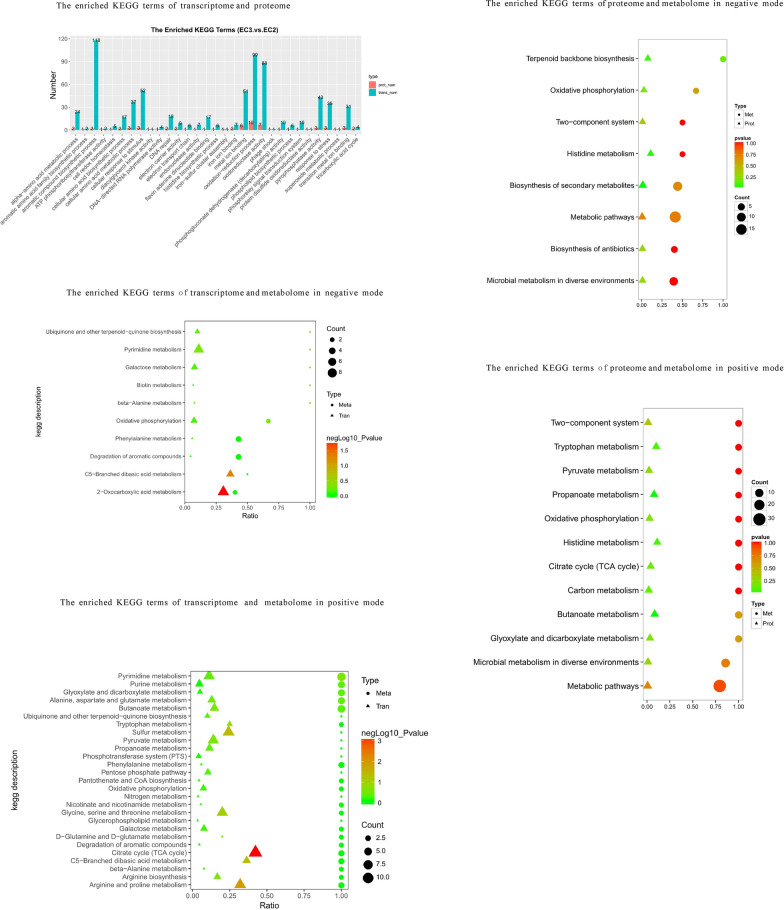
In the present paper, the co-culture system of Synechococcus elongates-Escherichia coli was established and put into operation stably for isoprene production. Compared with the axenic culture, the fermentation period of time was extended from 100 to 400 h in the co-culture and the isoprene production was increased to eightfold. For in depth understanding this novel system, the differential omics profiles were analyzed. The responses of BL21(DE3) to S. elongatus PCC 7942 were triggered by the oxidative pressure through the Fenton reaction and all these changes were linked with one another at different spatial and temporal scales. The oxidative stress mitigation pathways might contribute to the long-lasting fermentation process. The performance of this co-culture system can be further improved according to the fundamental rules discovered by the omics analysis.
The isoprene-producing co-culture system of S. elongates-E. coli was established and then analyzed by the omics methods. This study on the co-culture system of the model S. elongates-E. coli is of significance to reveal the common interactions between photo-autotrophic and heterotrophic species without natural symbiotic relation, which could provide the scientific basis for rational design of microbial community.
目前大多数微生物发酵都是采用分批或补料分批的方式进行的,具有很高的过程复杂性和大量的耗水量。连续微生物生产有助于发酵行业的绿色可持续发展。光自养和异养物种的共培养系统可以在建立生物基化学品生产的连续发酵模式方面发挥重要作用。
本文建立了聚球藻 elongatus-Escherichia coli 共培养系统,并稳定运行用于异戊二烯生产。与单培养相比,共培养的发酵时间从 100 小时延长到 400 小时,异戊二烯产量增加了 8 倍。为了深入了解这个新系统,我们分析了差异组学图谱。BL21(DE3)对聚球藻 elongatus PCC 7942 的反应是通过芬顿反应引发的氧化压力触发的,所有这些变化在不同的时空尺度上相互关联。氧化应激缓解途径可能有助于长时间的发酵过程。根据组学分析发现的基本规律,可以进一步提高这种共培养系统的性能。
建立了聚球藻 elongatus-E. coli 异戊二烯生产共培养系统,并采用组学方法进行了分析。对模式聚球藻 elongatus-E. coli 共培养系统的研究有助于揭示无自然共生关系的光自养和异养物种之间的共同相互作用,为微生物群落的合理设计提供了科学依据。