García-Guerrero Estefanía, Pérez-Simón José Antonio, Sánchez-Abarca Luis Ignacio, Díaz-Moreno Irene, De la Rosa Miguel A, Díaz-Quintana Antonio
Instituto de Biomedicina de Sevilla (IBIS)/Hospital Universitario Virgen del Rocío/CSIC/Universidad de Sevilla, Seville, Spain.
Hospital Universitario de Salamanca/Servicio de Hematología, Salamanca, Spain.
PLoS One. 2016 Apr 28;11(4):e0154219. doi: 10.1371/journal.pone.0154219. eCollection 2016.
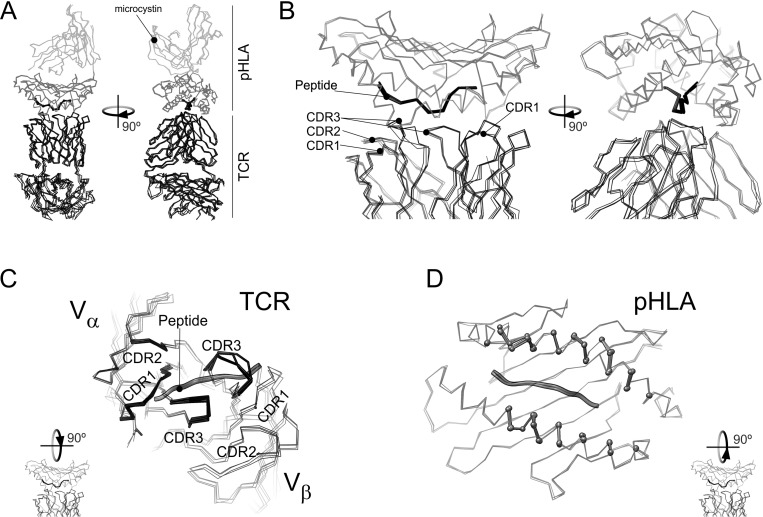
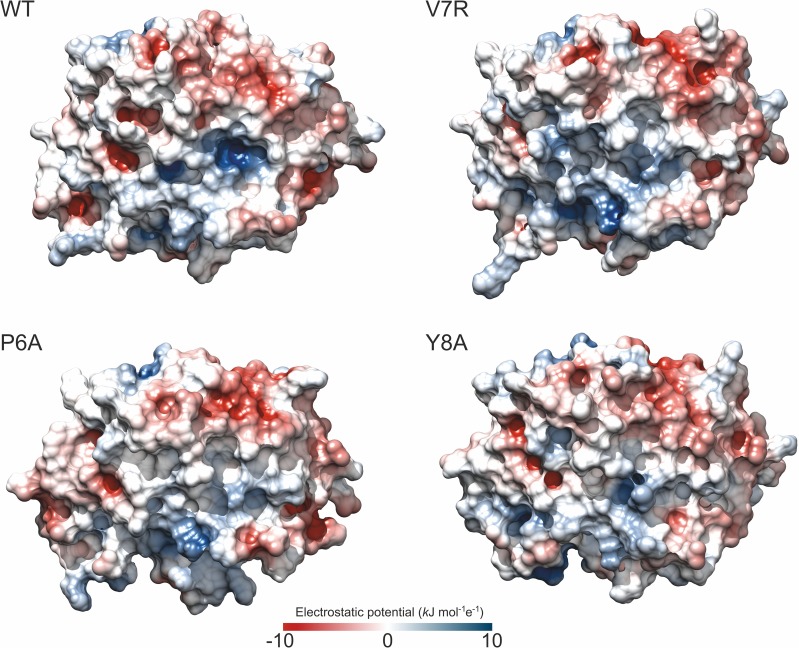
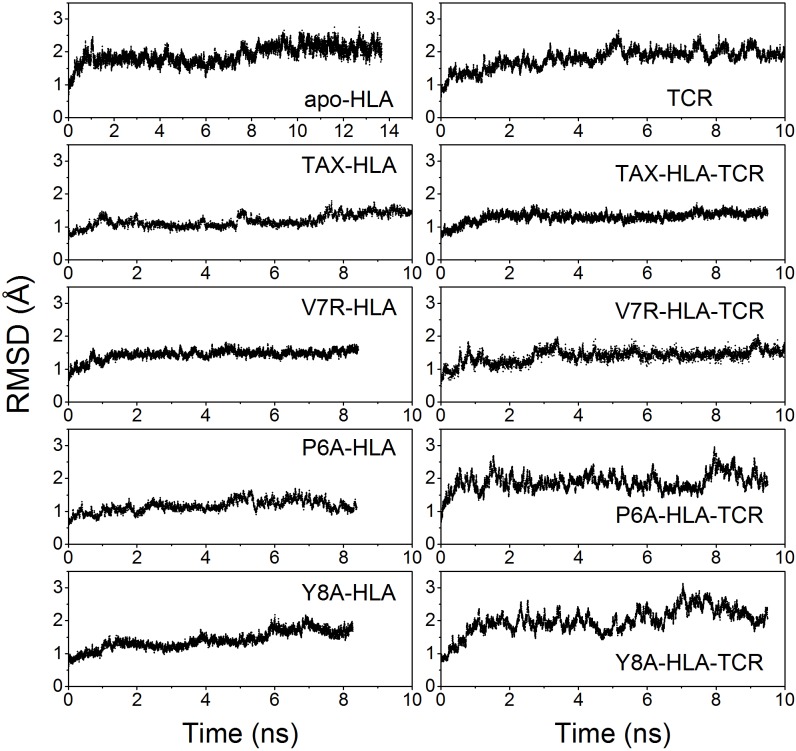
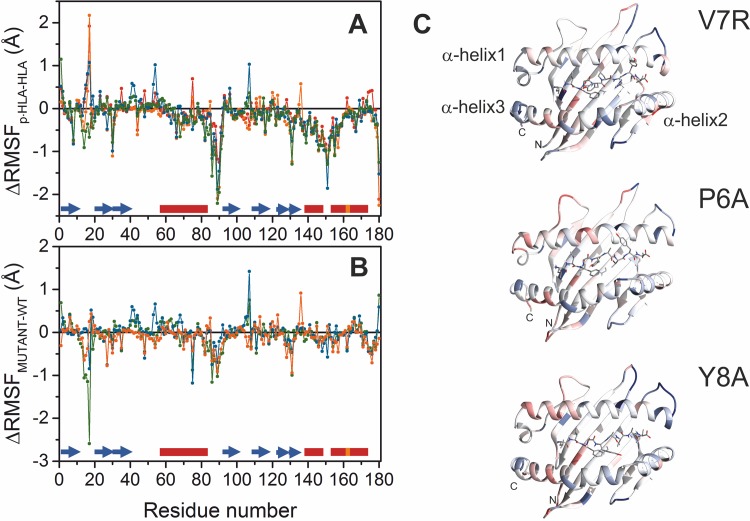
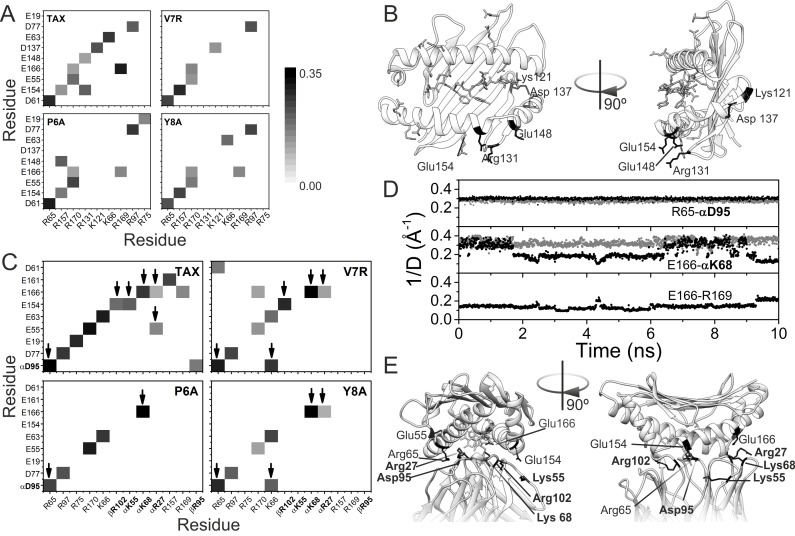
Generating the immune response requires the discrimination of peptides presented by the human leukocyte antigen complex (HLA) through the T-cell receptor (TCR). However, how a single amino acid substitution in the antigen bonded to HLA affects the response of T cells remains uncertain. Hence, we used molecular dynamics computations to analyze the molecular interactions between peptides, HLA and TCR. We compared immunologically reactive complexes with non-reactive and weakly reactive complexes. MD trajectories were produced to simulate the behavior of isolated components of the various p-HLA-TCR complexes. Analysis of the fluctuations showed that p-HLA binding barely restrains TCR motions, and mainly affects the CDR3 loops. Conversely, inactive p-HLA complexes displayed significant drop in their dynamics when compared with its free versus ternary forms (p-HLA-TCR). In agreement, the free non-reactive p-HLA complexes showed a lower amount of salt bridges than the responsive ones. This resulted in differences between the electrostatic potentials of reactive and inactive p-HLA species and larger vibrational entropies in non-elicitor complexes. Analysis of the ternary p-HLA-TCR complexes also revealed a larger number of salt bridges in the responsive complexes. To summarize, our computations indicate that the affinity of each p-HLA complex towards TCR is intimately linked to both, the dynamics of its free species and its ability to form specific intermolecular salt-bridges in the ternary complexes. Of outstanding interest is the emerging concept of antigen reactivity involving its interplay with the HLA head sidechain dynamics by rearranging its salt-bridges.
产生免疫反应需要通过T细胞受体(TCR)识别由人类白细胞抗原复合体(HLA)呈递的肽段。然而,与HLA结合的抗原中单个氨基酸的替换如何影响T细胞的反应仍不确定。因此,我们使用分子动力学计算来分析肽段、HLA和TCR之间的分子相互作用。我们将免疫反应性复合物与非反应性和弱反应性复合物进行了比较。生成了分子动力学轨迹以模拟各种p-HLA-TCR复合物的分离组分的行为。对波动的分析表明,p-HLA结合几乎不会限制TCR的运动,主要影响互补决定区3(CDR3)环。相反,与游离形式和三元形式(p-HLA-TCR)相比,无活性的p-HLA复合物在动力学上有显著下降。同样,游离的非反应性p-HLA复合物比反应性复合物显示出更少的盐桥。这导致了反应性和无活性p-HLA物种的静电势差异以及非激发复合物中更大的振动熵。对三元p-HLA-TCR复合物的分析还揭示了反应性复合物中有更多的盐桥。总之,我们的计算表明,每个p-HLA复合物对TCR的亲和力与其游离物种的动力学及其在三元复合物中形成特定分子间盐桥的能力密切相关。特别值得关注的是抗原反应性这一新兴概念,它涉及通过重新排列盐桥与HLA头部侧链动力学的相互作用。