Mann Michael L, Batllori Enric, Moritz Max A, Waller Eric K, Berck Peter, Flint Alan L, Flint Lorraine E, Dolfi Emmalee
Department of Geography, The George Washington University, Washington, DC, United States of America.
Department of Environmental Science, Policy, and Management, University of California Berkeley, Berkeley, CA, United States of America.
PLoS One. 2016 Apr 28;11(4):e0153589. doi: 10.1371/journal.pone.0153589. eCollection 2016.
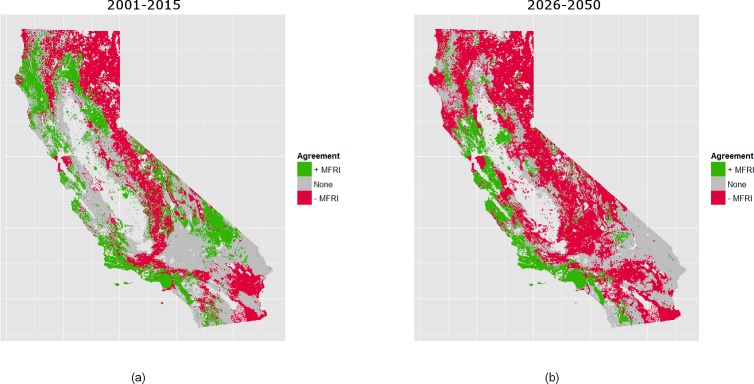
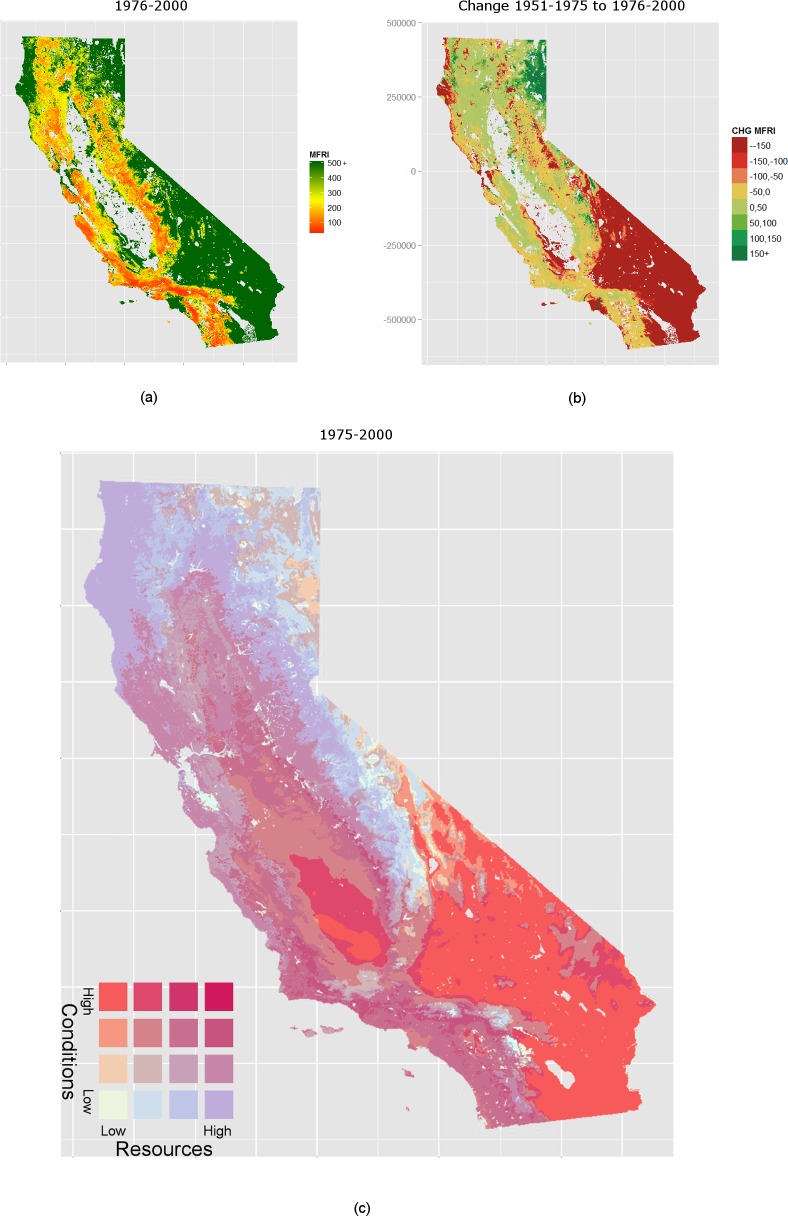
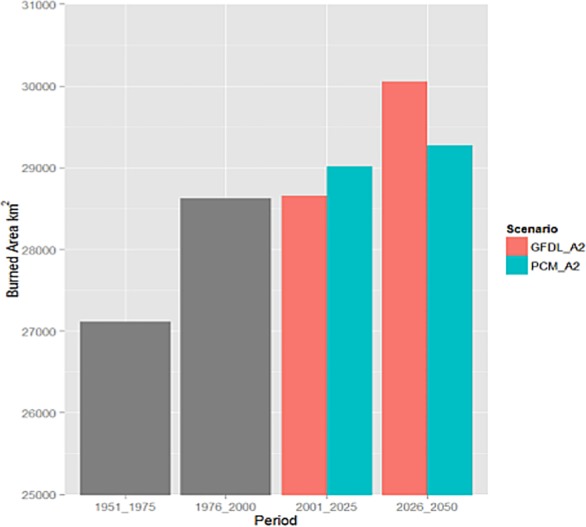
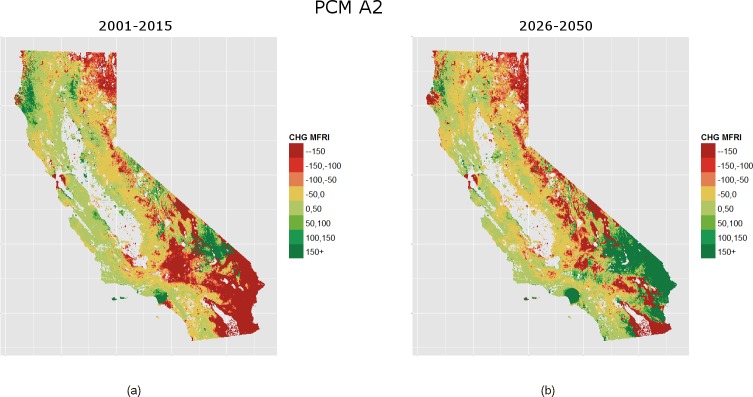
The costly interactions between humans and wildfires throughout California demonstrate the need to understand the relationships between them, especially in the face of a changing climate and expanding human communities. Although a number of statistical and process-based wildfire models exist for California, there is enormous uncertainty about the location and number of future fires, with previously published estimates of increases ranging from nine to fifty-three percent by the end of the century. Our goal is to assess the role of climate and anthropogenic influences on the state's fire regimes from 1975 to 2050. We develop an empirical model that integrates estimates of biophysical indicators relevant to plant communities and anthropogenic influences at each forecast time step. Historically, we find that anthropogenic influences account for up to fifty percent of explanatory power in the model. We also find that the total area burned is likely to increase, with burned area expected to increase by 2.2 and 5.0 percent by 2050 under climatic bookends (PCM and GFDL climate models, respectively). Our two climate models show considerable agreement, but due to potential shifts in rainfall patterns, substantial uncertainty remains for the semiarid inland deserts and coastal areas of the south. Given the strength of human-related variables in some regions, however, it is clear that comprehensive projections of future fire activity should include both anthropogenic and biophysical influences. Previous findings of substantially increased numbers of fires and burned area for California may be tied to omitted variable bias from the exclusion of human influences. The omission of anthropogenic variables in our model would overstate the importance of climatic ones by at least 24%. As such, the failure to include anthropogenic effects in many models likely overstates the response of wildfire to climatic change.
在加利福尼亚州,人类与野火之间代价高昂的相互作用表明,有必要了解它们之间的关系,尤其是在面对气候变化和人类社区不断扩张的情况下。尽管加利福尼亚州存在一些基于统计和过程的野火模型,但未来火灾的地点和数量仍存在巨大不确定性,此前发表的估计显示,到本世纪末火灾增加的幅度在9%至53%之间。我们的目标是评估1975年至2050年气候和人为因素对该州火灾状况的影响。我们开发了一个实证模型,该模型在每个预测时间步长整合了与植物群落相关的生物物理指标估计值和人为影响。从历史上看,我们发现人为影响在模型中的解释力高达50%。我们还发现,总燃烧面积可能会增加,在气候两端(分别为PCM和GFDL气候模型)的情况下,预计到2050年燃烧面积将分别增加2.2%和5.0%。我们的两个气候模型显示出相当大的一致性,但由于降雨模式可能发生变化,半干旱内陆沙漠和南部沿海地区仍存在很大的不确定性。然而,鉴于某些地区与人类相关变量的影响力,很明显,未来火灾活动的全面预测应包括人为和生物物理影响。此前关于加利福尼亚州火灾数量和燃烧面积大幅增加的研究结果,可能与排除人类影响导致的遗漏变量偏差有关。我们模型中遗漏人为变量会使气候变量的重要性至少被高估24%。因此,许多模型未纳入人为影响可能高估了野火对气候变化的反应。